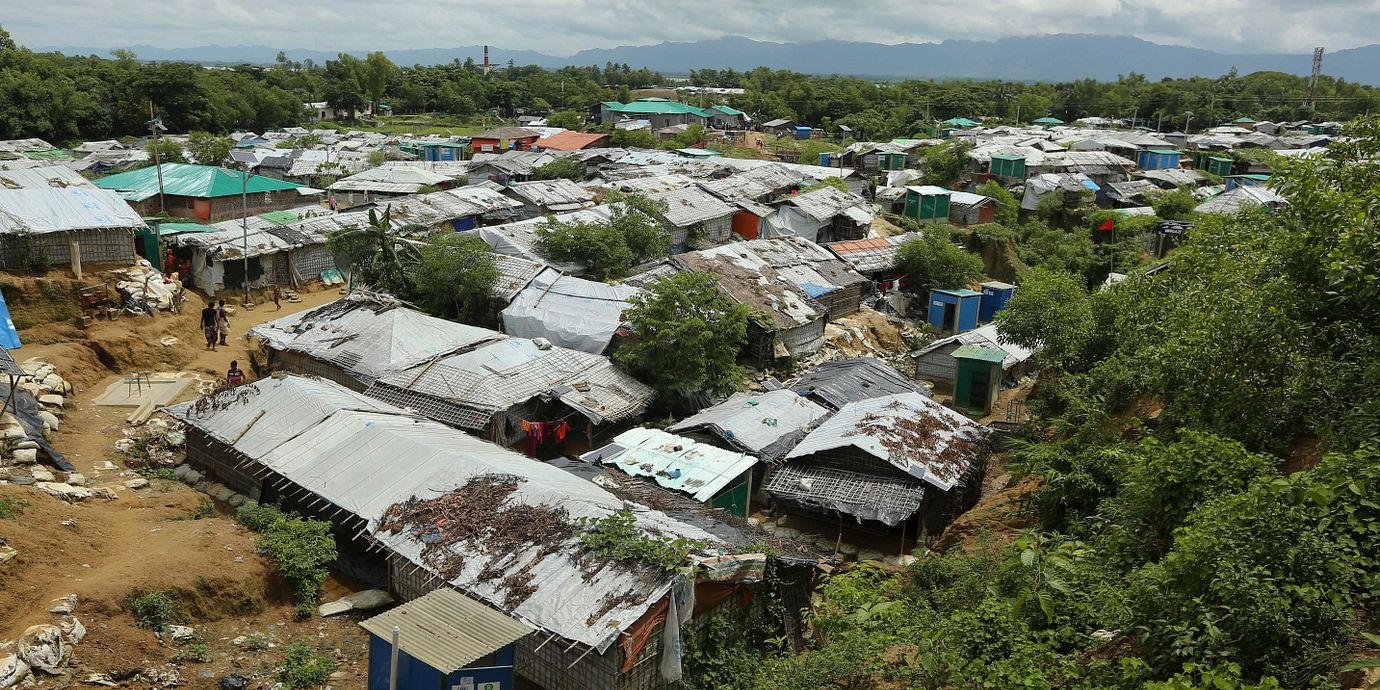
Fyra flyktingar ihjälskjutna i Bangladesh efter mord
En fjärde rohingyisk flykting har skjutits ihjäl efter mordet på en av regeringspartiets tjänstemän, bekräftar Bangladeshs polis enligt AFP.
Polis beskyllde Omar Faruks död på rohingyiska gängkriminella och har tidigare skjutit ihjäl tre flyktingar på grund av mordet.
Människorättsgrupper har tidigare anklagat polisen i Bangladesh för utomrättsliga avrättningar.
bakgrund
Rohingya-konflikten
Wikipedia (en)
The Rohingya conflict is an ongoing conflict in northern Rakhine State, Myanmar (formerly Arakan, Burma), characterised by sectarian violence between the Rohingya Muslim and Rakhine Buddhist communities, a military crackdown on Rohingya civilians by Myanmar's security forces, and militant attacks by Rohingya insurgents in Buthidaung, Maungdaw, and Rathedaung Townships, which border Bangladesh.The conflict arises chiefly from the religious and social differentiation between the Rakhine Buddhists and Rohingya Muslims. During World War II in Burma (present-day Myanmar), Rohingya Muslims, who were allied with the British and promised a Muslim state in return, fought against local Rakhine Buddhists, who were allied with the Japanese. Following independence in 1948, the newly formed union government of the predominantly Buddhist country denied citizenship to the Rohingyas, subjecting them to extensive systematic discrimination in the country. This has widely been compared to apartheid by many international academics, analysts, and political figures, including Desmond Tutu, a famous South African anti-apartheid activist.From 1947 to 1961, Rohingya mujahideen fought government forces in an attempt to have the mostly Rohingya populated region around the Mayu peninsula in northern Arakan (present-day Rahkine State) gain autonomy or secede, so it could be annexed by East Pakistan (present-day Bangladesh). During the late 1950s and early 1960s, the mujahideen lost most of its momentum and support, resulting in most of them surrendering to government forces.In the 1970s Rohingya separatist movements emerged from remnants of the mujahideen, and the fighting culminated with the Burmese government launching a massive military operation named Operation Dragon King in 1978 to expel so-called "foreigners". In the 1990s, the well-armed Rohingya Solidarity Organisation (RSO) was the main perpetrator of attacks on Burmese authorities near the Bangladesh–Myanmar border. The Burmese government responded militarily with Operation Clean and Beautiful Nation, but failed to disarm the RSO.In October 2016, Burmese border posts along the Bangladesh–Myanmar border were attacked by a new insurgent group, Harakah al-Yaqin, resulting in the deaths of at least 40 combatants. It was the first major resurgence of the conflict since 2001. Violence erupted again in November 2016, bringing the 2016 death toll to 134, and again on 25 August 2017, when the Arakan Rohingya Salvation Army (formerly Harakah al-Yaqin) launched coordinated attacks on 24 police posts and an army base that left 71 dead.A subsequent military crackdown by Myanmar prompted the Office of the U.N. High Commissioner for Human Rights (OHCHR) to investigate the matter and release a report on 11 October 2017 detailing the Burmese military's "systematic process" of driving hundreds of thousands of Rohingyas from Myanmar "through repeated acts of humiliation and violence".According to a March 2018 report by the ASEAN Parliamentarians for Human Rights (APHR), 43,000 Rohingya parents have been "reported lost, [and] presumed dead" since the beginning of the military crackdown in August 2017. An August 2018 study by Harvard University estimated that in the same period, 24,000 Rohingyas had been killed, 18,000 Rohingya women and girls had been raped, 116,000 Rohingyas had been beaten, and 36,000 Rohingyas had been victims of arson.
Omni är politiskt obundna och oberoende. Vi strävar efter att ge fler perspektiv på nyheterna. Har du frågor eller synpunkter kring vår rapportering? Kontakta redaktionen