Klart: Tuffaste sanktionerna mot Nordkorea på 20 år
FN:s säkerhetsråd har unisont röstat igenom vad som beskrivs som de tuffaste sanktionerna mot Nordkorea på 20 år, rapporterar nyhetsbyrån AP.
De nya sanktionerna innebär att andra länder måste införa handelsrestriktioner och inspektera all last till och från Nordkorea. Flyg- och raketbränsle hör till de varor som förbjuds, skriver AFP enligt SVT Nyheter.
– Resolutionen sänder en enkel signal till Pyongyang. Nordkorea måste överge sina farliga program och välja en bättre väg för sitt folk, säger Obama enligt nyhetsbyrån Reuters.
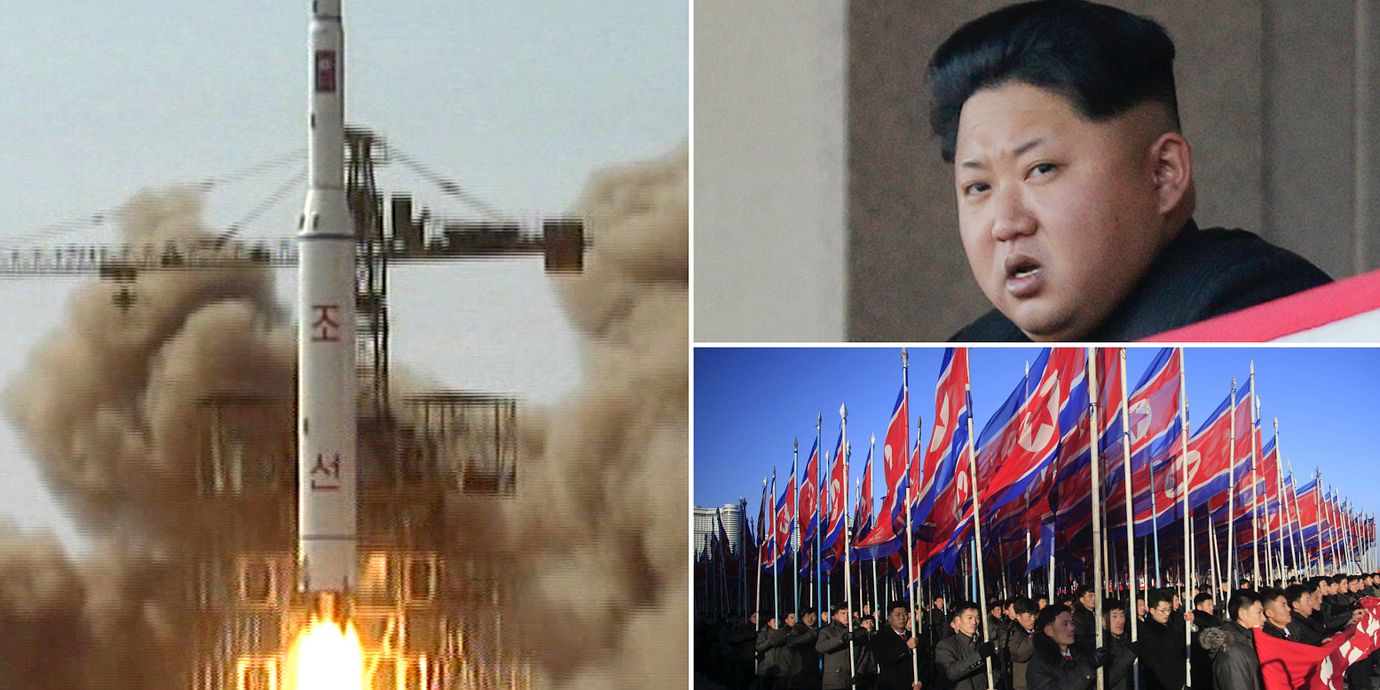
Inför omröstningen kallade Sydkoreas utrikesminister Yun Byung-se Nordkorea en ”serieförbrytare” med hänvisning till landets fjärde kärnvapentest i januari och robotuppskjutningen i februari.
bakgrund
Nordkoreas massförstörelsevapen
Wikipedia (en)
North Korea (officially the Democratic People's Republic of Korea or DPRK) declared in 2009 that it had developed a nuclear weapon, and possesses a small stockpile of relatively simple nuclear weapons. North Korea may also have a chemical and/or biological weapons capability. Since 2003, North Korea is no longer a party to the Treaty on the Non-Proliferation of Nuclear Weapons.
On October 9, 2006, North Korea announced it had successfully conducted its first nuclear test. An underground nuclear explosion was detected, its yield was estimated as less than a kiloton, and some radioactive output was detected.
On January 6, 2007, the North Korean government further confirmed that it had nuclear weapons.
In April 2009, reports surfaced that North Korea has become a "fully fledged nuclear power", an opinion shared by International Atomic Energy Agency (IAEA) Director General Mohamed ElBaradei. On May 25, 2009, North Korea conducted a second nuclear test, resulting in an explosion estimated to be between 2 and 7 kilotons. The 2009 test, like the 2006 test, is believed to have occurred at Mantapsan, Kilju County, in the north-eastern part of North Korea.
On February 11, 2013, the U.S. Geological Survey detected a magnitude 5.1 seismic disturbance, reported to be a third underground nuclear test. North Korea has officially reported it as a successful nuclear test with a lighter warhead that delivers more force than before, but has not revealed the exact yield. Multiple South Korean sources estimate the yield at 6–9 kilotons, while the German Federal Institute for Geosciences and Natural Resources estimates the yield at 40 kilotons.
On January 6, 2016 in Korea, the United States Geological Survey detected a magnitude 5.1 seismic disturbance, reported to be a fourth underground nuclear test. North Korea claimed that this test involved a hydrogen bomb. This claim has not been verified. Within hours, many nations and organizations had condemned the test. Expert U.S. analysts do not believe that a hydrogen bomb was detonated. Seismic data collected so far suggests a 6-9 kiloton yield and that magnitude is not consistent with the power that would be generated by a hydrogen bomb explosion. "What we're speculating is they tried to do a boosted nuclear device, which is an atomic bomb that has a little bit of hydrogen, an isotope in it called tritium," said Joseph Cirincione, president of the global security firm Ploughshares Fund.
On February 7, 2016, roughly a month after the alleged hydrogen bomb test, North Korea claimed to have put a satellite into orbit around the Earth. Japanese Prime Minister Shinzō Abe had warned the North to not launch the rocket, and if it did and the rocket violated Japanese territory, it would be shot down. Nevertheless, North Korea launched the rocket anyway, claiming the satellite was purely intended for peaceful, scientific purposes. Several nations, including the United States, Japan, and South Korea, have criticized the launch, and despite North Korean claims that the rocket was for peaceful purposes, it has been heavily criticized as an attempt to perform an ICBM test under the guise of a peaceful satellite launch. China also criticized the launch, however urged "the relevant parties" to "refrain from taking actions that may further escalate tensions on the Korean peninsula".
Omni är politiskt obundna och oberoende. Vi strävar efter att ge fler perspektiv på nyheterna. Har du frågor eller synpunkter kring vår rapportering? Kontakta redaktionen