Budskap från KKK sprids efter maktskiftet: ”Knappast sammanträffande”
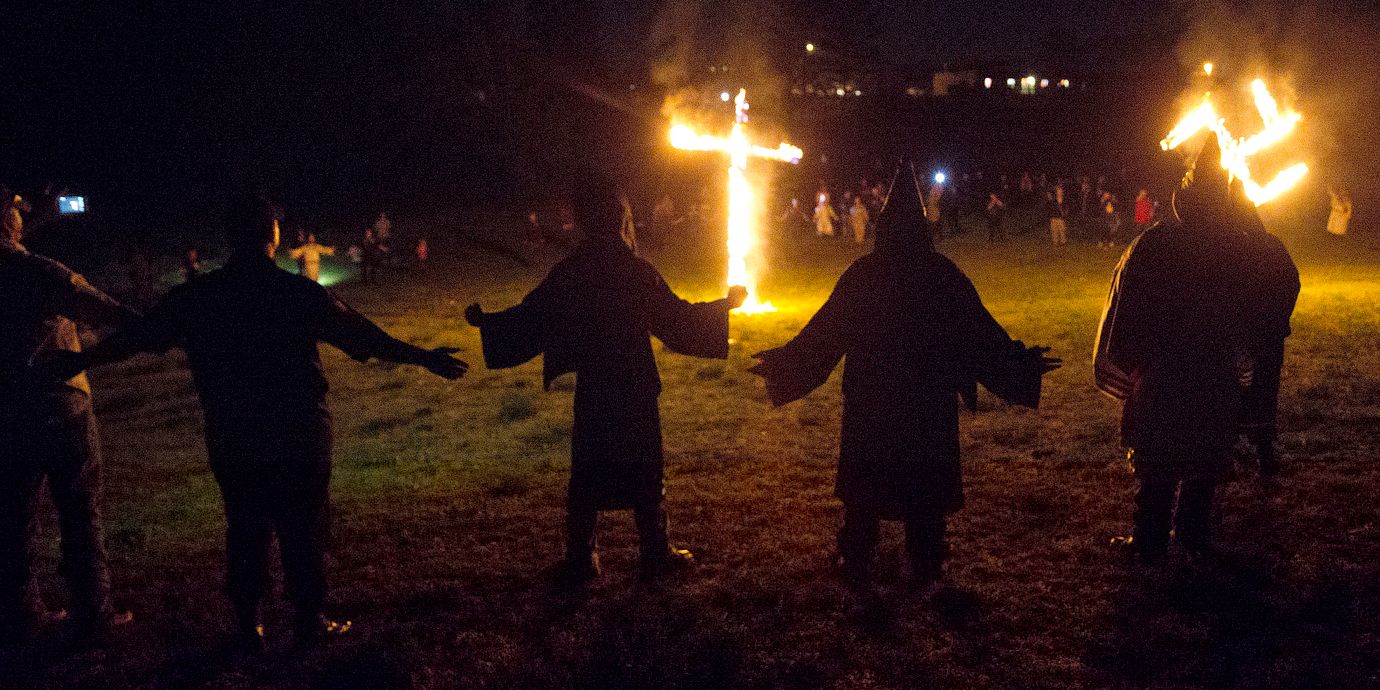
Flygblad från Ku Klux Klan som uppmanar invandrare att lämna delstaten har börjat spridas i flera städer i Kentucky efter Donald Trumps valvinst, rapporterar Washington Post.
Flygbladen visar en tecknad bild av ”Uncle Sam” som sparkar en barnfamilj framför sig och håller i en skylt som utropar ”massdeportation”.
– Jag har aldrig sett något liknande. Det var ganska upprörande för vårt samhälle, säger polischef Jon McCain i staden Bellevue som också uppger att det ”knappast är ett sammanträffande” att flygbladen började spridas samma dag som Trump svors in som president.
Trump kallade 2017 Ku Klux Klan ”motbjudande”. Hans administration har inte kommenterat händelserna i Kentucky.
bakgrund
Ku Klux Klan
Wikipedia (en)
The Ku Klux Klan (), commonly shortened to the KKK or the Klan, is an American Protestant-led Christian extremist, white supremacist, far-right hate group. It was founded in 1865 during Reconstruction in the devastated South. Various historians have characterized the Klan as America's first terrorist group. The group contains several organizations structured as a secret society, which have frequently resorted to terrorism, violence and acts of intimidation to impose their criteria and oppress their victims, most notably African Americans, Jews, and Catholics. There have been three distinct iterations with various other targets relative to time and place.
Each iteration of the Klan is defined by non-overlapping time periods, comprising local chapters with little or no central direction. Each has advocated reactionary positions such as white nationalism, anti-immigration and—especially in later iterations—Nordicism, antisemitism, anti-Catholicism, right-wing populism, anti-communism, homophobia, anti-atheism, and Islamophobia. The first Klan, founded by Confederate veterans, assaulted and murdered politically active Black people and their white political allies in the South.
The second iteration of the Klan originated in the late 1910s, and was the first to use cross burnings and standardized white-hooded robes. The KKK of the 1920s had a nationwide membership in the millions and reflected a cross-section of the native born white Protestant population.
The third Klan formed in the mid 20th century, largely as a reaction to the growing civil rights movement. It used murder and bombings to achieve its aims. All three movements are far-right extremist organizations, and have called for the "purification" of American society. In each era, membership was secret and estimates of the total were highly exaggerated by both allies and enemies.
The first Klan, established in the wake of the Civil War, was a defining organization of the Reconstruction era. Federal law enforcement began taking action against it around 1871. The Klan sought to overthrow Republican state governments in the South, especially by using voter intimidation and targeted violence against African-American leaders. The Klan was organized into numerous independent chapters across the Southern United States. Each chapter was autonomous and highly secretive about membership and plans. Members made their own, often colorful, costumes: robes, masks and pointed hats, designed to be terrifying and to hide their identities.
The second Klan started in 1915 as a small group in Georgia. It suddenly started to grow after 1920 and flourished nationwide in the early and mid-1920s, including urban areas of the Midwest and West. Taking inspiration from D. W. Griffith's 1915 silent film The Birth of a Nation, which mythologized the founding of the first Klan, it employed marketing techniques and a popular fraternal organization structure. Rooted in local Protestant communities, it sought to maintain white supremacy, often took a pro-Prohibition stance, and it opposed Jews, while also stressing its opposition to the alleged political power of the pope and the Catholic Church. This second Klan flourished both in the south and northern states; it was funded by initiation fees and selling its members a standard white costume. The chapters did not have dues. It used K-words which were similar to those used by the first Klan, while adding cross burnings and mass parades to intimidate others. It rapidly declined in the latter half of the 1920s.
The third and current manifestation of the KKK emerged after 1950, in the form of localized and isolated groups that use the KKK name. They have focused on opposition to the civil rights movement, often using violence and murder to suppress activists. This manifestation is classified as a hate group by the Anti-Defamation League and the Southern Poverty Law Center. As of 2016, the Anti-Defamation League puts total KKK membership nationwide at around 3,000, while the Southern Poverty Law Center puts it at 6,000 members total.
The second and third incarnations of the Ku Klux Klan made frequent references to a false mythologized perception of America's "Anglo-Saxon" blood, hearkening back to 19th-century nativism. Although members of the KKK swear to uphold Christian morality, Christian denominations widely denounce them.
Omni är politiskt obundna och oberoende. Vi strävar efter att ge fler perspektiv på nyheterna. Har du frågor eller synpunkter kring vår rapportering? Kontakta redaktionen