Sydkorea söker tecken på strålning efter bombtestet
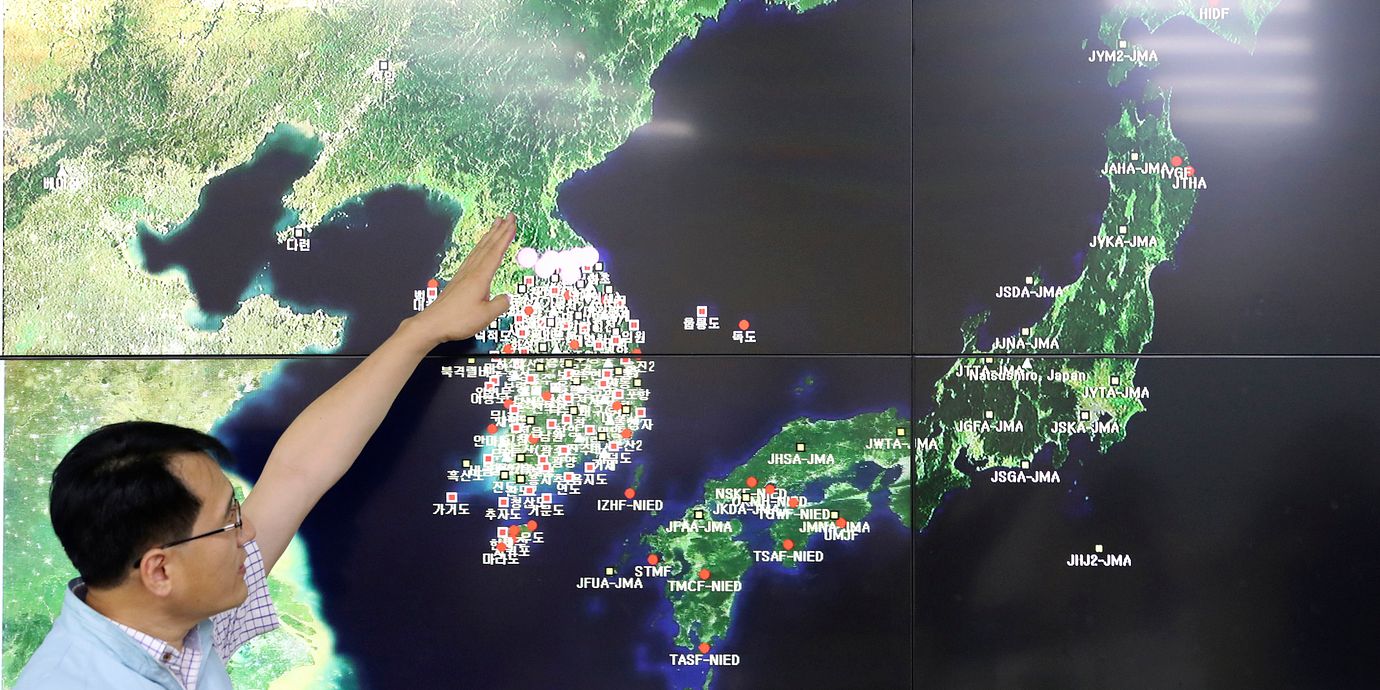
Sydkorea söker strålning efter grannlandets kärnvapentest, skriver AP. Men det är oklart om landet kommer hitta någon strålning då Nordkorea uppgett att det inte ska ha läckt ut något radioaktivtmaterial från platsen där testet utfördes.
Japans kärnvapenmyndighet uppger att ingen onormal förändring i strålningsnivåerna upptäckts under söndagskvällen, skriver nyhetsbyrån.
Dessutom uppger motsvarande myndighet i Kina att automatiska övervakningsstationer som bevakar strålning fungerar normalt.
Läs mer
Bakgrund
lista
Alla kärnvapentest som Nordkorea har genomfört
Wikipedia (en)
North Korea has conducted a total of five nuclear tests, in 2006, 2009, 2013 and twice in 2016, 2017.
Läs mer på Wikipedia
Hiroshima och Nagasaki-bomberna
Wikipedia (en)
During the final stage of World War II, the United States dropped nuclear weapons on the Japanese cities of Hiroshima and Nagasaki on August 6 and 9, 1945, respectively. The United States had dropped the bombs with the consent of the United Kingdom as outlined in the Quebec Agreement. The two bombings, which killed at least 129,000 people, remain the only use of nuclear weapons for warfare in history.
In the final year of the war, the Allies prepared for what was anticipated to be a very costly invasion of the Japanese mainland. This was preceded by a U.S. conventional and firebombing campaign that destroyed 67 Japanese cities. The war in Europe had concluded when Nazi Germany signed its instrument of surrender on May 8, 1945. The Japanese, facing the same fate, refused to accept the Allies' demands for unconditional surrender and the Pacific War continued. The Allies called for the unconditional surrender of the Imperial Japanese armed forces in the Potsdam Declaration on July 26, 1945—the alternative being "prompt and utter destruction". The Japanese response to this ultimatum was to ignore it.
By August 1945, the Allies' Manhattan Project had produced two types of atomic bombs, and the 509th Composite Group of the United States Army Air Forces (USAAF) was equipped with the specialized Silverplate version of the Boeing B-29 Superfortress that could deliver them from Tinian in the Mariana Islands. Orders for atomic bombs to be used on four Japanese cities were issued on July 25. On August 6, the U.S. dropped a uranium gun-type (Little Boy) bomb on Hiroshima, and American President Harry S. Truman called for Japan's surrender, warning it to "expect a rain of ruin from the air, the like of which has never been seen on this earth." Three days later, on August 9, a plutonium implosion-type (Fat Man) bomb was dropped on Nagasaki. Within the first two to four months following the bombings, the acute effects of the atomic bombings had killed 90,000–146,000 people in Hiroshima and 39,000–80,000 in Nagasaki; roughly half of the deaths in each city occurred on the first day. During the following months, large numbers died from the effect of burns, radiation sickness, and other injuries, compounded by illness and malnutrition. In both cities, most of the dead were civilians, although Hiroshima had a sizable military garrison.
Japan announced its surrender to the Allies on August 15, six days after the bombing of Nagasaki and the Soviet Union's declaration of war. On September 2, the Japanese government signed the instrument of surrender, effectively ending World War II. The justification for the bombings of Hiroshima and Nagasaki is still debated to this day.
bakgrund
TNT-ekvivalent
Wikipedia (sv)
TNT-ekvivalent är en metod för att kvantifiera energin som friges i explosioner. Ett «ton TNT» är en energienhet likvärdig med 4,184 gigajoule, som är den ungefärliga frigjorda energimängden i detoneringen av ett ton TNT. Ett megaton TNT är en energienhet likvärdig med 4,184 petajoule.
Kiloton och megaton TNT har traditionellt beskrivits som energifrigörelsen och därmed den destruktiva kraften i kärnvapen. I modern tid har TNT-ekvivalensen använts för att beskriva energifrigörelsen i andra destruktiva händelser, så som asteroidnedslag. TNT är däremot inte den energirikaste explosionen av de vanliga explosionerna. Dynamit har cirka 60 % högre energifrigörelse.
bakgrund
Kärnvapens räckvidd
Wikipedia (en)
The explosive yield of a nuclear weapon is the amount of energy released when that particular nuclear weapon is detonated, usually expressed as a TNT equivalent (the standardized equivalent mass of trinitrotoluene which, if detonated, would produce the same energy discharge), either in kilotons (kt—thousands of tons of TNT), in megatons (Mt—millions of tons of TNT), or sometimes in terajoules (TJ). An explosive yield of one terajoule is 0.239 kt of TNT. Because the accuracy of any measurement of the energy released by TNT has always been problematic, the conventional definition is that one kiloton of TNT is held simply to be equivalent to 1012 calories.
The yield-to-weight ratio is the amount of weapon yield compared to the mass of the weapon. The practical maximum yield-to-weight ratio for fusion weapons (thermonuclear weapons) has been estimated to six megatons of TNT per metric ton of bomb mass (25 TJ/kg). Yields of 5.2 megatons/ton and higher have been reported for large weapons constructed for single-warhead use in the early 1960s. Since then, the smaller warheads needed to achieve the increased net damage efficiency (bomb damage/bomb weight) of multiple warhead systems, has resulted in decreases in the yield/weight ratio for single modern warheads.
bakgrund
NORSAR
Wikipedia (en)
NORSAR or Norwegian Seismic Array was established in 1968 as part of the Norwegian-US agreement for the detection of earthquakes and nuclear explosions. NORSAR was the first non-US site included in ARPANET in 1973. It was also a connection point for ARPANET to spread to England, and then to the rest of Europe. Since 1999, NORSAR has been an independent research foundation.
Located at Kjeller, north of Oslo, NORSAR runs and maintains seismic arrays in Norway and it is the designated Norwegian National Data Centre for the Comprehensive Nuclear Test Ban Treaty. NORSAR conducts basic seismological research, develops software and provides consultancy for the petroleum industry.
bakgrund
Kärnvapen
Wikipedia (sv)
Kärnvapen är en typ av vapen vars sprängladdning får sin energi från fission, eller från olika kombinationer av fission och fusion, av atomkärnor, till skillnad mot konventionella vapen, vars sprängladdningar får sin energi från kemiska processer.
Kärnvapen finns i varianter från de minsta med sprängkraft som inte är mycket större än de största konventionella bomberna, till enormt kraftfulla konstruktioner som kan utplåna allt inom en radie på flera kilometer. Kärnvapen transporteras vanligen till målet med bombplan eller ballistiska robotar, men även artilleripjäser, kryssningsrobotar och minor med kärnladdningar finns. Många kärnvapen har provsprängts men endast två har använts i en väpnad konflikt: Atombomberna över Hiroshima och Nagasaki (Little Boy och Fat Man) sprängdes mot slutet av andra världskriget i augusti 1945 på order av USA:s president Harry S. Truman. Den som använder kärnvapen i en väpnad konflikt bedriver kärnvapenkrig.
Omni är politiskt obundna och oberoende. Vi strävar efter att ge fler perspektiv på nyheterna. Har du frågor eller synpunkter kring vår rapportering? Kontakta redaktionen