May bjuder in partiledarna till nya samtal redan i kväll
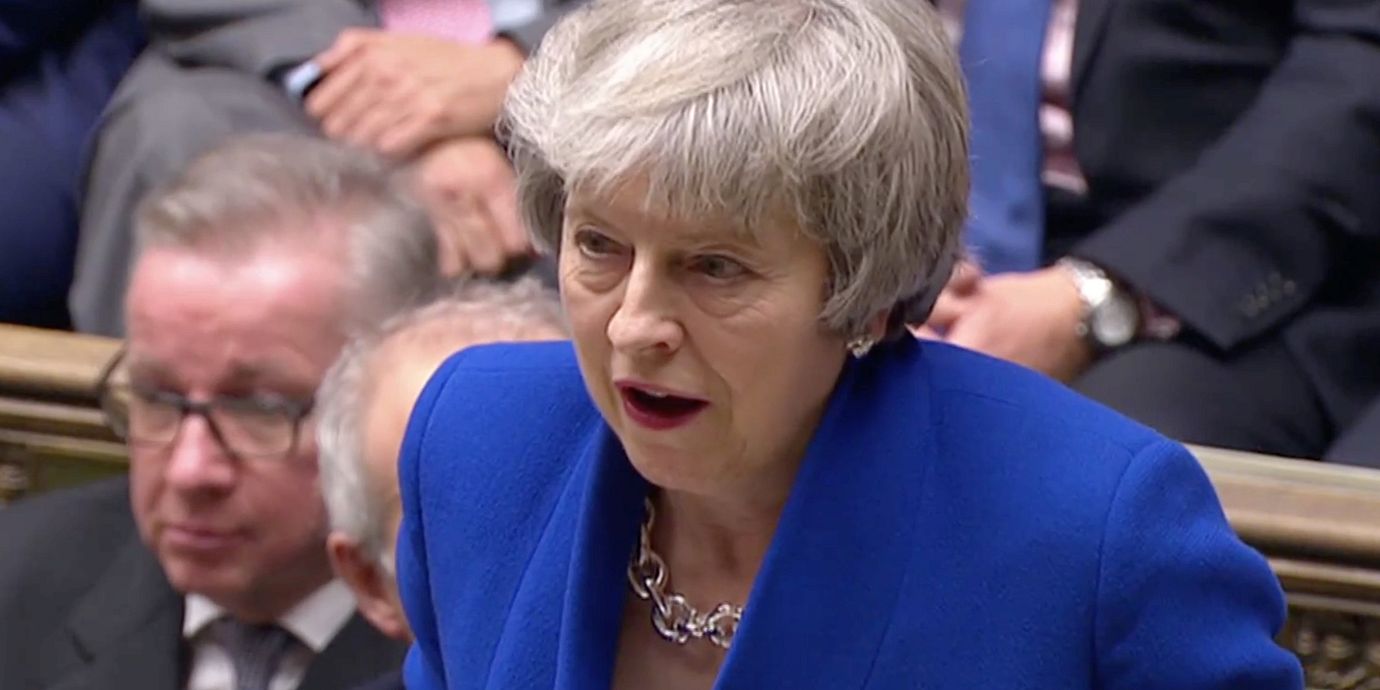
Theresa May är fast besluten om att leverera brexit såsom utlovat, det sa hon direkt efter beskedet om att hon klarade misstroendeomröstningen i parlamentet på onsdagskvällen.
Hon sa också att hon omgående vill hitta en väg framåt och att hon bjuder in de övriga partiledarna till individuella samtal för att staka ut vägen. Sådana samtal kan enligt May påbörjas redan under kvällen, skriver Sky News.
Liverapporter
Läs mer om brexit och misstroendeomröstningen
bakgrund
Misstroendeförklaring i Storbritannien
Wikipedia (en)
In the United Kingdom, confidence motions are a means of testing the support of the government (executive) in a legislative body, and for the legislature to remove the government from office. A confidence motion may take the form of either a vote of confidence, usually put forward by the government, or a vote of no confidence (or censure motion), usually proposed by the opposition. When such a motion is put to a vote in the legislature, if a vote of confidence is defeated, or a vote of no confidence is passed, then the incumbent government must resign, or call a general election.
It is a fundamental principle of the British constitution that the government must retain the confidence of the legislature, as it is not possible for a government to operate effectively without the support of the majority of the people's representatives. At the national level, this means that the UK government (the cabinet) must retain the confidence of a majority in the House of Commons.
It is possible for a vote of no confidence to succeed where there is a minority government or a small majority, or where there are internal party splits. Where there is a minority government, the government may seek agreements or pacts with minor parties in order to remain in office.
Despite their importance to the British constitution, for a long time the rules surrounding motions of no confidence were dictated solely by convention. However, since the Fixed-term Parliaments Act 2011, a vote of no confidence must be passed in a specific form in order to create the possibility of an early general election. Under the Act, if a motion of no confidence in the government is passed in express terms, the house must then adopt a vote of confidence within 14 days, or a general election is held.
A no confidence vote was last successfully used on 28 March 1979, when the minority government of James Callaghan was defeated in a confidence motion which read "That this House has no confidence in Her Majesty's Government". A no confidence vote can have the effect of uniting the ruling party; for this reason such motions are rarely used and successful motions are even rarer. Before 1979 the last successful motion of no confidence occurred in 1924.While motions of no confidence regarding party leadership may have time limits, motions of no-confidence concerning challenges to a ruling government do not and allow for MPs from any political party to participate at any period of time.
Omni är politiskt obundna och oberoende. Vi strävar efter att ge fler perspektiv på nyheterna. Har du frågor eller synpunkter kring vår rapportering? Kontakta redaktionen