Spanien sätter ner foten: Inga samtal med Skottland
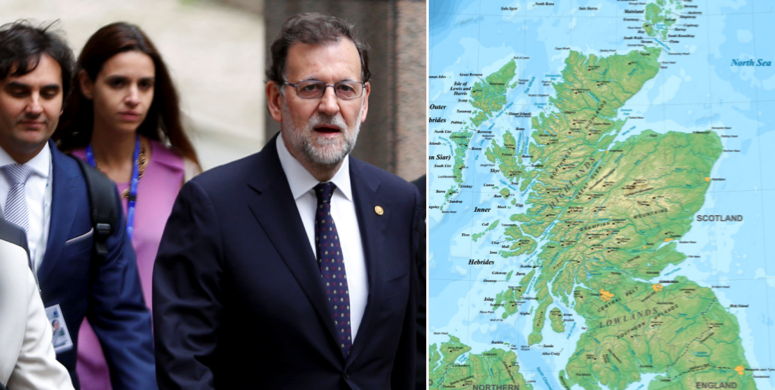
Spaniens premiärminister Mariano Rajoy motsätter sig kraftfullt att EU samtalar med Skottland om fortsatt medlemskap trots brexit, skriver The Independent.
– Om Storbritannien lämnar, så gör Skottland det också, sa Rajoy enligt tidningen under EU-toppmötets andra dag.
Paralleller kan lätt dras mellan Skottland och självständighetsrörelsen i Katalonien och Spanien är ett av flera länder som oroar sig över uppblossande separatism och speciallösningar, skriver The Guardian.
Skottlands försteminister Nicola Sturgeon har efter samtal med EU-parlamentets ordförande Martin Schulz sagt att man är fast beslutna att stanna i EU.
bakgrund
Katalonien
Wikipedia (sv)
Katalonien (katalanska Catalunya; spanska: Cataluña; aranesiska: Catalonha) är en autonom region i nordöstra Spanien med 7,6 miljoner invånare (2012). Katalonien omfattar de fyra provinserna Lleida, Tarragona, Girona och Barcelona. I provinsen Barcelona ligger huvudstaden med samma namn. Katalonien gränsar i väster till Aragonien och i söder till Valencia. I norr gränsar Katalonien till franska Katalonien (Roussillon) i Frankrike och till Andorra.
Regionen Katalonien domineras ekonomiskt av Barcelona, Spaniens näst största stad och mittpunkten i en starkt urbaniserad region. Området var ett av de första som industrialiserades i Spanien, och staden har därefter blivit både bas för Spaniens förlagsindustri och en växande turistnäring.
Katalonien är ett centrum för det katalanska språket, som under medeltiden dominerade inom större delen av kungariket Aragonien och numera är spritt inom de "katalanska länderna". Regionen har omväxlande haft självstyre eller upplevt nationalistisk självständighetskamp (ofta till följd av kulturell förföljelse). Sedan 1980-talet åtnjuter regionen ett brett självstyre – samtidigt med en uttalad nationalism – vilket lett till samarbetssvårigheter med andra regioner och den spanska staten. På senare år har en stark självständighetsrörelse vuxit fram.
bakgrund
Nationalism och regionalism i Spanien
Wikipedia (en)
The modern country of Spain was formed in the wake of the expansion of the Christian states in northern Spain, a process known as the Reconquista.
Several independent Christian Kingdoms and mostly independent political entities (Asturias, León, Galicia, Castile, Navarre, Aragon, Catalonia) were formed by their own inhabitants' efforts under aristocratic leadership, coexisting with the Muslim Iberian states and having their own identities and borders.
Eventually, the kingdoms of Castile and Aragon eclipsed the others in power and size through conquest and dynastic inheritance, their Crowns ultimately merging in 1469 with the marriage of the Catholic Monarchs. After this, the Muslim kingdom of Granada was conquered in 1492, and Navarre invaded and forced into the union in 1512, through a combination of conquest and collaboration of the local elites.
Portugal, formerly part of León, gained independence in 1128 after a split in the Royal inheritance of the daughters of Alfonso VI and remained independent throughout the reconquista process.
For a short time starting with Philip II of the House of Habsburg, Portugal was united with all the other realms under the same Head of State, in the Iberian Union. However the Portuguese revolted as the Dutch provinces and other Habsburg dominions and became officially independent again from their Sovereigns in 1640.
These kingdoms sometimes collaborated when they fought against Muslim Spain and sometimes allied themselves with the Muslims against rival Christian neighbors. The common non-Christian enemy has been usually considered the single crucial catalyst for the union of the different Christian realms. However, it was effective only for permanently reconquered territories. The unifications that came later were and are a whole different subject, as some of them happened long after the departure of the last Muslim rulers.
All these different kingdoms were ruled together, or separately in personal union, but maintained their particular ethnic differences, regardless of similarities through common origins or borrowed customs.
Since the reign of Philip V, there has been a process of uniformization by the central authorities. ,
This uniformization has been resisted by some of the local elites, who have their own national consciousness based on traditional, historical, linguistic and cultural attributes.
Some Kingdoms, like Navarre and the Lordships of the Basque Country, maintained constitutions based on their historical rights and laws, while other Kingdoms revolted against this process of centralism demanding a return of their derogated laws as well as better living conditions (Revolt of the Comuneros, Revolt of the Brotherhoods, Catalan Revolt). Nationalistic movements with significant support appear by the end of the 19th century, coinciding with the loss of the last parts of the Spanish Empire, the abolition of privileges, and continued high mercantile traditions with later industrial developments of some regions in comparison to others.
Following the Spanish Civil War, the Francoist imposition of Spanish as the only official language, and the persecution of all remaining historical languages and identities, had the effect of putting the constituent nations' survival in danger, leading to many powerful expressions of nationalism.
Since the beginning of the Spanish transition to democracy after the dictatorship of Francisco Franco, there have been many movements for more autonomy in certain regions of the country, advocating full independence in some cases, and an autonomous "community" in others. It is a controversial topic in Spain, and references to it can be found almost every day in the press, especially in the Basque Country and Catalonia.
Currently, the 2 most popular parties in Spain have different views on the subject. The People`s Party supports a more centralized Spain, with a unitary market, and usually doesn't support movements advocating greater regional autonomy. The Spanish Socialist Workers' Party supports a federal state with greater autonomy for the regions, but is opposed to total independence for any region.
The structure of this article is determined by the amount of popular support for the individual movements, so that even though there are political parties demanding independence from Spain for Castile, Cantabria, Valencia, Andalusia and Murcia, these parties hardly get any votes, and thus do not represent popular sentiment in their regions (percentages of nationalist and regionalist votes are given in parentheses according to figures of the elections held at municipality level in May 2007).
Note that the only two autonomous communities not mentioned in this article are Madrid (capital of the State, traditionally part of Castilla-la Nueva [New Castile in English], most of its population identifies itself primarily just with Spain).
Direktrapportering
Omni är politiskt obundna och oberoende. Vi strävar efter att ge fler perspektiv på nyheterna. Har du frågor eller synpunkter kring vår rapportering? Kontakta redaktionen