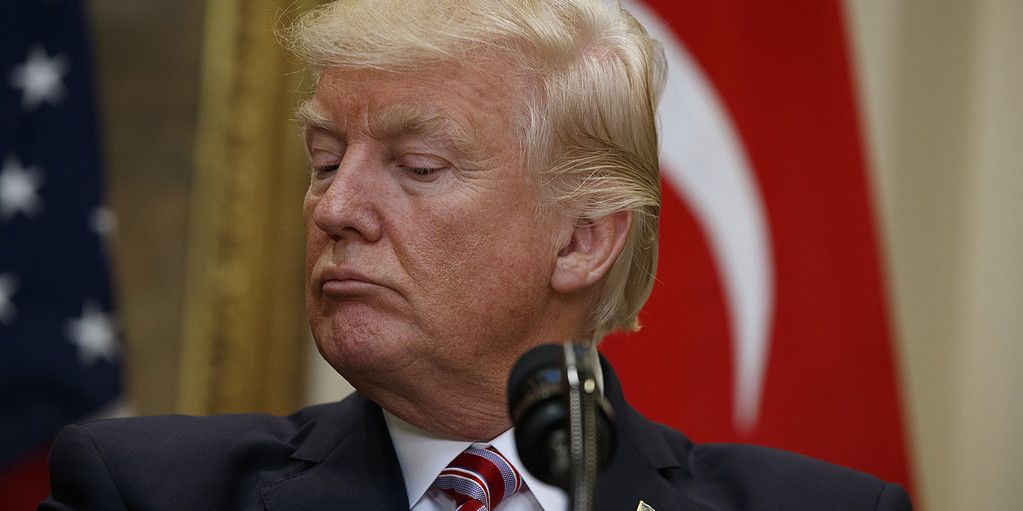
Toppdemokrat kräver att Trump ställs inför riksrätt
Texasdemokraten Al Green kräver nu som första kongressledamot att president Donald Trump ställs inför riksrätt, rapporterar CNN.
– Det här är vad jag tror på. Och det är här jag står. Jag kommer inte att låta mig rubbas. Presidenten måste ställas inför riksrätt, säger han enligt kanalen.
Samtidigt välkomnar demokratiske senatorn Joe Manchin att en särskild åklagare tillsätts för att utreda Trump-administrationens Rysslandskontakter.
bakgrund
Riksrätt i USA
Wikipedia (en)
Impeachment in the United States is an enumerated power of the legislature that allows formal charges to be brought against a civil officer of government for crimes alleged to have been committed. Most impeachments have concerned alleged crimes committed while in office, though there have been a few cases in which Congress has impeached and convicted officials partly for prior crimes. The actual trial on such charges, and subsequent removal of an official upon conviction, is separate from the act of impeachment itself. Impeachment proceedings have been initiated against several presidents of the United States. Andrew Johnson and Bill Clinton are the only two presidents to have been successfully impeached by the House of Representatives, and both were later acquitted by the Senate. The impeachment process against Richard Nixon was technically unsuccessful, as Nixon resigned his office before the vote of the full House for impeachment, but successful in the broader sense of leading to Nixon's departure. To date, no U.S. President has been removed from office by impeachment and conviction.
Impeachment is analogous to indictment in regular court proceedings; trial by the other house is analogous to the trial before judge and jury in regular courts. Typically, the lower house of the legislature impeaches the official and the upper house conducts the trial.
At the federal level, Article II of the United States Constitution states in Section 4 that "The President, Vice President, and all civil Officers of the United States shall be removed from Office on Impeachment for, and conviction of, Treason, Bribery, or other High Crimes and Misdemeanors." The House of Representatives has the sole power of impeaching, while the United States Senate has the sole power to try all impeachments. The removal of impeached officials is automatic upon conviction in the Senate. In Nixon v. United States (1993), the Supreme Court determined that the federal judiciary cannot review such proceedings.
Impeachment can also occur at the state level: state legislatures can impeach state officials, including governors, in accordance with their respective state constitutions.
At the Philadelphia Convention, Benjamin Franklin noted that, historically, the removal of "obnoxious" chief executives had been accomplished by assassination. Franklin suggested that a proceduralized mechanism for removal—impeachment—would be preferable.
Läs också
bakgrund
United States House Committee on Oversight and Government Reform
Wikipedia (en)
The Committee on Oversight and Government Reform is a United States House of Representatives committee that has existed in varying forms since 1816.
The Committee on Oversight and Government Reform is the main investigative committee in the U.S. House of Representatives. After Republicans gained control of the House in 1995, the committee was reorganized to include just seven subcommittees. This reorganization consolidated the jurisdiction previously covered by 3 full committees and 14 subcommittees, and resulted in a 50 percent cut in staff. In 2007, Henry Waxman (D-CA), the chairman of the committee, proposed an additional reorganization which combined the duties of the seven previous subcommittees into five. This reorganization was adopted by the full committee January 18, 2007.
As of the 115th Congress, the Chairman of the House Oversight and Government Reform Committee is Rep. Jason Chaffetz of Utah and the Ranking Member is Maryland Congressman Elijah Cummings.
The Committee's government-wide oversight jurisdiction and expanded legislative authority make it one of the most influential and powerful committees in the House. The Committee serves as Congress' chief investigative and oversight committee, and is granted broad jurisdiction. The chairman of the committee is one of only three committee chairmen in the House with the authority to issue subpoenas without a committee vote or consultation with the ranking member. However, in recent history, it has become practice to refrain from unilateral subpoenas.
Omni är politiskt obundna och oberoende. Vi strävar efter att ge fler perspektiv på nyheterna. Har du frågor eller synpunkter kring vår rapportering? Kontakta redaktionen