Mätning: Många israeler inte bekymrade av svälten
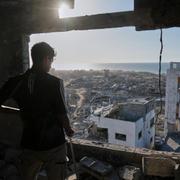
Israeliska judar och israeliska araber har fundamentalt olika syn på situationen i Gaza. Det visar en opinionsmätning som Haaretz rapporterar om.
Deltagarna i undersökningen fick bland annat frågan om hur bekymrade de är över rapporterna om svälten och lidandet i Gaza. Nästan 80 procent av de israeliska judarna svarade ”inte särskilt bekymrad” eller ”inte bekymrad alls”. Av de arabiska israelerna svarade 86 procent att de är mycket eller ganska bekymrade.
Mätningen visar också på stora skillnader inom gruppen av israeliska judar. Av dem som står till vänster svarar 70 procent att de är oroliga över svälten i Gaza.
bakgrund
Runt 20 procent av Israels befolkning är araber
Wikipedia (en)
The Arab citizens of Israel form the country's largest ethnic minority. Their community mainly consists of former Mandatory Palestine citizens (and their descendants) who continued to inhabit the territory that was acknowledged as Israeli by the 1949 Armistice Agreements. Notions of identity among Israel's Arab citizens are complex, encompassing civic, religious, and ethnic components. Most sources report that the majority of Arabs in Israel prefer to be identified as Palestinian citizens of Israel.
In the wake of the 1948 Palestine war, the Israeli government conferred Israeli citizenship upon all Palestinians who had remained or were not expelled. However, they were subject to discrimination by being placed under martial law until 1966, while other Israeli citizens were not. In the early 1980s, Israel granted citizenship eligibility to the Palestinians in East Jerusalem and the Syrian citizens of the Golan Heights by annexing both areas, though they remain internationally recognized as part of the Israeli-occupied territories, which came into being after the Six-Day War of 1967. Acquisition of Israeli citizenship in East Jerusalem has been scarce, as only 5% of Palestinians in East Jerusalem were Israeli citizens in 2022, largely due to Palestinian society's disapproval of naturalization as complicity with the occupation. After the Second Intifada, the opposition loosened, but Israel made the process more difficult, approving only 38% of new Palestinian applications.
According to the Israel Central Bureau of Statistics, the Israeli Arab population stood at 2.1 million people in 2023, accounting for 21% of Israel's total population. The majority of these Arab citizens identify themselves as Arab or Palestinian by nationality and as Israeli by citizenship. They mostly live in Arab-majority towns and cities, some of which are among the poorest in the country, and generally attend schools that are separated to some degree from those attended by Jewish Israelis. Arab political parties traditionally did not join governing coalitions until 2021, when the United Arab List became the first to do so. The Druze and the Bedouin in the Negev and the Galilee have historically expressed the strongest non-Jewish affinity to Israel and are more likely to identify as Israelis than other Arab citizens.
Speakers of both Arabic and Hebrew, their traditional vernacular is mostly Levantine Arabic, including Lebanese Arabic in northern Israel, Palestinian Arabic in central Israel, and Bedouin Arabic across the Negev. Because the modern Arabic dialects of Israel's Arabs have absorbed multiple Hebrew loanwords and phrases, it is sometimes called the Israeli Arabic dialect. By religious affiliation, the majority of Arab Israelis are Muslims, but there are significant Christian and Druze minorities, among others. Arab citizens of Israel have a wide variety of self-identification: as Israeli or "in Israel"; as Arabs, Palestinians, or Israelis; and as Muslims, Christians or Druze.
Omni är politiskt obundna och oberoende. Vi strävar efter att ge fler perspektiv på nyheterna. Har du frågor eller synpunkter kring vår rapportering? Kontakta redaktionen