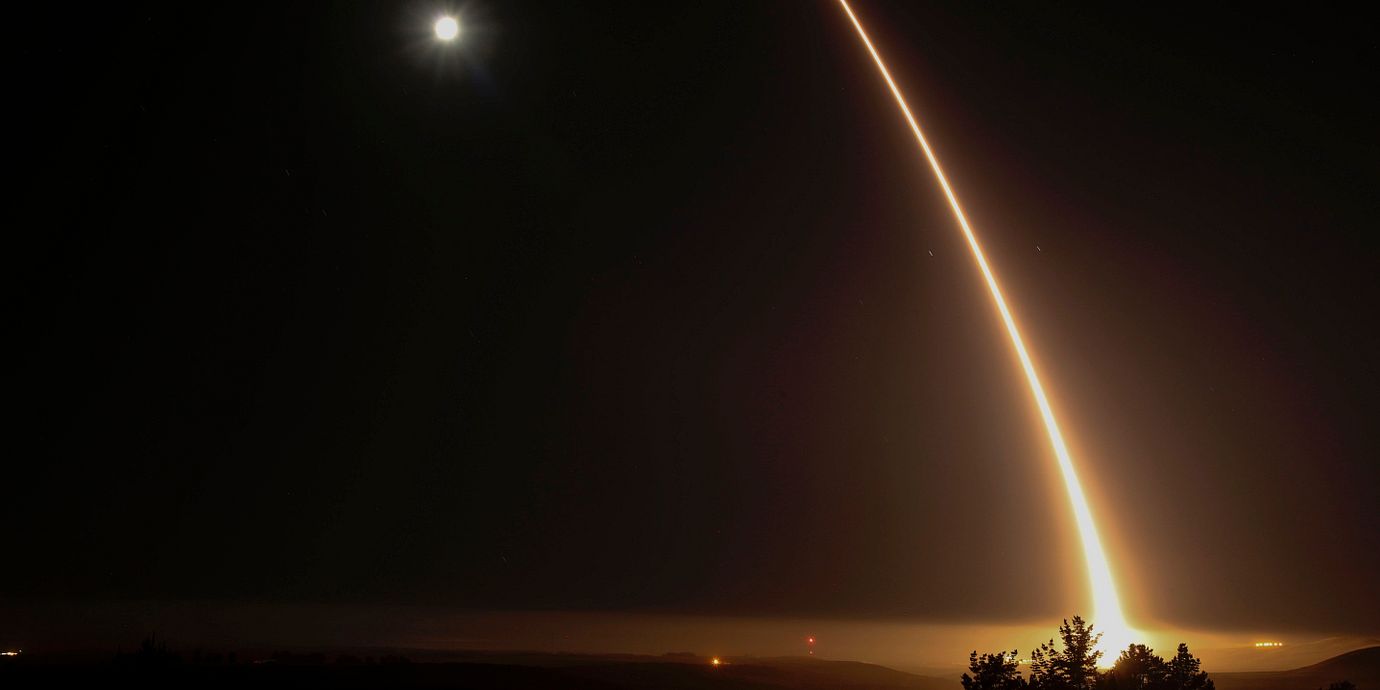
USA testsköt robot: ”Bevisar vår kapacitet”
USA har testskjutit en interkontinental ballistisk robot från flygbasen Vandenberg i Kalifornien, skriver AFP. Roboten avfyrades vid 9-tiden, svensk tid. Testet kommer i en tid av ökade spänningar och allt högre vapenskrammel mellan USA och Nordkorea. Flygvapnet säger till nyhetsbyrån att testet av roboten, kallad Minuteman III, inte ska tolkas som en markering mot Nordkorea.
”Testet bevisar Minuteman III:s kapacitet och säkrar vårt försvar mot kärnvapenhot”, heter det i ett uttalande från flygbasen.
bakgrund
LGM-30 Minuteman
Wikipedia (en)
The LGM-30 Minuteman is a U.S. land-based intercontinental ballistic missile (ICBM), in service with the Air Force Global Strike Command. As of 2017, the LGM-30G Minuteman III version is the only land-based ICBM in service in the United States.
Development of the Minuteman began in the mid-1950s as the outgrowth of basic research into solid fuel rocket motors which indicated an ICBM based on solids was possible. Such a missile could stand ready for extended periods of time with little maintenance, and then launch on command. In comparison, existing U.S. missile designs using liquid fuels required a lengthy fueling process immediately before launch, which left them open to the possibility of surprise attack. This potential for immediate launch gave the missile its name; like the Revolutionary War's Minutemen, the Minuteman was designed to be launched on a moment's notice.
Minuteman entered service in 1962 as a weapon tasked primarily with the deterrence role, threatening Soviet cities with a counterattack if the U.S. was attacked. However, with the development of the U.S. Navy's Polaris which addressed the same role, the Air Force began to modify Minuteman into a weapon with much greater accuracy with the specific intent of allowing it to attack hardened military targets, including Soviet missile silos. The Minuteman-II entered service in 1965 with a host of upgrades to improve its accuracy and survivability in the face of an anti-ballistic missile (ABM) system the Soviets were known to be developing. Minuteman-III followed in 1970, using three smaller warheads instead of one large one, which made it very difficult to attack by an anti-ballistic missile system which would have to hit all three widely separated warheads to be effective. Minuteman-III was the first multiple independently targetable reentry vehicle (MIRV) ICBM to be deployed. Each missile can carry up to three nuclear warheads, which have a yield in the range of 300 to 500 kilotons.
Peaking at 1,000 missiles in the 1970s, the current U.S. force consists of 450 Minuteman-III missiles in missile silos around Malmstrom AFB, Montana; Minot AFB, North Dakota; and F.E. Warren AFB, Wyoming. By February 2018 this will be reduced to 400 armed missiles, with 50 unarmed missiles in reserve, and four non-deployed test launchers to comply with the New START treaty. The Air Force plans to keep the missile in service until at least 2030. It is one component of the U.S. nuclear triad—the other two parts of the triad being the Trident submarine-launched ballistic missile (SLBM), and nuclear weapons carried by long-range strategic bombers.
bakgrund
Interkontinental ballistisk robot
Wikipedia (sv)
En interkontinental ballistisk robot eller missil (på engelska Intercontinental Ballistic Missile, förkortat ICBM) är en ballistisk robot med en räckvidd på mer än 5 500 km.
Omni är politiskt obundna och oberoende. Vi strävar efter att ge fler perspektiv på nyheterna. Har du frågor eller synpunkter kring vår rapportering? Kontakta redaktionen