Kräver ökat skydd efter borgmästarmorden
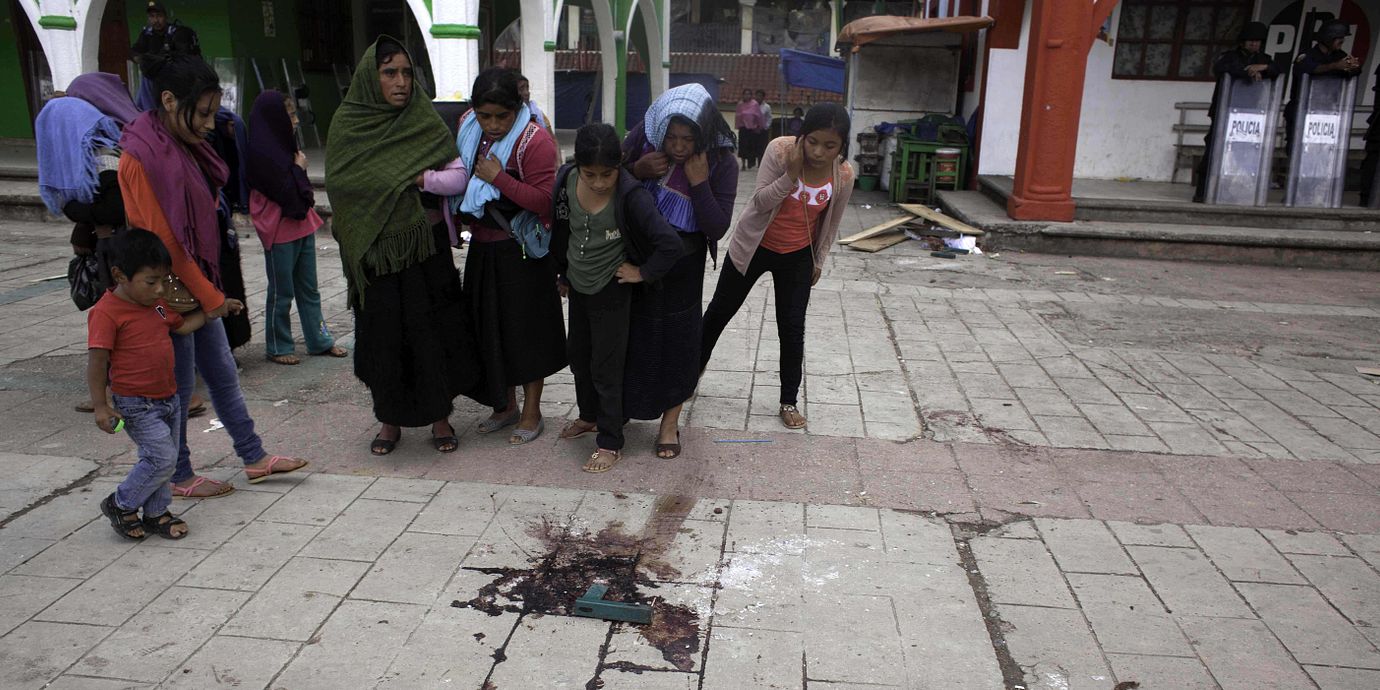
Efter att två borgmästare nyligen dödats kräver lokala ledare i Mexiko att staten erbjuder utsatta borgmästare skydd, skriver BBC. I lördags mördades en borgmästare från delstaten Chiapas och några timmar senare hans kollega i staden Pungabarato.
Sex personer har gripits misstänkta för det första mordet, skriver AFP.
bakgrund
Mexikanska knarkkriget
Wikipedia (en)
The Mexican Drug War (also known as the Mexican War on Drugs; Spanish: guerra contra el narcotráfico en México) is the Mexican theater of the Global War on Drugs, an ongoing low-intensity asymmetric war between the Mexican Government and various drug trafficking syndicates. Since 2006, when intervention with the Mexican military began, the government's principal goal has been to put down the drug-related violence. Additionally, the Mexican government has claimed that their primary focus is on dismantling the powerful drug cartels, rather than on preventing drug trafficking, which is left to U.S. functionaries.
Although Mexican drug cartels, or drug trafficking organizations, have existed for several decades, their influence has increased since the demise of the Colombian Cali and Medellín cartels in the 1990s. Mexican drug cartels now dominate the wholesale illicit drug market and in 2007 controlled 90% of the cocaine entering the United States. Arrests of key cartel leaders, particularly in the Tijuana and Gulf cartels, has led to increasing drug violence as cartels fight for control of the trafficking routes into the United States.
Analysts estimate that wholesale earnings from illicit drug sales range from $13.6 to $49.4 billion annually.
By the end of Felipe Calderón's administration (2006–12), the official death toll of the Mexican Drug War was at least 60,000. Estimates set the death toll above 120,000 killed by 2013, not including 27,000 missing.
bakgrund
Politiken i Mexiko
Wikipedia (en)
The Politics of Mexico take place in a framework of a federal presidential representative democratic republic whose government is based on a congressional system, whereby the president of Mexico is both head of state and head of government, and of a multi-party system. The federal government represents the United Mexican States and is divided into three branches: executive, legislative and judicial, as established by the Political Constitution of the United Mexican States, published in 1917. The constituent states of the federation must also have a republican form of government based on a congressional system as established by their respective constitutions.
The executive power is exercised by the executive branch, which is headed by the President, advised by a cabinet of secretaries that are independent of the legislature. Legislative power is vested upon the Congress of the Union, a two-chamber legislature comprising the Senate and the Chamber of Deputies. Judicial power is exercised by the judiciary, consisting of the Supreme Court of Justice of the Nation, the Council of the Federal Judiciary and the collegiate, unitary and district tribunals.
The politics of Mexico are dominated by three political parties: National Action Party (PAN), the Party of the Democratic Revolution (PRD) and Institutional Revolutionary Party (PRI).
Omni är politiskt obundna och oberoende. Vi strävar efter att ge fler perspektiv på nyheterna. Har du frågor eller synpunkter kring vår rapportering? Kontakta redaktionen