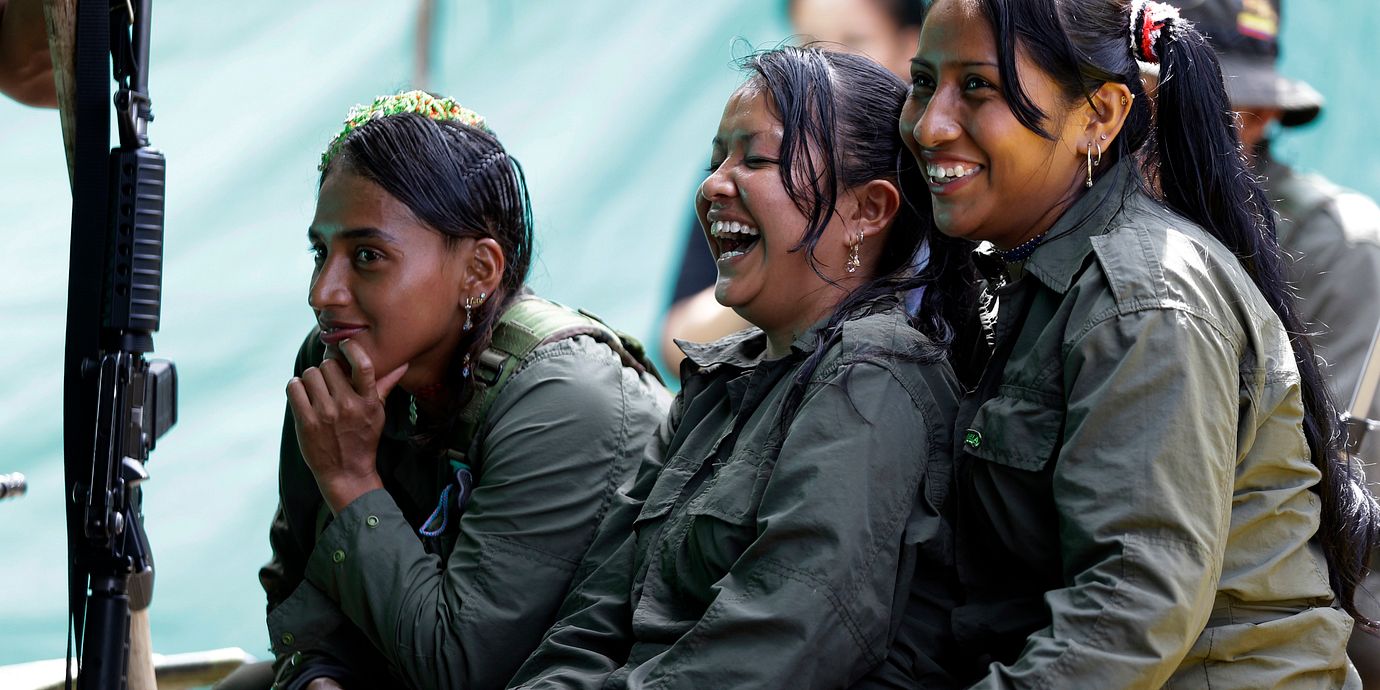
Farcgerillans ledare ger formell order om vapenvila
Ledaren för Farcgerillan i Colombia, Rodrigo Londono som också går under namnet Timoleon Jimenez, har formellt utfärdat order om vapenvila, rapporterar internationella nyhetsbyråer.
Det innebär att över 50 år av strider mellan regeringen och gerillan är över. Vapenvilan träder i kraft vid midnatt, natten till måndag, lokal tid.
Gerillans ledning ska nästa månad samlas för att ratificera fredsavtalet och en politisk framtidsstrategi ska även tas fram.
Fredsavtalet måste också godkännas i en folkomröstning, som hålls den 2 oktober.
bakgrund
Timoleón Jiménez
Wikipedia (en)
Rodrigo Londoño Echeverri, also known under the alias Timoleón Jiménez or Timochenko or Timochenco, born January 22, 1959 in Calarcá, Quindío, is the highest in command of the rebel group Revolutionary Armed Forces of Colombia.
'Timochenko' took over the FARC leadership in November 2011 from Alfonso Cano after the latter was killed by the Colombian army.
With more than 30 years of experience and a reputation of being a military commander he "has widespread respect among the rank-and-file, particularly the hardliners that form the core of the rural fighters". According to the Colombian Air Force his alias is referring to Soviet Marshal Semyon Timoshenko.
Before also assuming the leadership of the guerrilla group, Timochenko was one of the commanders of the Middle Magdalena Bloc of the FARC-EP and was thought to have some 800 men under his command.
Timochenko has been a member of the seven-member ruling guerrilla secretariat since the early 1990s. He is believed to operate in the Norte de Santander province on the border with Venezuela. Colombian authorities have frequently said that the FARC leader was hiding in Venezuela, but in April 2010, Colombian President Juan Manuel Santos stated that the Colombian government's most recent intelligence said that Timochenko was on the Colombian side of the border. According to Colombian intelligence sources Timochenko is currently located in the Serranía del Perijá, northeastern Colombia.
bakgrund
Konflikten i Colombia
Wikipedia (en)
The Colombian Conflict began approximately in 1964 or 1966 and is a low-intensity asymmetric war between the Colombian government, paramilitary groups, crime syndicates and left-wing guerrillas such as the Revolutionary Armed Forces of Colombia (FARC), and the National Liberation Army (ELN), fighting each other to increase their influence in Colombian territory.
It is historically rooted in the conflict known as La Violencia, which was triggered by the 1948 assassination of populist political leader Jorge Eliécer Gaitán, and in the aftermath of United States-backed strong anti-communist repression in rural Colombia in the 1960s that led liberal and communist militants to re-organize into FARC.
The reasons for fighting vary from group to group. The FARC and other guerrilla movements claim to be fighting for the rights of the poor in Colombia to protect them from government violence and to provide social justice through communism. The Colombian government claims to be fighting for order and stability, and seeking to protect the rights and interests of its citizens. The paramilitary groups claim to be reacting to perceived threats by guerrilla movements. Both guerrilla and paramilitary groups have been accused of engaging in drug trafficking and terrorism. All of the parties engaged in the conflict have been criticized for numerous human rights violations.
According to a study by Colombia's National Centre for Historical Memory, 220,000 people have died in the conflict between 1958 and 2013, most of them civilians (177,307 civilians and 40,787 fighters) and more than five million civilians were forced from their homes between 1985 – 2012, generating the world's second largest population of internally displaced persons (IDPs). 16.9% of the population in Colombia has been a direct victim of the war. Colombian President Juan Manuel Santos said that a peace deal with the FARC by 20 July 2016 would end the conflict with this organization if the talks which started in 2012 were successfully concluded. On 23 June 2016, the Colombian government and the FARC rebels have signed a historic ceasefire deal, bringing them closer to ending more than five decades of conflict. Its success will largely depend on how the state chooses to address the needs of the 8 million people who were affected or displaced by the civil war, according to a study.

Omni är politiskt obundna och oberoende. Vi strävar efter att ge fler perspektiv på nyheterna. Har du frågor eller synpunkter kring vår rapportering? Kontakta redaktionen