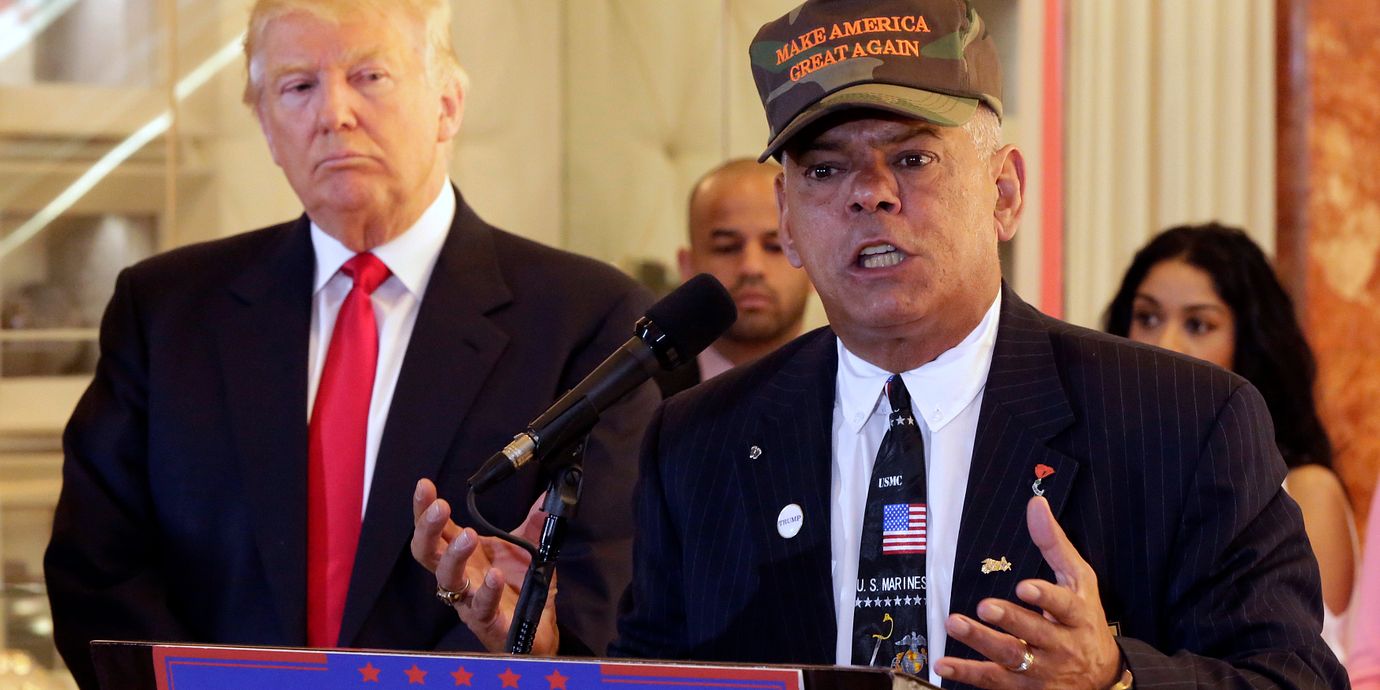
Rådgivare: Ångrar HUR jag sa att Clinton borde skjutas
Donald Trumps rådgivare i veteranfrågor, Al Baldasaro, hamnade i juli i blåsväder för att i en radiointervju ha sagt att Hillary Clinton borde ”ställas framför en patrull och skjutas för förräderi”.
Det republikanska partiet tog avstånd från uttalandet men först nu säger Baldasaro själv att han ångrar hur han uttryckte sig.
– Det är synd för vad jag borde ha sagt var att hon måste dömas som skyldig. Vi har lagar i det här landet – om förräderi. Jag använde ordet ’borde’ och medierna gick igång på det, säger Baldasaro till Buzzfeed News.
bakgrund
Förräderi i USA
Wikipedia (en)
In law, treason is the crime that covers some of the more extreme acts against one's nation or sovereign. Historically, treason also covered the murder of specific social superiors, such as the murder of a husband by his wife or that of a master by his servant. Treason against the king was known as high treason and treason against a lesser superior was petty treason. A person who commits treason is known in law as a traitor. Oran's Dictionary of the Law (1983) defines treason as "...[a]...citizen's actions to help a foreign government overthrow, make war against, or seriously injure the [parent nation]." In many nations, it is also often considered treason to attempt or conspire to overthrow the government, even if no foreign country is aiding or involved by such an endeavor.
Outside legal spheres, the word "traitor" may also be used to describe a person who betrays (or is accused of betraying) his own political party, nation, family, friends, ethnic group, team, religion, social class, or other group to which he may belong. Often, such accusations are controversial and disputed, as the person may not identify with the group of which he is a member, or may otherwise disagree with the group members making the charge. See, for example, race traitor, often used by White supremacists, or directed at people in inter-racial relationships (cf. miscegenation).
At times, the term "traitor" has been used as a political epithet, regardless of any verifiable treasonable action. In a civil war or insurrection, the winners may deem the losers to be traitors. Likewise the term "traitor" is used in heated political discussion – typically as a slur against political dissidents, or against officials in power who are perceived as failing to act in the best interest of their constituents. In certain cases, as with the German Dolchstoßlegende, the accusation of treason towards a large group of people can be a unifying political message. Treason is considered to be different and on many occasions a separate charge from 'Treasonable Felony' in many parts of the world.
Omni är politiskt obundna och oberoende. Vi strävar efter att ge fler perspektiv på nyheterna. Har du frågor eller synpunkter kring vår rapportering? Kontakta redaktionen