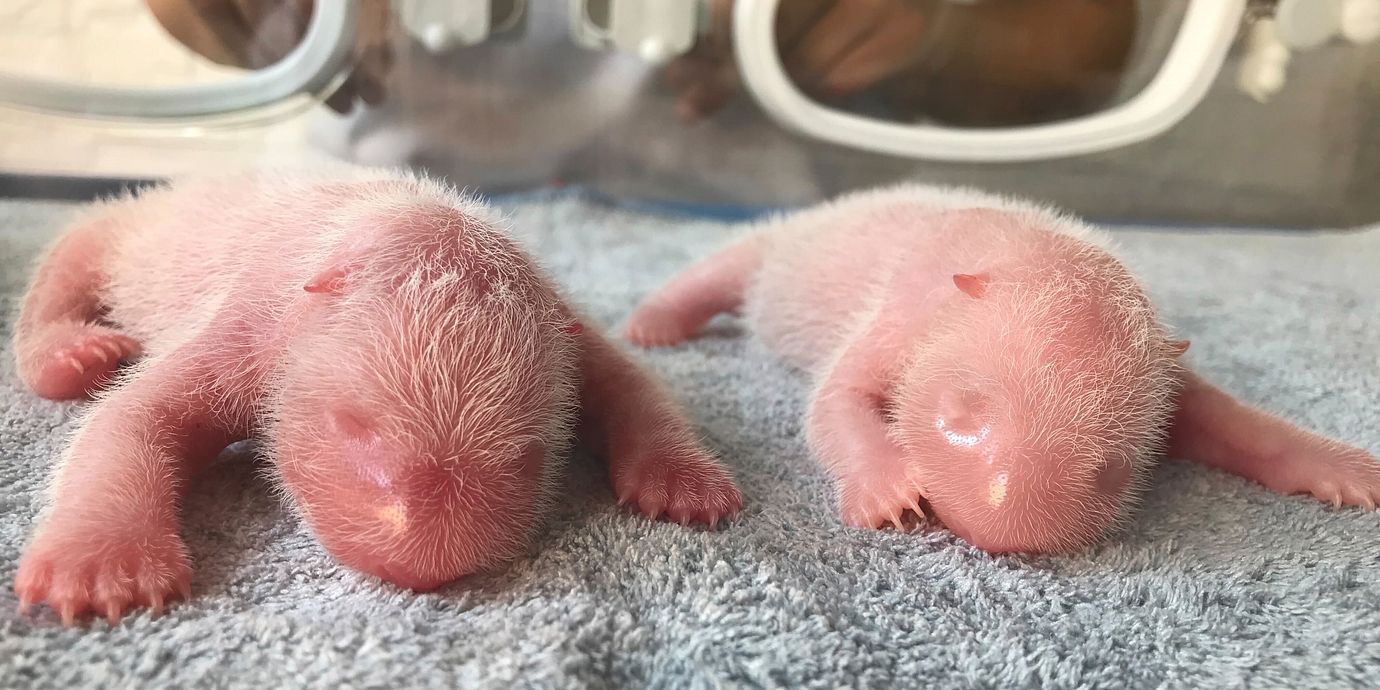
Pandatvillingar födda på forskningscentrum i Kina
Pandahonan Qin Qin på forskningscentret Qinling i Shaanxi-provinsen i sydvästra Kina har fött tvillingar, rapporterar AP.
Ungarna, en hane och en hona, är Qin Qins andra par tvillingar. En annan hona, Yong Yong, födde också tvillingar tidigare denna månad.
Kinesiska medier har inte sagt något om ungarnas pappa. Kinesiska veterinärer har länge använt artificiell inseminering för att öka pandapopulationen, som länge varit hotad.
Totalt bedöms cirka 1 800 pandor leva vilt, medan ytterligare cirka 500 djur finns på djurparker och i reservat.
bakgrund
Panda
Wikipedia (en)
The giant panda (Ailuropoda melanoleuca), also known as the panda bear (or simply the panda), is a bear species endemic to China. It is characterised by its bold black-and-white coat and rotund body. The name "giant panda" is sometimes used to distinguish it from the red panda, a neighboring musteloid. Though it belongs to the order Carnivora, the giant panda is a folivore, with bamboo shoots and leaves making up more than 99% of its diet. Giant pandas in the wild occasionally eat other grasses, wild tubers, or even meat in the form of birds, rodents, or carrion. In captivity, they may receive honey, eggs, fish, yams, shrub leaves, oranges, or bananas along with specially prepared food.The giant panda lives in a few mountain ranges in central China, mainly in Sichuan, and also in neighbouring Shaanxi and Gansu. As a result of farming, deforestation, and other development, the giant panda has been driven out of the lowland areas where it once lived, and it is a conservation-reliant vulnerable species. A 2007 report showed 239 pandas living in captivity inside China and another 27 outside the country. By December 2014, 49 giant pandas lived in captivity outside China, living in 18 zoos in 13 countries. Wild population estimates vary; one estimate shows that there are about 1,590 individuals living in the wild, while a 2006 study via DNA analysis estimated that this figure could be as high as 2,000 to 3,000. Some reports also show that the number of giant pandas in the wild is on the rise. By March 2015, the wild giant panda population had increased to 1,864 individuals. In 2016, it was reclassified on the IUCN Red List from "endangered" to "vulnerable", affirming decade-long efforts to save the panda. In July 2021, Chinese authorities also reclassified the giant panda as vulnerable.The giant panda has often served as China's national symbol, appeared on Chinese Gold Panda coins since 1982 and as one of the five Fuwa mascots of the 2008 Summer Olympics.
Omni är politiskt obundna och oberoende. Vi strävar efter att ge fler perspektiv på nyheterna. Har du frågor eller synpunkter kring vår rapportering? Kontakta redaktionen