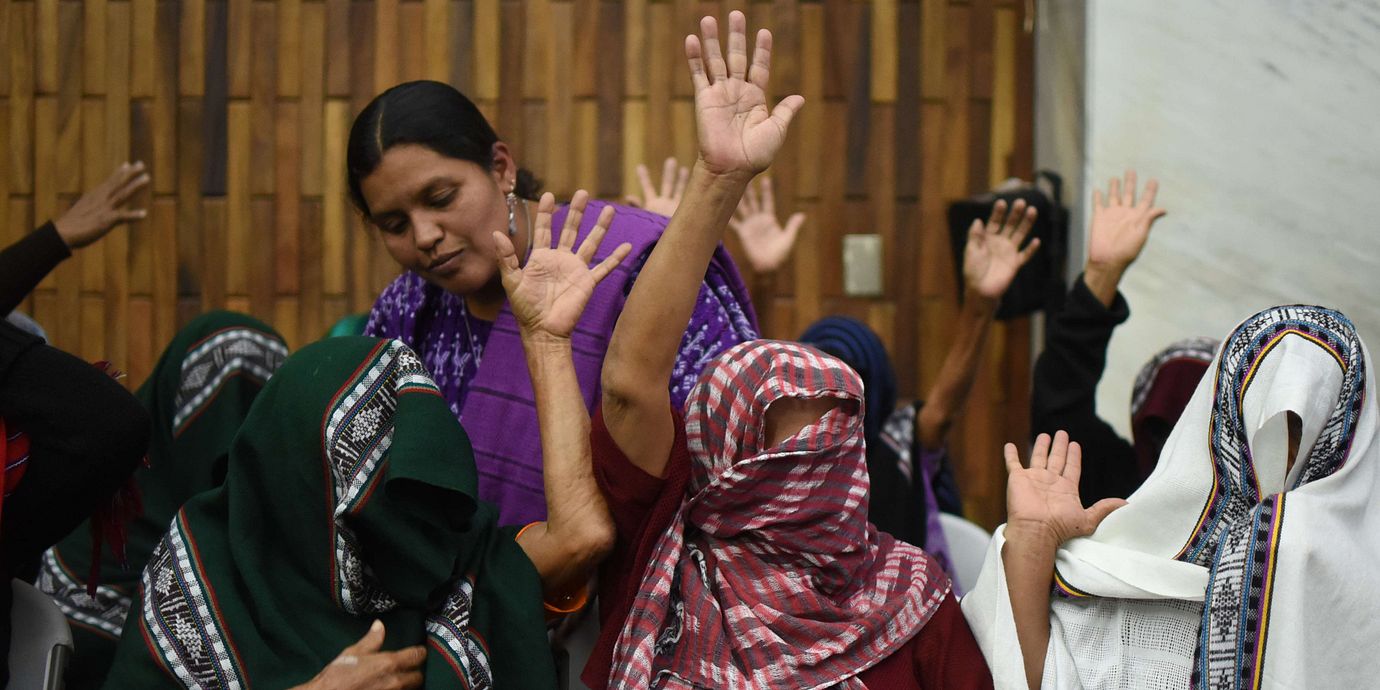
Får 360 år i fängelse för att ha haft sexslavar
Två tidigare militärer i Guatemala döms till fängelse i totalt 360 år för att ha hållit 15 kvinnor som hushålls- och sexslavar. Den tidigare arméofficern Esteelmer Reyes Giron döms för brott mot mänskligheten och mordet på en kvinna och hennes två unga döttrar, rapporterar Al Jazeera.
Brotten inträffade under inbördeskriget som pågick från 1960 till 1996. Offren har vittnat om att de hölls fångna på en militärbas från 1982 till 1983.
När armén gjorde intrång i ursprungsbefolkningens byar fördes männen i samhällena bort. Kvinnorna tog sig till militärbasen för att fråga efter sina män och blev då våldtagna och tvingades städa och laga mat åt soldaterna.
bakgrund
Inbördeskriget i Guatemala
Wikipedia (en)
The Guatemalan Civil War ran from 1960 to 1996. It was fought between the government of Guatemala and various leftist rebel groups supported chiefly by ethnic Mayan indigenous people and Ladino peasants, who together make up the rural poor. The government forces of Guatemala have been condemned for committing genocide against the Mayan population of Guatemala during the civil war and for widespread human rights violations against civilians.
Democratic elections during the Guatemalan Revolution in 1944 and 1951 had brought popular leftist governments to power, but a United States backed coup d'état in 1954 installed the military regime of Carlos Castillo Armas, who was followed by a series of conservative military dictators. In 1970, Colonel Carlos Manuel Arana Osorio became the first of a series of military dictators representing the Institutional Democratic Party or PID. The PID dominated Guatemalan politics for twelve years through electoral frauds favoring two of Col. Carlos Arana's proteges (Gen. Kjell Eugenio Laugerud Garcia in 1974 and Gen. Romeo Lucas Garcia in 1978). The PID lost its grip on Guatemalan politics when General Efraín Ríos Montt, together with a group of junior army officers, seized power in a military coup on 23 March 1982. In the 1970s continuing social discontent gave rise to an insurgency among the large populations of indigenous people and peasants, who traditionally bore the brunt of unequal land tenure. During the 1980s, the Guatemalan military assumed almost absolute government power for five years; it had successfully infiltrated and eliminated enemies in every socio-political institution of the nation, including the political, social, and intellectual classes. In the final stage of the civil war, the military developed a parallel, semi-visible, low profile but high-effect, control of Guatemala's national life.
As well as fighting between government forces and rebel groups, the conflict included, much more significantly, a large-scale, coordinated campaign of one-sided violence by the Guatemalan state against the civilian population from the mid-1960s onward. Victims of government repression included indigenous activists, suspected government opponents, returning refugees, critical academics and students, left-leaning politicians, trade unionists, religious workers, journalists, and street children. The Guatemalan state is accredited with being the first in Latin America to engage in widespread use of forced disappearances against its opposition with the number of disappeared estimated at between 40,000 and 50,000 from 1966 until the end of the war. In total, it is estimated that 200,000 civilians were killed or "disappeared" during the conflict, most at the hands of the military, police and intelligence services.
In 2009, Guatemalan courts sentenced Felipe Cusanero as the first person convicted of the crime of ordering forced disappearances. This was followed by the 2013 trial of former president Efraín Ríos Montt genocide for the killing and disappearances of more than 1,700 indigenous Ixil Mayans during his 1982-83 rule; the accusations from genocide derived from the "Memoria del Silencio" report - written by the UN-appointed Commission for Historical Clarification- which considered that genocide could have occurred in Quiché between 1981 and 1983, although it did not take into consideration potential economic interests in the Ixcán region - situated in Franja Transversal del Norte- given the oil fields that were discovered in that area in 1975. The first former head of state to be tried for genocide by his own country's judicial system, Montt was found guilty the day following the conclusion of his trial and was sentenced to 80 years in prison; a few days later, however, the sentence was reversed and the trial was scheduled to start again because of alleged judicial anomalies. Finally, the trial began again on 23 July 2015.
Omni är politiskt obundna och oberoende. Vi strävar efter att ge fler perspektiv på nyheterna. Har du frågor eller synpunkter kring vår rapportering? Kontakta redaktionen