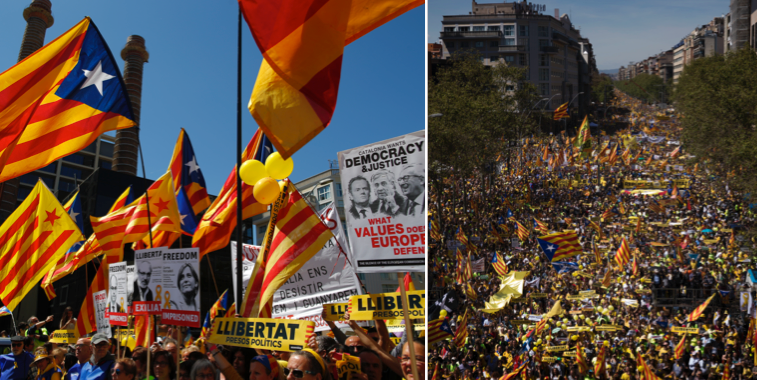
Massiva demonstrationer för fängslade separatister
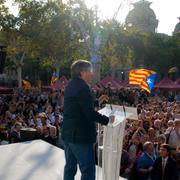
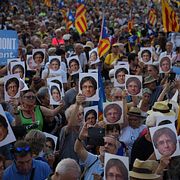
Massiva demonstrationer hålls i Barcelona under söndagen. Fler än 300 000 personer deltar för att kräva att de nio separatistledarna som sitter fängslade – anklagade för uppror – släpps.
Demonstrationerna anordnas av Nationella katalanska församlingen och Omnium, två gräsrotsgrupper som är för självständighet, skriver AFP.
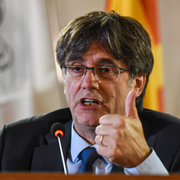
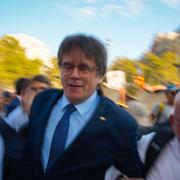
Demonstrationen hålls tio dagar efter att en tysk domstol avfärdat utlämningsförfrågan för Kataloniens sparkade separatistledare Carles Puigdemont som anklagas för uppror.
bakgrund
Katalanska självständighetsrörelsen
Wikipedia (en)
The Catalan independence movement (Catalan: independentisme català; Spanish: independentismo catalán) is a political movement historically derived from Catalan nationalism, which seeks independence of Catalonia from Spain. The Estelada flag, which has a "blue" and a "red" version, has become its main symbol. The political movement began in 1922 when Francesc Macià founded the political party Estat Català (Catalan State). In 1931, Estat Català and other parties formed Esquerra Republicana de Catalunya (Republican Left of Catalonia; ERC). Macià proclaimed a Catalan Republic in 1931, subsequently accepting autonomy within the Spanish state after negotiations with the leaders of the Second Spanish Republic. During the Spanish Civil War, General Francisco Franco abolished Catalan autonomy in 1938. Following Franco's death in 1975, Catalan political parties concentrated on autonomy rather than independence.
The modern independence movement began in 2010 when the Constitutional Court of Spain ruled that some of the articles of the 2006 Statute of Autonomy—which had been agreed with the Spanish government and passed by a referendum in Catalonia—were unconstitutional, and others were to be interpreted restrictively. Popular protest against the decision quickly turned into demands for independence. Starting with the town of Arenys de Munt, over 550 municipalities in Catalonia held symbolic referendums on independence between 2009 and 2011. All of the towns returned a high "yes" vote, with a turnout of around 30% of those eligible to vote. A 2010 protest demonstration against the court's decision, organised by the cultural organisation Òmnium Cultural, was attended by over a million people. The popular movement fed upwards to the politicians; a second mass protest on 11 September 2012 (the National Day of Catalonia) explicitly called on the Catalan government to begin the process towards independence. Catalan president Artur Mas called a snap general election, which resulted in a pro-independence majority for the first time in the region's history. The new parliament adopted the Catalan Sovereignty Declaration in early 2013, asserting that the Catalan people had the right to decide their own political future.
The Catalan government announced a referendum, to be held in November 2014, on the question of statehood. The referendum was to ask two questions: "Do you want Catalonia to become a State?" and (if so) "Do you want this State to be independent?" The Spanish government referred the proposed referendum to the Spanish Constitutional Court, which ruled it unconstitutional. The Catalan government then changed it from a binding referendum to a non-binding "consultation". Despite the Spanish court also banning the non-binding vote, the Catalan self-determination referendum went ahead on 9 November 2014. The result was an 81% vote for "yes-yes", with a turnout of 42%. Mas called another election for September 2015, which he said would be a plebiscite on independence. Although winning the majority of the seats, Pro-independence parties fell just short of a majority of votes (they got 47%) in the September election. The new parliament passed a resolution declaring the start of the independence process in November 2015. The following year, new president Carles Puigdemont, announced a binding referendum on independence. Although deemed illegal by the Spanish government and Constitutional Court, the referendum was held on 1 October 2017. In a vote where the anti-independence parties called for non-participation, results showed a 90% vote in favour of independence, with a turnout of 43%. Based on this result, on 27 October 2017 the Parliament of Catalonia approved a resolution creating an independent Republic unilaterally, by a vote considered illegal by the lawyers of the Parliament of Catalonia for violating the decisions of the Constitutional Court of Spain.
In the Parliament of Catalonia, parties explicitly supporting independence are Partit Demòcrata Europeu Català (Catalan European Democratic Party; PDeCAT), formerly named Convergència Democràtica de Catalunya (Democratic Convergence of Catalonia; CDC); Esquerra Republicana de Catalunya (Republican Left of Catalonia; ERC), and Candidatura d'Unitat Popular (Popular Unity Candidacy; CUP). Parties opposed to the regional independence are Ciutadans (Citizens), the PP Català (People's Party (Spain)), the Partit dels Socialistes de Catalunya (Socialists' Party of Catalonia; PSC), and Podem (Podemos), the third largest party in the Spanish parliament. The latter supports a legal and agreed referendum.
Omni är politiskt obundna och oberoende. Vi strävar efter att ge fler perspektiv på nyheterna. Har du frågor eller synpunkter kring vår rapportering? Kontakta redaktionen