Årtiondets största techfloppar listade

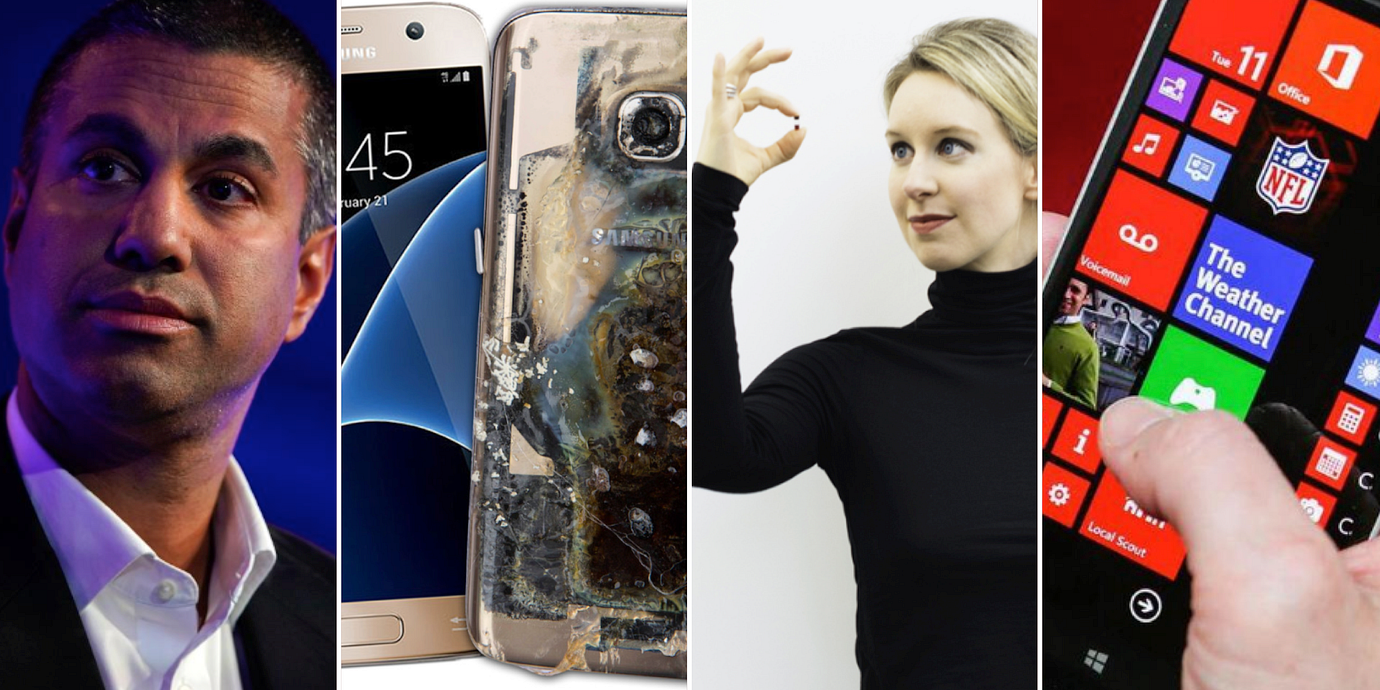
Techsajten The Verge summerar det snart gångna årtiondet med att lista de största techflopparna under 2010-talet. I toppen av listan hittar man den amerikanska kommunikationsmyndigheten FCC:s ordförande Ajit Pai, som trots protester från miljontals amerikaner valde att lätta på reglerna för så kallad nätneutralitet i USA.

På andra plats kommer Samsungs telefonmodell Galaxy Note 7, som av många betraktas som ett av historiens största produktlanseringsfiaskon. Detta då telefonerna visade sig vara benägna att överhettas och börja brinna, i vissa fall till och med explodera.

Företaget Theranos, vars vd och grundare Elizabeth Holmes lyckades lura investerare, chefer och kunder att man hade lyckats utveckla en metod för att ställa säkra diagnoser med hjälp av mycket små mängder blod, hamnar på tredje plats.

På de resterande platserna på topp 10-delen av listan kommer Windows Phone, Google Glass, Amazons Fire Phone, 3D-tv, Googles strategi för meddelande-appar, användarintegriteten och Apples tangentbord av så kallad butterfly-typ.

Andra tjänster, produkter, företag och företeelser som finns med längre ned på listan är Apple Maps, Blackberry, Valves Steam Machine, Playstation Vita, Microsoft Kinect, Googles Project Ara, Weworks börsnotering, hoverboards, Vine, Apples laddningsmatta Airpower, Magic Leap, Samsungs AI-assistent Bixby samt spelet Flappy Bird.

 
Ajit Pai
Wikipedia (en)
Ajit Varadaraj Pai (; born January 10, 1973) is an American lawyer who serves as the Chairman of the United States Federal Communications Commission (FCC). He is the first Indian American to hold the office. He has served in various positions at the FCC since being appointed to the commission by President Barack Obama in May 2012, at the recommendation of Mitch McConnell. He was confirmed unanimously by the United States Senate on May 7, 2012, and was sworn in on May 14, 2012, for a five-year term.In January 2017, newly inaugurated president Donald Trump designated Pai as FCC Chairman. In March 2017, Trump announced that he would renominate Pai to serve another five-year term (remaining Chairman of the FCC). Pai was confirmed by the U.S. Senate for an additional five-year term on October 2, 2017. Before his appointment to the FCC, Pai held positions with the Department of Justice, the United States Senate, the FCC's Office of General Counsel, and Verizon Communications. Pai is a proponent of repealing net neutrality in the United States and, on December 14, 2017, voted with the majority of the FCC to reverse the decision to regulate the internet under Title II of the Communications Act of 1934.
 
Theranos
Wikipedia (en)
Theranos () was a privately held health technology corporation, initially touted as a breakthrough technology company, but subsequently infamous for its false claims to have devised blood tests that only needed very small amounts of blood. Founded in 2003 by then-19-year-old Elizabeth Holmes, Theranos raised more than US$700 million from venture capitalists and private investors, resulting in a $10 billion valuation at its peak in 2013 and 2014. Investors and the media hyped Theranos as a breakthrough in the large blood-testing market, where the U.S. diagnostic-lab industry posts annual sales of over $70 billion. Theranos claimed its technology was revolutionary and that its tests required only about 1/100 to 1/1,000 of the amount of blood that would ordinarily be needed and cost far less than existing tests. A turning point came in October 2015, when investigative reporter John Carreyrou of The Wall Street Journal questioned the validity of Theranos' technology. The company faced a string of legal and commercial challenges from medical authorities, investors, the U.S. Securities and Exchange Commission (SEC), Centers for Medicare and Medicaid Services (CMS), state attorneys general, former business partners, patients, and others. By June 2016, it was estimated that Holmes's personal net worth had dropped from $4.5 billion to virtually nothing. The company was near bankruptcy until it received a $100 million loan from Fortress Investment Group in 2017 secured by its patents. In September 2018, the company ceased operations. In July 2016, Theranos received sanctions from the CMS, including the revocation of its CLIA certificate and prohibition of Holmes and other company officials from owning or operating a laboratory for two years. Theranos announced it would close its laboratory operations and wellness centers to work on miniature medical testing machines. In April 2017, Theranos said it had reached a settlement agreement with CMS. Following the CMS sanctions, the Walgreens pharmacy chain terminated its contract with Theranos and filed a lawsuit claiming continuous breaches of contract. The suit was settled out of court, with Theranos compensating Walgreens for a much smaller amount than the claimed $140 million, reported at about $30 million. After all efforts to find a buyer went nowhere, what remained of the company dissolved on September 4, 2018.On March 14, 2018, Theranos, Holmes, and former company president Ramesh "Sunny" Balwani were charged with "massive fraud" by the SEC. One section of the complaint says Holmes falsely claimed in 2014 that the company had annual revenues of $100 million, a thousand times more than the actual figure of $100,000. Theranos and Holmes agreed to resolve the charges against them, with Holmes paying a fine of $500,000, returning the remaining 18.9 million shares that she held, relinquishing her control of the company, and being barred from being an officer or director of any public company for ten years. According to the agreement, if Theranos were acquired or otherwise liquidated, Holmes would not profit from her ownership until more than $750 million was returned to investors and other preferred shareholders. Theranos and Holmes neither admitted nor denied the allegations in the SEC's complaint. Balwani did not settle. On June 15, 2018, the U.S. Attorney for the Northern District of California announced the indictment of Holmes on wire fraud and conspiracy charges. Balwani was also indicted on the same charges. The jury selection for the trial will begin on July 28, 2020, and the trial will commence in August 2020.
 
Samsung Galaxy Note 7
Wikipedia (en)
The Samsung Galaxy Note 7 (stylized as Samsung Galaxy Note7) is a discontinued Android-based phablet designed, developed, produced and marketed by Samsung Electronics. Unveiled on 2 August 2016, it was officially released on 19 August 2016 as a successor to the Galaxy Note 5. It is Samsung's first phone with an USB-C connector and the last phone in the Galaxy Note Series to have a home button. Although it is the sixth main device in the Galaxy Note series, Samsung branded its series number as "7" skipping the "6", so that consumers would not perceive it as being inferior to the flagship Samsung Galaxy S7, and to prevent confusion about the order of release due to the same release year (2016). The Galaxy Note 7 is an evolution of the Galaxy Note 5 that inherited hardware components and improvements from the Galaxy S7, including the restoration of expandable storage and IP68 water resistance, and new features such as a dual-sided curved display, support for high-dynamic-range (HDR) color, improvements to the bundled stylus and new software features which utilize it, an iris recognition system, and a USB-C port. Demand for the Galaxy Note 7 on-launch was high, breaking pre-order records in South Korea and causing international releases to be delayed in some markets due to supply shortages. The Galaxy Note 7 also received positive reviews from critics, praising the quality of its construction, HDR support, as well as its streamlined user interface, although it was panned for its high price and increasing similarities in overall specifications to the main Galaxy S series phones. On 2 September 2016, Samsung suspended sales of the Galaxy Note 7 and announced an informal recall, after it was found that a manufacturing defect in the phones' batteries had caused some of them to generate excessive heat, resulting in fires. A formal U.S. recall was announced on 15 September 2016. Samsung exchanged the affected phones for a new revision, which utilized batteries sourced from a different supplier. However, after reports emerged of incidents where these replacement phones also caught fire, Samsung recalled the Galaxy Note 7 worldwide on 10 October 2016, and permanently ceased production of the device on 11 October. As a safety precaution, they distributed multi-layer fireproof boxes with packing instructions. Due to the recalls, Samsung has issued software updates in some markets that are intended to "eliminate their ability to work as mobile devices", including restricting battery capacity, and blocking their ability to connect to wireless networks. Samsung has stated that it intends to recycle reusable silicon and components from the recalled models, and release refurbished models "where applicable". The recall had a major impact on Samsung's business in the third quarter of 2016, with the company projecting that its operating profits would be down by 33% in comparison to the previous quarter. Credit Suisse analysts estimated that Samsung would lose at least US$17 billion in revenue from the production and recall of the Galaxy Note 7. In July 2017, 9 months after the Note7 recall, Samsung released a refurbished version of the Galaxy Note 7 called Galaxy Note Fan Edition (marketed as Samsung Galaxy Note FE). It has a smaller battery of 3200 mAh and is supplied with Android Nougat with Samsung Experience UI, the operating system of the Galaxy S8. The successor to the Galaxy Note 7, the Galaxy Note 8, was announced on 23 August 2017 and released almost a month later.
Omni är politiskt obundna och oberoende. Vi strävar efter att ge fler perspektiv på nyheterna. Har du frågor eller synpunkter kring vår rapportering? Kontakta redaktionen