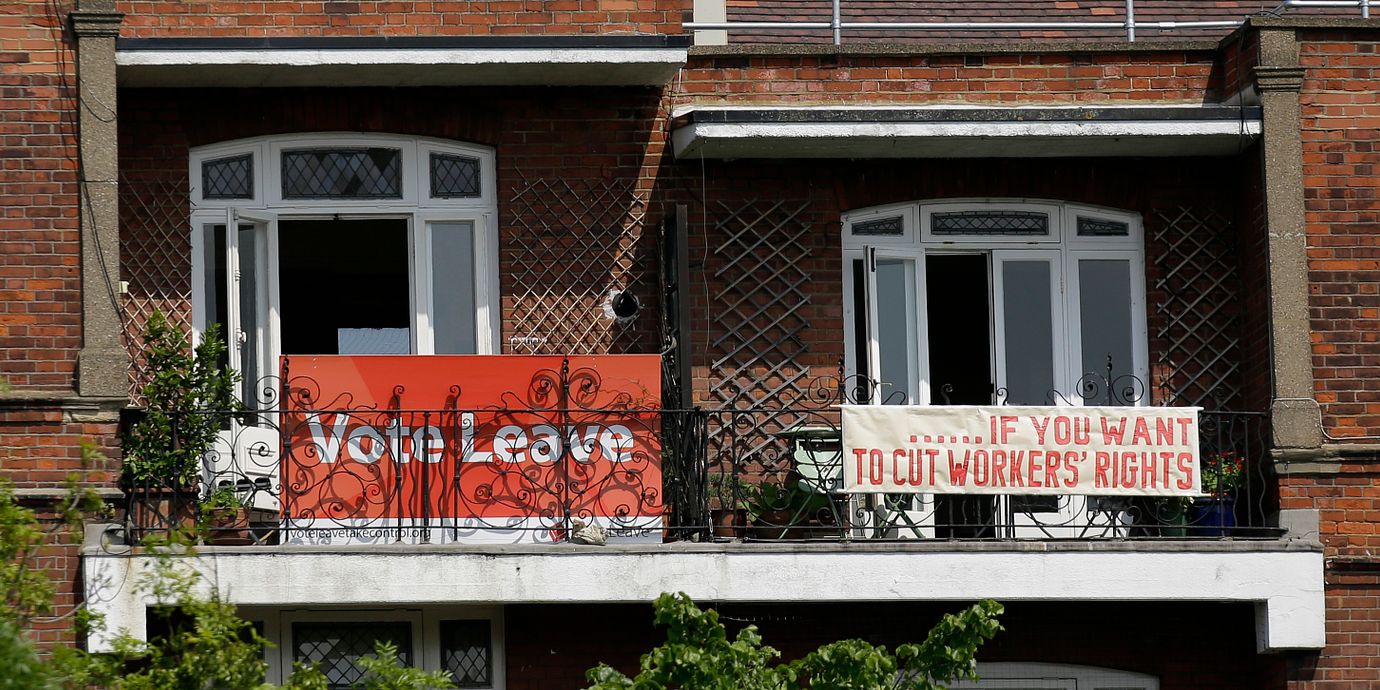
De tar kampen om Brexit på balkongen
Debatten om Storbritanniens vara eller icke vara i den europeiska unionen skapar inte bara missämja hos politiker i parlamentet, utan också mellan grannar. Störd av grannen som hängt upp banderollen med orden ”rösta lämna”, har 61-årige Frank Chalmers på sin intilliggande balkong hängt sin egen banderoll med orden: ”... om du vill ta bort arbetarnas rättigheter”.
Men, goda grannar är de ändå, som en fredsgåva ska Chalmers ha gett sin eu-skeptiska granne en flaska vin, rapporterar Reuters.
bakgrund
Brexit
Wikipedia (en)
The United Kingdom European Union membership referendum, also known as the EU referendum within the United Kingdom, is a referendum that is scheduled to take place in the United Kingdom and Gibraltar on 23 June 2016. Membership of the European Union has been a topic of debate in the United Kingdom since the country joined the European Economic Community (the "Common Market"), as it was known then, in 1973.
In accordance with a Conservative Party manifesto commitment, the legal basis for a referendum was established by the passage of the European Union Referendum Act 2015 by the British Parliament. It will be the third plebiscite to be held throughout the United Kingdom, and the second time the British electorate has been asked to vote on the issue of European Union membership: the first was held in 1975, when it was known as the EEC. Membership was approved in that referendum by 67% of voters – but the nature of the EU has changed substantially since then and the result of this referendum is expected to be significantly closer.
Those who favour a British withdrawal from the European Union – commonly referred to as a Brexit (a portmanteau of British and exit) – argue that the EU has a democratic deficit and that being a member undermines national sovereignty, while those who favour membership argue that in a world with many supranational organisations, any theoretical loss of sovereignty is compensated by the benefits of EU membership. Those who want to leave the EU (most British Eurosceptics) argue that it would allow the UK to better control immigration, thus reducing pressure on public services, housing and jobs; would save billions in EU membership fees; would allow the UK to make its own trade deals; and would free it from EU regulations and bureaucracy that they see as needless and costly. Those who want to remain argue that leaving the EU would risk the UK's prosperity, diminish its influence over world affairs, jeopardise national security by reducing access to common European criminal databases, and result in trade barriers between the UK and the EU. In particular, they argue that leaving the EU would lead to job losses, delays in investment coming to the UK and risks to large and small business.
Omni är politiskt obundna och oberoende. Vi strävar efter att ge fler perspektiv på nyheterna. Har du frågor eller synpunkter kring vår rapportering? Kontakta redaktionen