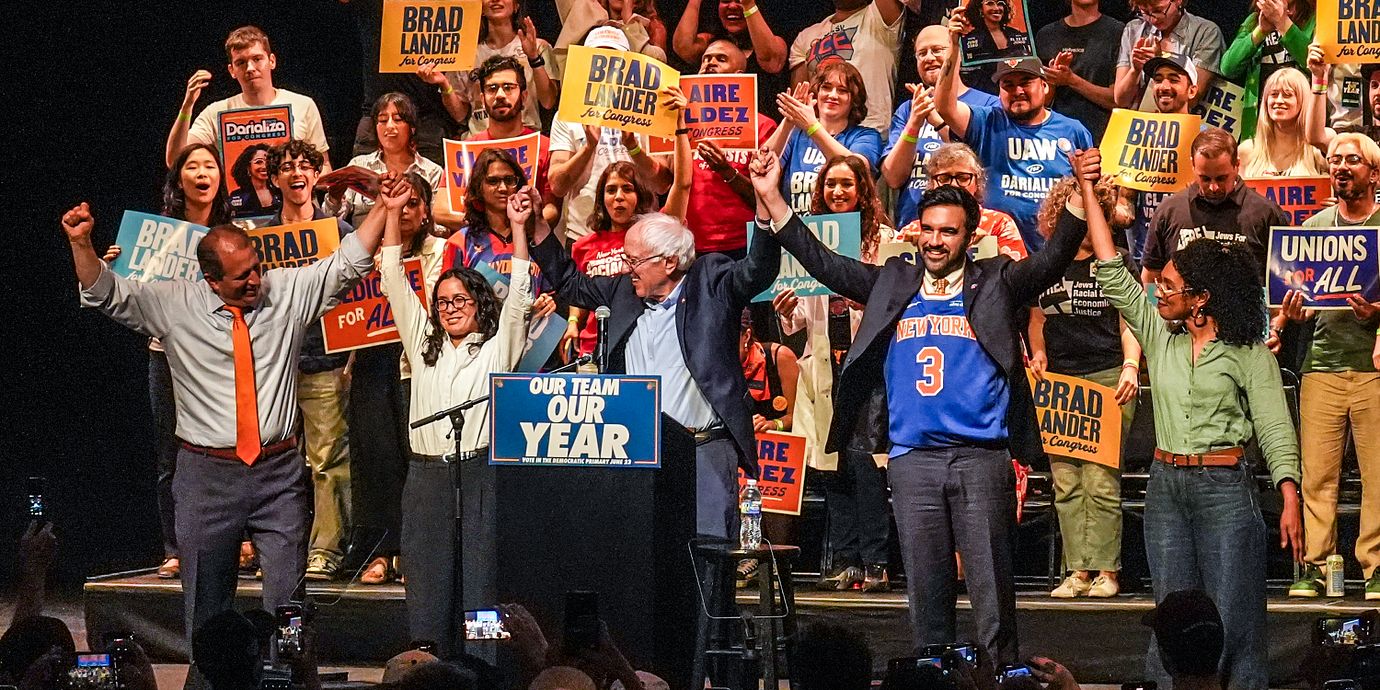
Primävalsvinnare Brad Lander och Claire Valdez till vänster. Senatorn Bernie Sanders och New Yorks borgmästare Zohran Mamdani i mitten och kandidaten Darializa Avila till höger. (Ryan Murphy /AP/TT / AP)

Demokraternas ”Tea Party” ritar om partiet

Den vänsterorienterade falangen inom Demokraterna, de så kallade progressiva, håller på att förändra partiet i grunden.

Axios beskriver utvecklingen som Demokraternas egen ”Tea Party-liknande revolt” – en hänvisning till den konservativa gräsrotsrörelse som bidrog till att flytta Republikanerna åt höger under 2010-talet.

Nu petar progressiva kandidater sittande demokrater i primärvalen, vilket skapat oro inom partiet. En av de tydligaste förändringarna gäller synen på Israel, rapporterar Axios.

Etablerade demokrater oroar sig för att själva förlora sina platser om de inte intar en mer kritisk hållning till Israel.

– Våra segrar över AIPAC-stödda kandidater tvingar Demokraterna att äntligen lyssna på sina väljare, säger Justice Democrats talesperson Usamah Andrabi.

Förra veckan röstade också 103 demokrater i representanthuset för ett förslag som skulle stoppa amerikanska biståndsmedel till Israel.


bakgrund
 
AIPAC är en amerikansk pro-Israel lobbyorganisation
Wikipedia (en)
The American Israel Public Affairs Committee (AIPAC; , AY-PAK) is an American pro-Israel lobbying group that advocates for policies strengthening the U.S.–Israel relationship. Founded in 1954 as the American Zionist Committee for Public Affairs, the organization adopted its current name in 1959. AIPAC is considered one of the most influential lobbying groups in the United States. Until 2021, AIPAC did not raise funds for political candidates itself; its members raised money for candidates through political action committees unaffiliated with AIPAC and by other means. In late 2021, AIPAC formed its own political action committee and announced plans for a Super PAC, which can spend money on candidates' behalf. AIPAC's critics have said it acts as an agent of the Israeli government and that it has a "stranglehold" on the United States Congress. AIPAC has been accused of being strongly allied with Israel's Likud party and the U.S. Republican Party. An AIPAC spokesman has called this a "malicious mischaracterization". AIPAC describes itself as a bipartisan organization. Its supporters claim its bipartisan nature can be seen at its yearly policy conference, which in 2016 included both major parties' nominees, Hillary Clinton and Donald Trump. But reporting has found that its political spending has often supported efforts against candidates—mostly Democrats—considered "insufficiently supportive" of Israel. In the lead-up to the 2024 elections, The Guardian reported that AIPAC had recruited and supported challengers to candidates who had been critical of Israel's actions in the Gaza war. AIPAC has also been criticized as unrepresentative of the diversity of views among American Jews who support Israel, and for aligning closely with policies of right-wing Israeli governments. As of 2025, AIPAC reports more than 5 million members in the U.S., 17 regional offices, and "a vast pool of donors". It was founded in 1954 by Isaiah L. Kenen, a lobbyist for the Israeli government, partly to counter international criticism of Israel's Qibya massacre of Palestinian villagers that year. AIPAC became an influential organization during the 1980s. In 2002, it expressed intent to lobby Congress to authorize use of force in Iraq, and in 2003, the Iraq War was defended at AIPAC events. In 2005, a Pentagon analyst pleaded guilty to espionage charges of passing U.S. government secrets to senior AIPAC officials, in what became known as the AIPAC espionage scandal.
bakgrund
 
Tea Party movement
Wikipedia (en)
The Tea Party movement was an American right-wing, fiscally conservative political movement within the Republican Party that began in 2007, catapulted into the mainstream by Congressman Ron Paul's presidential campaign. The movement expanded in response to the policies of Democratic president Barack Obama and was a major factor in the 2010 wave election in which Republicans gained 63 House seats and took control of the U.S. House of Representatives. Participants in the movement called for lower taxes and for a reduction of the national debt and federal budget deficit through decreased government spending. The movement supported small-government principles and opposed the Affordable Care Act (also known as Obamacare), President Obama's signature health care legislation. The Tea Party movement has been described as both a popular constitutional movement and as an "astroturf movement" purporting to be spontaneous and grassroots, but alleged to have been influenced by outside interests. The movement was composed of a mixture of libertarian, right-wing populist, and conservative activism. It sponsored multiple protests and supported various political candidates since 2009. The movement took its name from the December 1773 Boston Tea Party, a watershed event in the American Revolution, with some movement adherents using Revolutionary era costumes. The Tea Party movement was popularly launched following a February 19, 2009, call by CNBC reporter Rick Santelli on the floor of the Chicago Mercantile Exchange for a "tea party". On February 20, 2009, The Nationwide Tea Party Coalition also helped launch the Tea Party movement via a conference call attended by around 50 conservative activists. Supporters of the movement subsequently had a major impact on the internal politics of the Republican Party. While the Tea Party was not a political party in the strict sense, research published in 2016 suggests that members of the Tea Party Caucus voted like a right-wing third party in Congress. A major force behind the movement was Americans for Prosperity (AFP), a conservative political advocacy group founded by businessman and political activist David Koch. By 2016, Politico wrote that the Tea Party movement had died; however, it also said that this was in part because some of its ideas had been absorbed by the mainstream Republican Party. CNBC reported in 2019 that the conservative wing of the Republican Party "has basically shed the tea party moniker".
Omni är politiskt obundna och oberoende. Vi strävar efter att ge fler perspektiv på nyheterna. Har du frågor eller synpunkter kring vår rapportering? Kontakta redaktionen