Exdiktator begravd som hjälte – trots protester
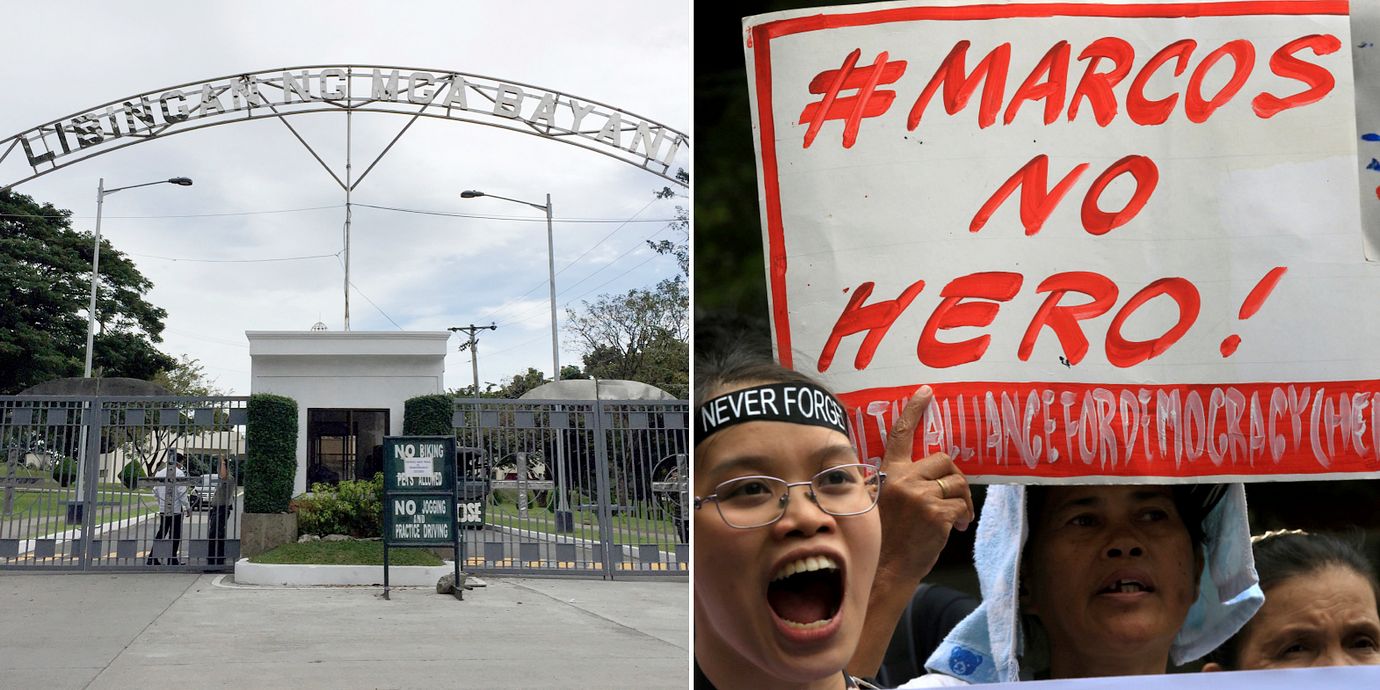
Filippinernas tidigare diktator Ferdinand Marcos har nu fått sin statsbegravning på Nationella hjältarnas gravplats, utanför Manila. Det rapporterar flera medier. Militären sköt salut och den filippinska flaggan skänktes till Marcos änka Imelda.
Frågan om exdiktatorns begravning har splittrat landet sedan hans död 1989. Marcos, som blev president 1965, styrde Filippinerna med järnhand fram till 1986, då han tvingades från makten. Tiotusentals människor fängslades och torterades under hans militärstödda styre, enligt människorättsorganisationer. I augusti beslutade landets president Rodrigo Duterte att Marcos skulle hedras med en statsbegravning. Beslutet utlöste stora protester och överklagades till högsta domstolen, utan framgång.
bakgrund
Ferdinand Marcos
Wikipedia (en)
Ferdinand Emmanuel Edralin Marcos, Sr. (September 11, 1917 – September 28, 1989) was a Filipino politician,and a World War II veteran who was President of the Philippines from 1965 to 1986. He ruled as a dictator under martial law from 1972 until 1981. While his regime started an unprecedented number of infrastructure projects and monuments (known colloquially as an "edifice complex'" and at great taxpayer cost), it also became infamous for its corruption, extravagance and brutality.
Prior to Marcos's presidency, he served as a member of the Philippine House of Representatives from 1949 to 1959 and of the Philippine Senate from 1959 to 1965, where he was also Senate President from 1963 to 1965. Marcos fought alongside with the Americans during the Japanese Invasion and participated in the Bataan Death March, and he would later claim during his election campaigns that he has been "the most decorated war hero in the Philippines", a claim which was later proven to be false. United States Army documents that were uncovered called the claim "fraudulent" and "absurd". However, President Fidel Ramos backed Marcos' claim that Marcos founded the anti-Japanese guerrilla group Maharlika and has mentioned in his presidential inaugural biography that his father Narciso Ramos served as one of the leaders of Marcos' guerrilla group.
He was elected President in 1965. The Philippine national debt used to fund development projects grew from $2 billion at the beginning of his term to $26 billion by the end of 1985. Meanwhile, based on World Bank data, Philippine Annual Gross Domestic Product grew from $5.27 billion in 1964 to $37.14 billion in 1982, a year prior to the assassination of Ninoy Aquino. Indeed, between 1972 and 1979, the Philippines enjoyed its best economic development since 1945. Political instability in the wake of the Aquino assassination, unexpected drop in access to international credit and high interest rates, and difficulty in managing balance of payments position due to falling export prices subsequently fueled a severe economic recession in 1984 and 1985. By the end of 1985, GDP stood at $30.7 following two years of economic contraction and poverty incidence grew slightly from 41% at the time Marcos took the Presidency in the 60s to around 44% in 1985.
Citing more than 15 bombing incidences and an intensifying armed communist insurgency, Marcos placed the Philippines under martial law on September 23, 1972, during which he revamped the constitution, silenced the media, and used violence and oppression against political opposition. Martial law was ratified by 90.77% of the voters during the Philippine Martial Law referendum, 1973 though the referendum was marred with controversy. The Washington Post revealed in 1989 that the Communists plotted the 1971 Plaza Miranda bombing to provoke Marcos into cracking down his opponents, allowing them to increase recruits which were needed to make use of weapons and financial aid coming from China.
A 1976 Amnesty International report had listed 88 government torturers. The same report mentioned "President Ferdinand E. Marcos, Secretary of National Defense Juan Ponce Enrile, Solicitor General Estelito P. Mendoza, Major General Fidel V. Ramos (Commanding General of The Philippine Constabulary), Brigadier General Guillermo Santos, Judge Advocate General of the Armed Forces of the Philippines and other senior officials" with responsibility for the administration of prisoners arrested under martial law.
Public outrage led to the snap elections of 1986 and to the People Power Revolution in February 1986, which removed him from power. To avoid what could have been a military confrontation in Manila between pro- and anti-Marcos troops, Marcos was advised by President Ronald Reagan through Sen. Paul Laxalt to "cut and cut cleanly", after which Marcos fled to Hawaii. Marcos was succeeded by Corazon (Cory) Aquino, widow of the assassinated opposition leader Senator Benigno (Ninoy) Aquino, Jr. who had flown back to the Philippines to face the dictator.
According to source documents provided by the Presidential Commission on Good Government, a government agency created by the Aquino Government which by itself was affected by corruption scandals after it was alleged that officials wanted a cut of Marcos' assets and were "milking" sequestered assets, the Marcos family had plundered $5–10 billion USD. The Presidential Commission on Good Government also maintained that the Marcos family enjoyed a decadent lifestyle—taking away billions of dollars from the country in the course of their US-backed rule between 1965 and 1986. His wife Imelda Marcos, whose excesses during the couple's kleptocracy made her infamous in her own right, spawned the term "Imeldific". In 2008, Philippines trial court judge Silvino Pampilo, acquitted Imelda Marcos, then widow of Ferdinand Marcos, of 32 counts of illegal money transfer after having previously been convicted of graft in 1993. In 2010, she was ordered to repay the Philippine government almost $280,000 for funds taken by Ferdinand Marcos in 1983. In 2012, a US Court of Appeals of the Ninth Circuit upheld a contempt judgement against Imelda and her son Bongbong Marcos for violating an injunction barring them from dissipating their assets, and awarded $353.6 million to human rights victims. Despite still facing numerous ongoing criminal graft charges, as of March 2016, she was still active in Philippine politics along with two of her four children, Imee Marcos and Ferdinand "Bongbong" Marcos Jr.
As of October 2015, Imelda Marcos still faces 10 criminal charges of graft, down from 900 cases in the 1990s, as most of the cases were dismissed for lack of evidence.
Omni är politiskt obundna och oberoende. Vi strävar efter att ge fler perspektiv på nyheterna. Har du frågor eller synpunkter kring vår rapportering? Kontakta redaktionen