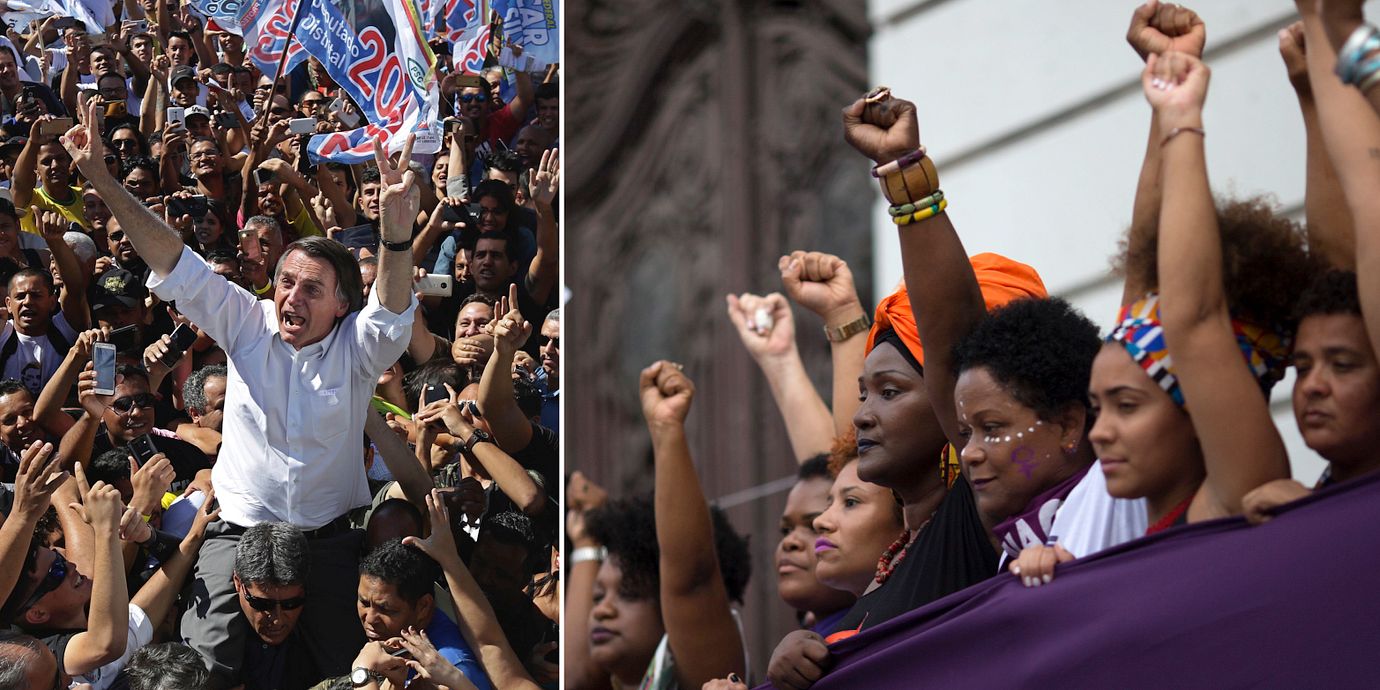
Expert: Detta är Brasiliens viktigaste val någonsin
Mycket står på spel när Brasilien går till urnorna på söndag för att välja en ny president. Det säger James N Green, chef på Brownuniversitets Brasilien-program till The Guardian.
Green är starkt kritiskt till högerpopulisten Jair Bolsonaro som leder i opinionsmätningarna och kallar det landets viktigaste val någonsin.
– Jag vill inte ens tänka på hur det skulle bli om han vinner. Det skulle bli början på slutet på demokratin, säger han till tidningen.
Bolsonaro gick till motattack mot sina kritiker i en tv-intervju på torsdagen.
– Är jag verkligen så farlig? Att jag skulle önska kvinnor, svarta och medborgare i nordöstra Brasilien illa? Det är inte sant! sa han.
bakgrund
Jair Bolsonaro
Wikipedia (en)
Jair Messias Bolsonaro (Portuguese: [ʒaˈiʁ meˈsiɐs bowsoˈnaɾu]; born 21 March 1955) is a Brazilian politician and former military officer. He has been a member of the Chamber of Deputies since 1991 and is currently a member of the Social Liberal Party (PSL). A controversial figure in Brazil, he is known for his far-right and populist political views, including sympathetic comments about Brazil's 1964–1985 military dictatorship.He is his party's presidential candidate in the 2018 Brazilian presidential election.
bakgrund
Presidentvalet i Brasilien
Wikipedia (en)
General elections are scheduled to be held in Brazil on 7 October 2018 to elect the President, Vice President and the National Congress. Elections for state Governors and Vice Governors, state Legislative Assemblies and Federal District Legislative Chamber will be held at the same time.
The 2014 elections saw Workers' Party candidate Dilma Rousseff reelected as President in the second round with 51.6% of the vote, defeating Aécio Neves of the Brazilian Social Democracy Party who received 48.4% of the vote. Rousseff had first been elected in the 2010 elections, succeeding her political mentor, Luiz Inácio Lula da Silva, who was in office from 2003 until 2011.
However, on 3 December 2015, impeachment proceedings against Rousseff were officially accepted by the Chamber of Deputies. On 12 May 2016, the Federal Senate temporarily suspended Rousseff's powers and duties for up to six months or until the Senate reached a verdict: to remove her from office if found guilty or to acquit her from the crimes charged. Vice President Michel Temer, of the Brazilian Democratic Movement Party, assumed her powers and duties as Acting President of Brazil during the suspension. On 31 August 2016, the Senate voted 61–20 in favor of impeachment, finding Rousseff guilty of breaking budgetary laws and removing her from office. Critics of the impeachment saw it as a legislative coup d'état, since the budgetary adjustments happened in her first term, and not after her re-election. Vice President Temer succeeded Rousseff as the 37th President of Brazil. His government implemented policies that contradicted the platform on which Rousseff's Workers Party had been elected, in one of the most controversial and politically-heated periods of modern Brazilian history.
Omni är politiskt obundna och oberoende. Vi strävar efter att ge fler perspektiv på nyheterna. Har du frågor eller synpunkter kring vår rapportering? Kontakta redaktionen