Wikipedia (en)
The Gülen movement is an Islamic transnational religious and social movement led by Turkish Islamic theologian and preacher Fethullah Gülen, who now lives in the United States. The movement has no official name but it is usually referred to as Hizmet ("the Service") by its followers and as Cemaat ("the Community/Assembly") by the broader public in Turkey. Its largest body is the Alliance for Shared Values.
The Turkish Justice and Development Party (AKP) government, formerly an ally of Gülen, has designated the movement as a terrorist organisation under the name Gülenist Terror Organisation (Fetullahçı Terör Örgütü, FETÖ) or Parallel State Organisation (Paralel Devlet Yapılanması, PDY) since 11 December 2015 and has accused it of trying to infiltrate the Turkish state and overthrow the government during a failed coup attempt in 2016.
The movement has attracted supporters and critics in Turkey, Central Asia, and other parts of the world. It is active in education with private schools and universities in over 180 countries as well as many American charter schools operated by followers. The movement denies that the charter schools have a direct affiliation. It has initiated forums for interfaith dialogue. It has substantial investments in media, finance, and for-profit health clinics. Some have praised the movement as a pacifist, modern-oriented version of Islam, and as an alternative to more extreme schools of Islam such as Salafism. But it has also been accused of having "global, apocalyptic ambition" and a "cultish hierarchy".
After the 2013 corruption investigations in Turkey into alleged corrupt practices by several bureaucrats, ministers, mayors, and family members of the ruling AKP of Turkey was uncovered, President Recep Tayyip Erdoğan blamed the movement for initiating the investigations as a result of a break in previously friendly relations. The group was considered to have influence on the Turkish police force and the judiciary. The movement is accused of attempting to overthrow the democratically elected Turkish government through a judicial coup by the use of corruption investigations. The government determined the movement to be a national security threat to Turkey and seized the group-owned newspaper (Zaman—the most circulated newspaper in Turkey before the seizure) and several companies that have ties with the group. Investigations of the group are continuing into several accusations.
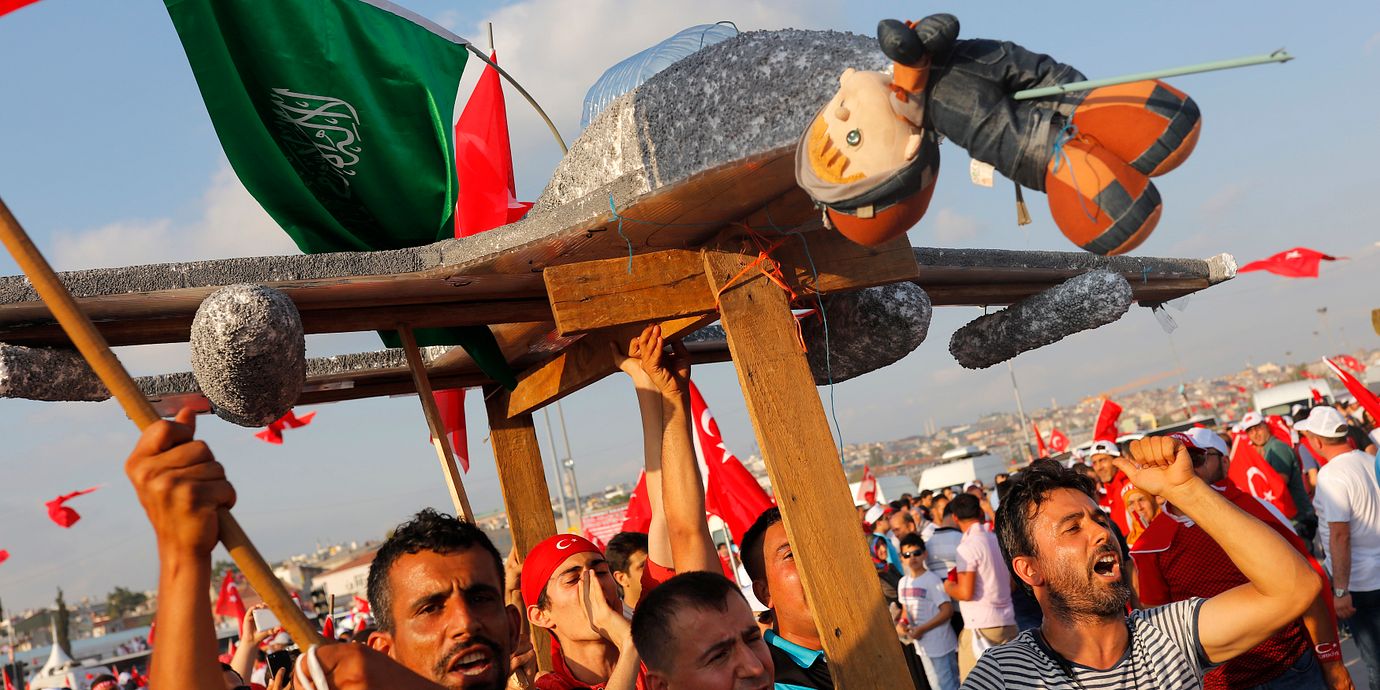
During the July 2016 Turkish coup d'état attempt, Turkish President Erdoğan and Prime Minister Binali Yıldırım blamed the group for the coup and authorities have arrested thousands of soldiers and judges. Over ten thousand education staff were suspended and the licenses of over 20,000 teachers working at private institutions were revoked for alleged affiliation to Gülen. Fethullah Gülen strongly condemned the coup, and rejected claims of his involvement.