IAEA: Nordkoreas förmåga att tillverka kärnvapen ökar
Nordkorea har ökat sin förmåga att tillverka kärnvapen, uppger det internationella atomenergiorganet IAEA enligt AFP.
Enligt IAEA-chefen Rafael Grossi har man bland annat kunnat se att aktiviteten vid reaktorn Yongbyon ökat kraftigt.
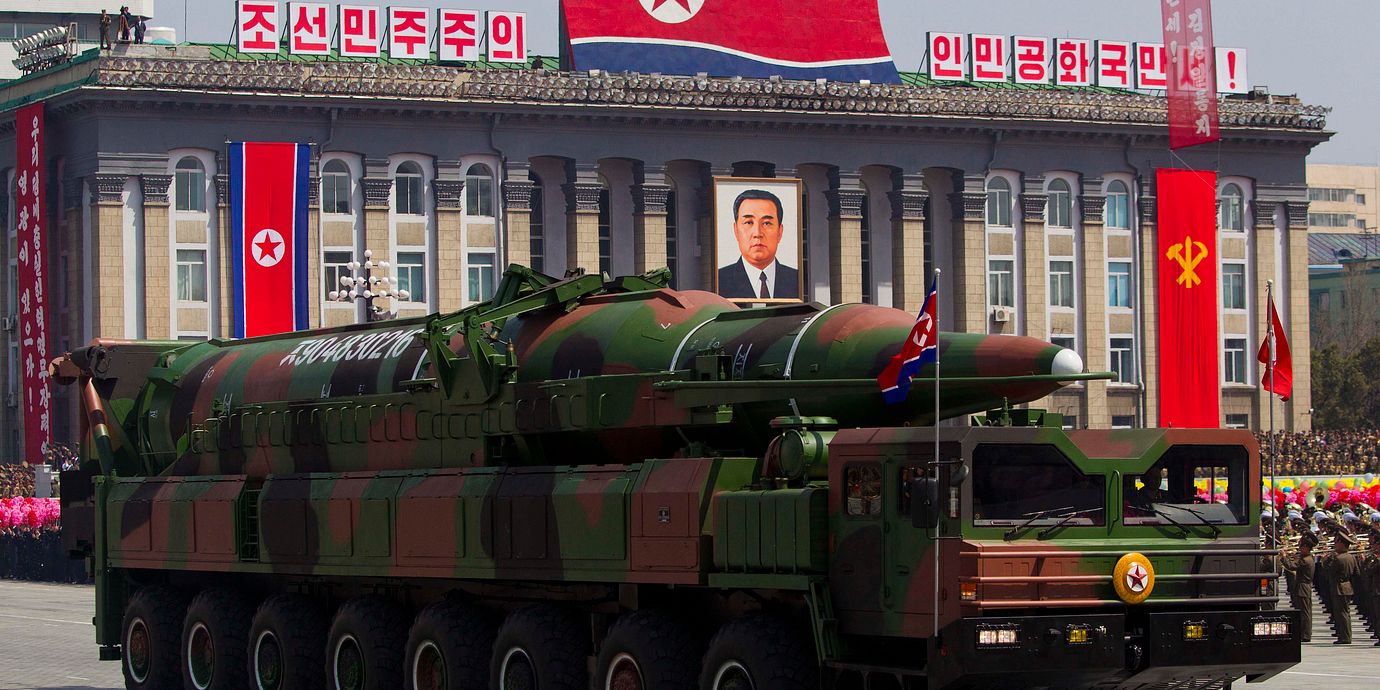
Enligt Arms Control Association har Nordkorea för närvarande någonstans mellan 30 och 50 kärnvapen: världens minsta arsenal av sitt slag.
Tidigare gjorde IAEA bedömningen att landet producerade tillräckligt med anrikat radioaktivt material för att tillverka sex nya kärnvapen per år. Den nya bedömningen är tolv.
bakgrund
Nordkoreas massförstörelsevapen
Wikipedia (en)
North Korea is the tenth country to develop and most recent to openly test nuclear weapons. As of 2025, its arsenal is estimated as the world's smallest, with around 50 nuclear weapons and production of fissile material for six to seven nuclear weapons per year. North Korea is also believed to have one of the world's largest chemical weapons stockpiles. North Korea is party to the Biological Weapons Convention, one of four UN members not to ratify the Chemical Weapons Convention, and the only country to announce withdrawal from the Non-Proliferation Treaty (NPT).
North Korea is the only country confirmed to conduct nuclear weapons tests in the 21st century, carrying out six underground tests at Punggye-ri from 2006 to 2017. Via these, North Korea is believed to have developed thermonuclear and boosted fission weapons. Despite its low warhead count, the Korean People's Army Strategic Force is estimated to operate over 363 ballistic missiles; 17 of these are intercontinental-range such as the Hwasong-17, another 27 are intermediate/medium-range such as the Hwasong-12, and the remaining 319 are short-range, primarily the Hwasong-11D. The Force also operates the Hwasal-1/-2 cruise missiles and reportedly tactical nuclear weapons. North Korea is developing submarine-launched ballistic missiles such as the Pukguksong-1 and Hwasong-11S. Its missile development is linked to its satellite program.
Posited motives for North Korean nuclear proliferation include the fall of communism, a wavering alliance with China, desire to deter and/or negotiate with the United States, or its domestic politics. Its program is closely tied to the Korean conflict, which partially stems from the lack of a peace treaty concluding the Korean War; South Korea hosted US nuclear weapons from 1958 to 1991, and pursued a domestic program from 1970 to 1981.
North Korea had developed nuclear technology since the 1960s, with supply from the Soviet Union. Despite joining the NPT in 1989, it failed to comply with International Atomic Energy Agency (IAEA) safeguards, and triggered a 1993 diplomatic crisis by announcing its intent to withdraw from the NPT. The 1994 Agreed Framework with the United States paused withdrawal and briefly improved relations, but was never fully implemented. The framework broke down in 2003; North Korea expelled IAEA inspectors and announced immediate NPT withdrawal. The subsequent six-party talks continued until 2007 but made little progress. Its first test in 2006 was met with international sanctions. Subsequent nuclear and missile tests have been internationally provocative, leading to a crisis in 2017–2018. In 2024, North Korea signed a security treaty with Russia, gaining sanctions bypasses and potential technology transfer. North Korea has also exported missiles to Egypt, Iran, Syria, and Pakistan, and assisted the construction of the Al Kibar reactor of the Syrian nuclear weapons program.
North Korea is widely believed to have a chemical weapons arsenal of up to 5,000 tons, including sarin and mustard gas. Kim Jong Un is widely believed to have ordered the 2017 assassination of Kim Jong-nam, which used the chemical nerve agent, VX. It is unclear if North Korea has an offensive biological weapons program, although like many countries it has the industrial capability for one.
Omni är politiskt obundna och oberoende. Vi strävar efter att ge fler perspektiv på nyheterna. Har du frågor eller synpunkter kring vår rapportering? Kontakta redaktionen