Wikipedia (en)
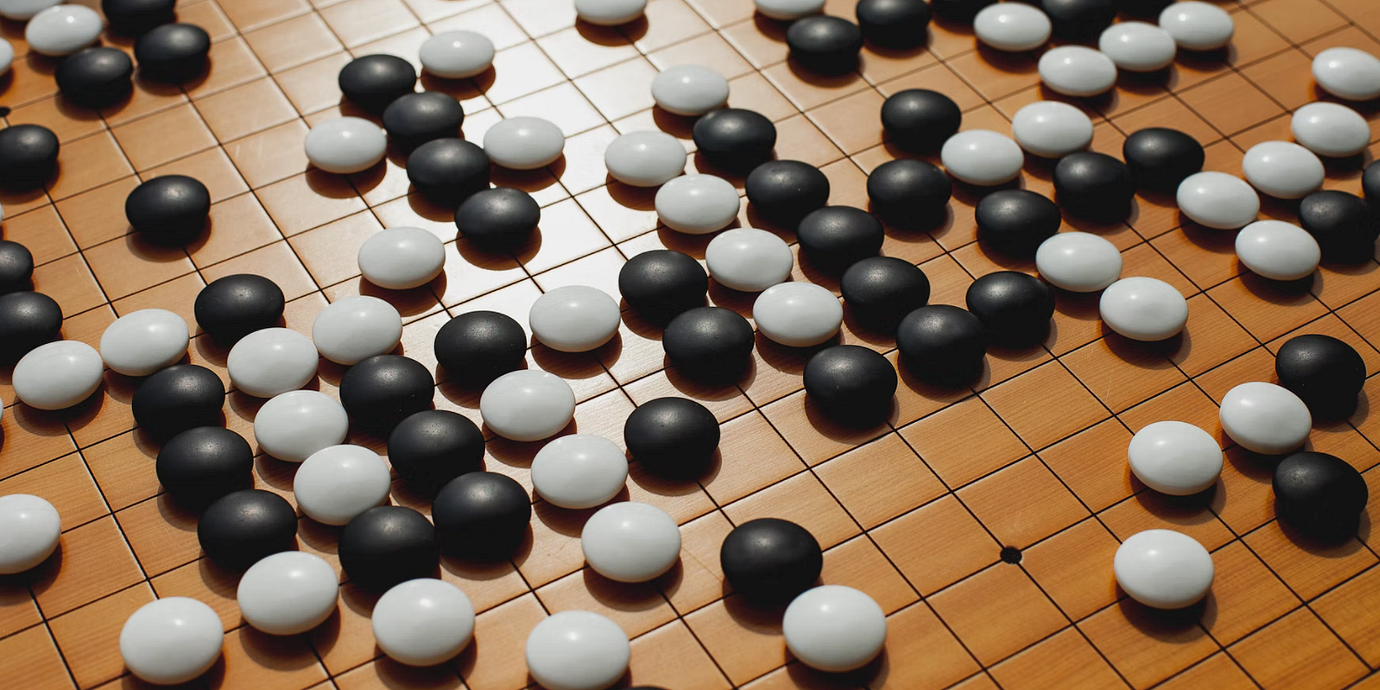
Go or Weiqi, Weichi (simplified Chinese: 围棋; traditional Chinese: 圍棋; pinyin: wéiqí) is an abstract strategy board game for two players in which the aim is to surround more territory than the opponent. The game was invented in China more than 2,500 years ago and is believed to be the oldest board game continuously played to the present day. A 2016 survey by the International Go Federation's 75 member nations found that there are over 46 million people worldwide who know how to play Go and over 20 million current players, the majority of whom live in East Asia.The playing pieces are called stones. One player uses the white stones and the other, black. The players take turns placing the stones on the vacant intersections (points) of a board. Once placed on the board, stones may not be moved, but stones are removed from the board if the stone (or group of stones) is surrounded by opposing stones on all orthogonally adjacent points, in which case the stone or group is captured. The game proceeds until neither player wishes to make another move. When a game concludes, the winner is determined by counting each player's surrounded territory along with captured stones and komi (points added to the score of the player with the white stones as compensation for playing second). Games may also be terminated by resignation.
The standard Go board has a 19×19 grid of lines, containing 361 points. Beginners often play on smaller 9×9 and 13×13 boards, and archaeological evidence shows that the game was played in earlier centuries on a board with a 17×17 grid. However, boards with a 19×19 grid had become standard by the time the game reached Korea in the 5th century CE and Japan in the 7th century CE.Go was considered one of the four essential arts of the cultured aristocratic Chinese scholars in antiquity. The earliest written reference to the game is generally recognized as the historical annal Zuo Zhuan (c. 4th century BCE).Despite its relatively simple rules, Go is extremely complex. Compared to chess, Go has both a larger board with more scope for play and longer games and, on average, many more alternatives to consider per move. The number of legal board positions in Go has been calculated to be approximately 2.1×10170, which is vastly greater than the number of atoms in the observable universe, estimated to be of the order of 1080.