Kinesisk ilska mot Trump – har framfört protest
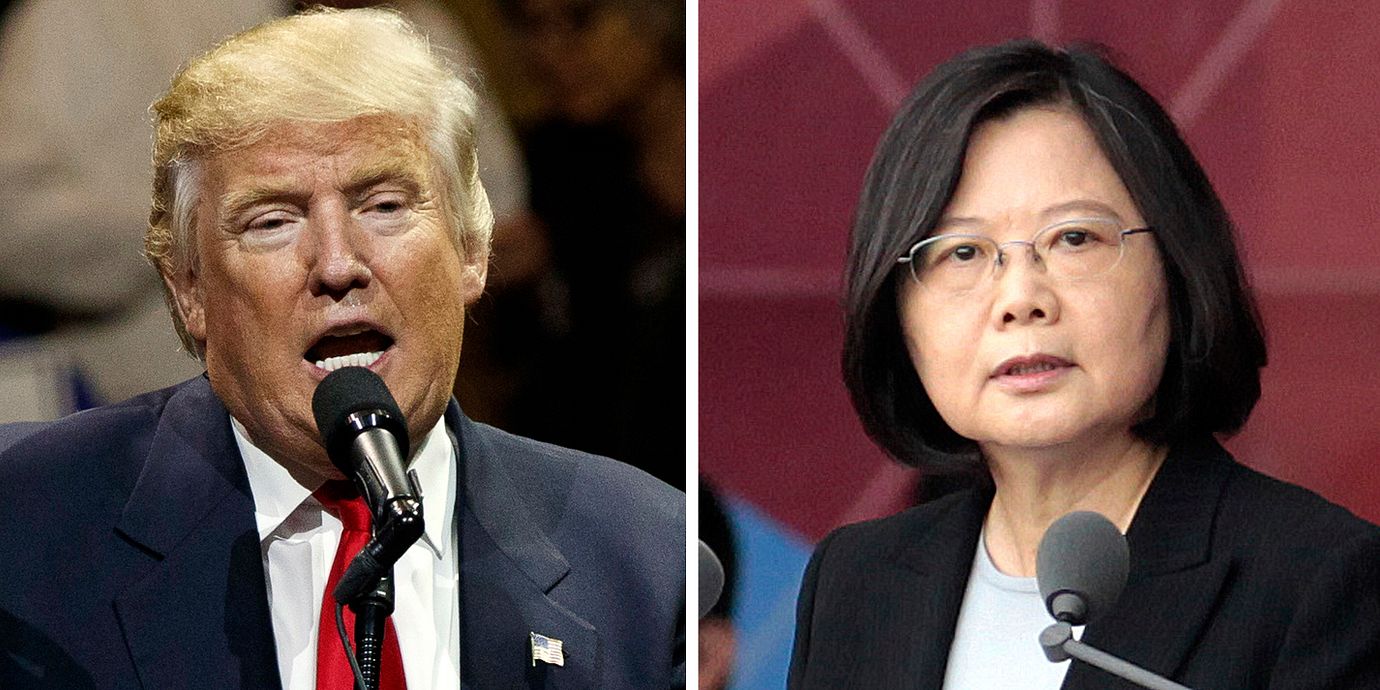
Precis som förväntat har Donald Trumps telefonsamtal med Taiwans ledare Tsai Ing-wen skapat vrede i Kina. Landets utrikesdepartement meddelade under lördagen att man framfört en protest till USA och uppmanat Vita huset att upprätthålla principen om ”ett Kina”.
”Det måste verkligen stå klart att det bara finns ett Kina i världen. Taiwan är en omistlig del av landets territorium”, skriver departementet i ett uttalande.
bakgrund
Principen om ett Kina
Wikipedia (en)
The One-China policy refers to the policy or view that there is only one state called "China", despite the existence of two governments that claim to be "China".
As a policy, this means that countries seeking diplomatic relations with the People's Republic of China (PRC) must break official relations with the Republic of China (ROC) and vice versa. Hence, all the countries recognizing the ROC recognize it as the sole legitimate representative of all of "China" and not just the island of Taiwan and other islands which it controls. Similarly, all states that recognize the PRC either recognize the PRC as the legitimate representative of Taiwan or acknowledge the PRC's views on the matter.
The One China policy is also different from the "One China principle", which is the principle that insists both Taiwan and mainland China are inalienable parts of a single "China". A modified form of the "One China" principle known as the "1992 Consensus" is the current policy of the PRC government, and at times, the policy of the ROC government, depending on which major political party is in power. Under this "consensus", both governments "agree" that there is only one sovereign state encompassing both mainland China and Taiwan, but disagree about which of the two governments is the legitimate government of this state. An analogous situation exists with Korea and Syria.
The One-China principle faces opposition from supporters of the Taiwan independence movement, which pushes to establish the "Republic of Taiwan" and cultivate a separate identity apart from China called "Taiwanization". Taiwanization's influence on the government of the ROC has caused instability: after the Communist Party of China expelled the ROC in the Chinese Civil War from most of Chinese territory in 1949 and founded the PRC, the ROC's Chinese Nationalist government, which still held Taiwan, continued to claim legitimacy as the government of all of China. Under former President Lee Teng-hui, additional articles were appended to the ROC constitution in 1991 so that it applied effectively only to the Taiwan Area prior to national unification. However, recent ROC President Ma Ying-jeou has re-asserted claims on mainland China as late as October 8, 2008.
Omni är politiskt obundna och oberoende. Vi strävar efter att ge fler perspektiv på nyheterna. Har du frågor eller synpunkter kring vår rapportering? Kontakta redaktionen