”Världens största isberg” har lämnat Antarktis
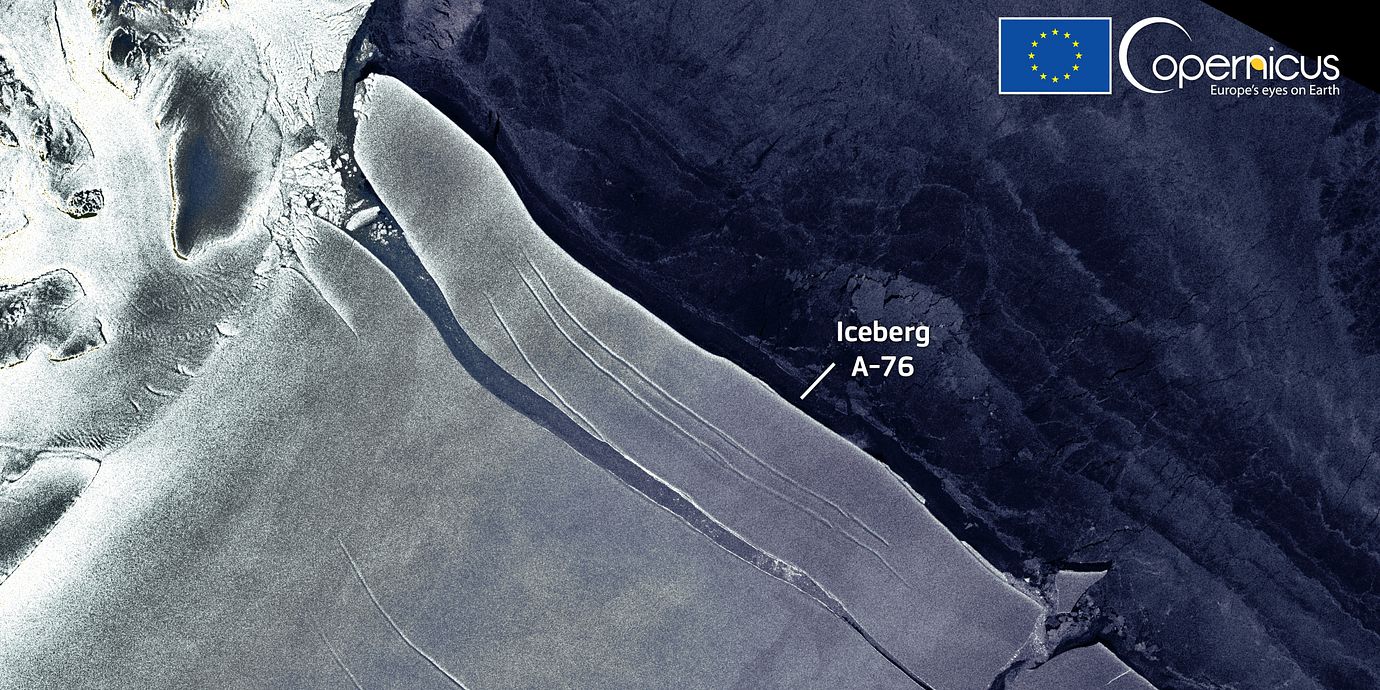
Ett gigantiskt isberg har lossnat från Antarktis och flutit ut i Weddelhavet, skriver flera medier med hänvisning till europeiska rymdstyrelsen ESA.
Isbergets yta är cirka 4 320 kvadratkilometer, vilket är större än Mallorca och fyra gånger så stort som New York City. Det gör A-76, som det officiella namnet lyder, till världens för närvarande största isberg.
Det är naturligt att is lossnar längs med ismassorna på Antarktis men enligt forskare blir det vanligare i och med klimatförändringarna.
bakgrund
Antarktis
Wikipedia (en)
The Antarctic ice sheet is one of the two polar ice caps of the Earth. It covers about 98% of the Antarctic continent and is the largest single mass of ice on Earth. It covers an area of almost 14 million square kilometres (5.4 million square miles) and contains 26.5 million cubic kilometres (6,400,000 cubic miles) of ice. A cubic kilometer of ice weighs approximately one metric gigaton, meaning that the ice sheet weighs 26,500,000 gigatons. Approximately 61 percent of all fresh water on the Earth is held in the Antarctic ice sheet, an amount equivalent to about 58 m of sea-level rise. In East Antarctica, the ice sheet rests on a major land mass, while in West Antarctica the bed can extend to more than 2,500 m below sea level.
Satellite measurements by NASA indicate a still increasing sheet thickness above the continent, outweighing the losses at the edge. The reasons for this are not fully understood, but suggestions include the climatic effects on ocean and atmospheric circulation of the ozone hole, and/or cooler ocean surface temperatures as the warming deep waters melt the ice shelves.
Omni är politiskt obundna och oberoende. Vi strävar efter att ge fler perspektiv på nyheterna. Har du frågor eller synpunkter kring vår rapportering? Kontakta redaktionen