”Lite söt och lite läskig” – en dag i en matrobots liv
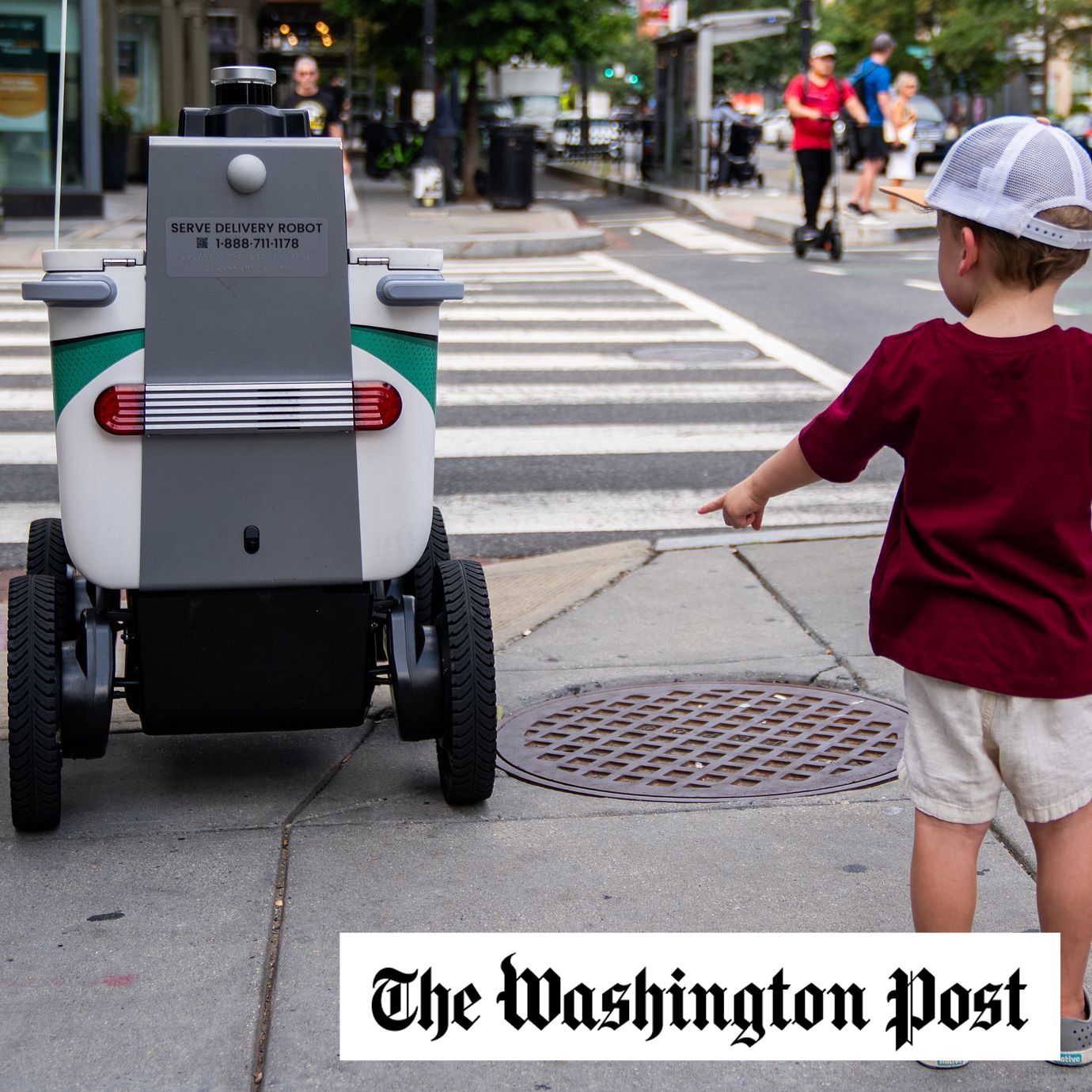
När en budrobot vid namn Jouya gav sig ut på Washingtons trottoarer – med en reporter i hälarna – blev det ingen uppvisning i effektivitet.
Jouya stannade gång på gång, tvingades bromsa för nyfikna förbipasserande, körde in på en avstängd trottoar och hann passera både Ungerns ambassad och en gaybar. Någon mat blev däremot aldrig hämtad.
Samtidigt susade mänskliga bud förbi på sina mopeder, skriver The Washington Post. Reaktionerna på robotarna är blandade.
– Den är lite söt och lite läskig, säger 21-åriga Grace Williams.
(Svensk översättning av Omni.)
How effective are food delivery robots? We followed one around D.C.
California-based companies Coco Robotics and competitor Serve Robotics launched in Washington this summer. Reactions vary from praise to indifference to disdain.
It was a hot Thursday afternoon in Washington, and Coco was misbehaving.
Outside JINYA Ramen Bar on 14th Street NW, restaurant manager Thomas Pham was struggling to open up the lid on a pink-and-orange robot from a company called Coco Robotics.
“Coco is being naughty today,” Pham said. Delivery drivers whizzed by as Pham tried to put an order inside the robot.
This summer, California-based companies Coco Robotics and competitor Serve Robotics launched in Washington, using robots to deliver food from participating restaurants to hungry residents in neighborhoods including Bloomingdale, Dupont Circle and Logan Circle.
Overall, Pham said, he likes the robots, even if they only deliver about five meals out of the restaurant’s roughly 100 daily orders. “For some reason, today it’s having an issue of opening,” said Pham, who called the company for help. Maybe the customer canceled the order?
Minutes before, as the sherbet-colored robot moseyed over to the ramen restaurant, passersby couldn’t help but gawk and smirk. “That thing’s weird,” a lady yelled at it from across the street.
“It’s kind of cute, kind of scary,” 21-year-old Grace Williams said as her mom jumped in front of the robot to see if it would stop. (It did.)
Delivery robots have rolled around the District for nearly a decade, but they haven’t become as popular as they have in cities like Los Angeles, where Coco alone says hundreds of its robots deliver food from thousands of restaurants. But thanks to advances in artificial intelligence, the companies say they’re the stuff of the future. In Washington, reactions from customers and restaurants have varied from praise to indifference to disdain.
Ali Kashani, CEO of Serve Robotics, waxes poetic when he talks about experiencing robot delivery for the first time. “It’s like your first car, or your first kiss: You’re never going to forget it,” he said. “It’s magical.”
On a recent evening, a Coco robot bopped down the sidewalk to Justin Pepper’s house in Logan Circle. It waited to cross the street and deferred to pedestrians who didn’t step out of the way. Its movement was distinctly bouncy. Its little orange flag fluttered in the humid breeze.
The robot sometimes stopped, as if it were concerned why it was being followed. (This reporter looked at its camera and told the human remotely overseeing the trip that he was on assignment for The Washington Post. There were no issues after that.)
Eventually, the robot parked outside a gray townhouse, and out came Pepper. He entered a code into the robot, and the lid opened up. His dinner - sushi from Zeppelin - was inside.
Pepper wasn’t all that impressed by the device. “Undecided,” he said. Companies tout the robots as speedier than human delivery drivers, but that hasn’t been the case for Pepper.
“We haven’t experienced it being faster,” he said. “My main thought for our first robot delivery was, ‘This is strange,’ because it delivered two doors down and took a five-point turn as I was trying to retrieve my food.”
For years, the autonomous vehicle company Waymo has been lobbying the District to allow it to operate commercially in D.C. By comparison, it’s much easier for delivery robots to come to Washington.
Serve Robotics and Coco Robotics added Washington to their lists of cities when the D.C. Department of Transportation granted them permits in July. During the first three months of operation, each company is limited to a maximum fleet size of 25 devices, and each robot is restricted to a small zone.
Humans keep watch remotely and can take over the robot’s controls if necessary, but no tip is required. Customers can request a robot when ordering on Uber Eats or DoorDash, but they can also say they don’t want one.
Coco Robotics CEO Zach Rash said demand in D.C. has been high from both customers and restaurants, marking “the strongest start of any city we’ve launched.”
In the District, where traffic is a perennial issue and traffic deaths are up, both companies argue their robots can cut down on congestion and improve road safety by reducing the number of delivery cars on streets.
“Why move a two-pound burrito in a two-ton car? It really doesn’t make sense,” Kashani said. “If you remove that car, you’re immediately making the city safer for the pedestrians, for the kids, for the bikers.”
“It’s like your first car, or your first kiss: You’re never going to forget it”
There is little federal oversight for sidewalk delivery robots, so weight limits, operating speeds, insurance requirements, reporting obligations and accessibility protections can vary across jurisdictions, according to Sarah Fox, an associate professor at the University of Michigan who has researched delivery robots. Companies can make broad claims about safety and accessibility without having to demonstrate performance against a shared benchmark, Fox added.
“Delivery robots raise broader questions about the privatization of public space. Sidewalks become part of a company’s logistics network even though the public may absorb the associated costs,” Fox said.
Still, the robots themselves don’t weigh much, and they tend to travel at walking speed, which means they’re unlikely to cause serious injuries, according to Aidan While, an urban planning professor at the University of Sheffield who has researched delivery robots.
“The last thing you want to do if you’re a robot operator is kill anyone,” While said.
Some experts have raised concerns about potential accessibility issues for people with disabilities.
“A robot blocking a narrow sidewalk, curb cut, crossing, bus stop, or entrance may inconvenience a nondisabled pedestrian but eliminate the only accessible route for someone using a wheelchair” or another mobility device, Fox said.
A Serve spokesperson said the company designed its robots to yield to pedestrians and mobility devices and to stop, pull over and reroute when space is limited. In April, Coco announced it would share sidewalk data with the app BlindSquare to warn visually impaired users about construction and other obstacles.
A few restaurants said the devices have some advantages over humans.
In Dupont Circle, Nik Charan, manager of Talkin’ Tacos, said the restaurant sometimes faces the problem of delivery drivers eating their customers’ orders. But that doesn’t happen with the robots. “That’s a huge relief,” he said.
He said he hopes the companies will increase their fleets and allow the robots to go longer distances. “It’s more convenient to work with robots than delivery drivers,” Charan said.
At Beau Thai in Logan Circle, manager Kobie Chok said sometimes when the restaurant is busy, delivery drivers leave because they don’t want to wait around for an order. “But Coco, they are okay. They can wait,” Chok said. Still, that benefit is minimal so far, Chok added, since only a tiny fraction of the restaurant’s deliveries go out in robots.
“The last thing you want to do if you’re a robot operator is kill anyone”
In Northern Virginia, a white delivery robot from a company called Avride has made an ardent fan out of 2-year-old Lottie. Her mother, Kerry Connelly, said Lottie is obsessed with the little devices.
“She just decided they were her robots,” Connelly said.
For Lottie’s birthday at the end of July, Connelly arranged for cupcakes and Thai food to be delivered to their Arlington neighborhood via robot. “When it came into view, she was so happy. She ran down there to see it,” Connelly said.
Other robots have fallen on tougher times.
An intense Thursday night storm that downed dozens of trees around the D.C. area sent one crashing on top of a Coco robot. By Friday afternoon, most of the tree had been removed, and a company spokesperson said the scratched-up-but-still-standing robot remained functional.
Coco and Serve say they hope to expand in Washington. Still, there are growing pains.
On a recent afternoon, a Serve robot named Jouya spent hours ambling around Washington, halting every few minutes before getting back on its way. On one block, a lady kept jumping in front of Jouya, taunting it and forcing it to stop. Other people took selfies with it.
Jouya wandered for hours. It stopped by the farmers market outside the National Geographic Museumof Exploration. It stopped by the Hungarian Embassy. It stopped by the gay bar Trade. At one point, it traveled down a closed sidewalk, despite construction and to the amusement of nearby workers.
“They seem uncertain,” said Laylaa Randera, who works at the farmers market. She said she would avoid robot deliveries because she prefers a human touch. (A Serve spokesperson said the company’s robots are performing data collection to improve performance in addition to doing deliveries.)
All afternoon, delivery drivers zipped past Jouya on their scooters. As the sun beat down, the robot sounded like fans whirring inside an overheating laptop. For hours, Jouya never picked up an order.
© 2026 The Washington Post. Sign up for the Today's Worldview newsletter here.