bakgrund
Sommarens värmeböljor i Europa
Wikipedia (en)
Starting in late May 2026, several severe heatwaves affected Europe. Temperature records were broken in Austria, Belarus, Belgium, Czechia, Denmark, France, Germany, Hungary, Ireland, Italy, the Netherlands, Poland, Romania, Slovakia, Slovenia, Spain, Switzerland and the United Kingdom. The first heatwave began on 24 May, with temperatures higher than normal and several heat-related deaths. Temperatures were the highest ever recorded for May, with climate change causing the earlier onset of Central Europe's summer. Western Europe was the most affected area, with reports of record-breaking temperatures in France, Ireland and the United Kingdom. Other countries with unusually high temperatures were Portugal, at 40 °C (104 °F), and Spain, with temperatures in the southwest reaching 39 °C (102 °F).
A second, more severe heatwave began on 17 June, just days before the summer solstice. In France, Météo-France declared 23 June the country's hottest day since measurements began in 1947, with temperatures reaching 44.3 °C (111.7 °F) in Pissos, 42.1 °C (107.8 °F) in Bordeaux, and a June record of 40.9 °C (105.6 °F) in Paris. In the United Kingdom, temperatures peaked at 38.0 °C (100.4 °F). On 26 June, the World Meteorological Organization said the heatwave was expected to affect many areas of western, central, and southern Europe over the following two weeks, with the focus of the heat likely to shift towards the Balkans. By 5 July, over 5,600 excess deaths were reported. Analysis by World Weather Attribution concluded it was the most severe heatwave ever recorded over the region studied, and that it was "virtually impossible" to explain its greater intensity relative to the 1976 Britain & Ireland heatwave without accounting for climate change in Europe.
A third heatwave in the United Kingdom began on 4 July. The UK Health Security Agency implemented many heat-health alerts across England. The first areas of England officially met heatwave conditions during the morning of 6 July as temperatures in parts of south-eastern England exceeded 28 °C (82 °F) for the third consecutive day; temperatures peaked at 34.0 °C (93.2 °F) in Teddington. Temperatures peaked at 35.5 °C (95.9 °F) in Wisley, Surrey on 9 July, which the Met Office reported was the eighth day above 34 °C (93.2 °F) in 2026, marking a new UK record for the most number of days exceeding that temperature in a single year. The length of this heatwave has led to 'extreme' marine heatwaves, affecting the southern North Sea and parts of the English Channel, which could have potentially negative impacts on marine life.
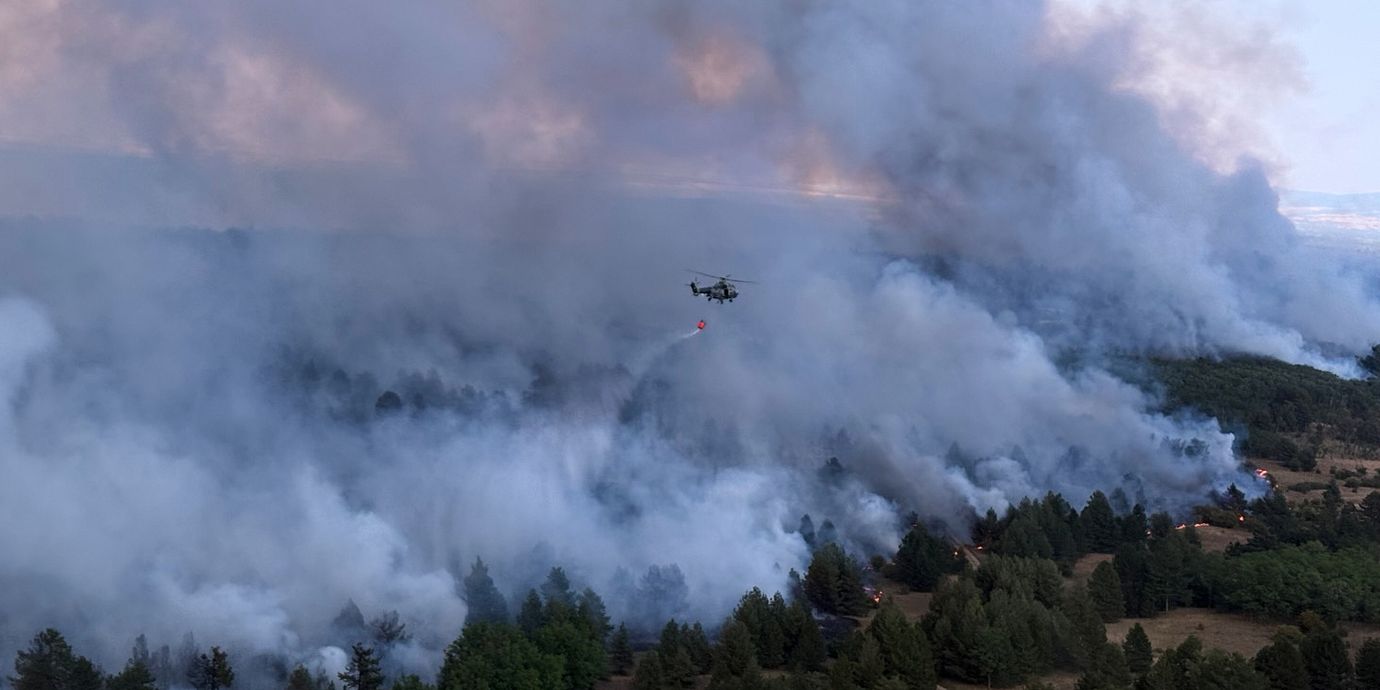
The heat also caused many forest fires across Europe.
Public discussion focused on climate change adaptation, net-zero emissions goals, and the role of air conditioning in Europe, where the technology is used much less than in China and the US.