PKK-grundare hoppas på ”ny politisk era” ett år efter historiska beskedet
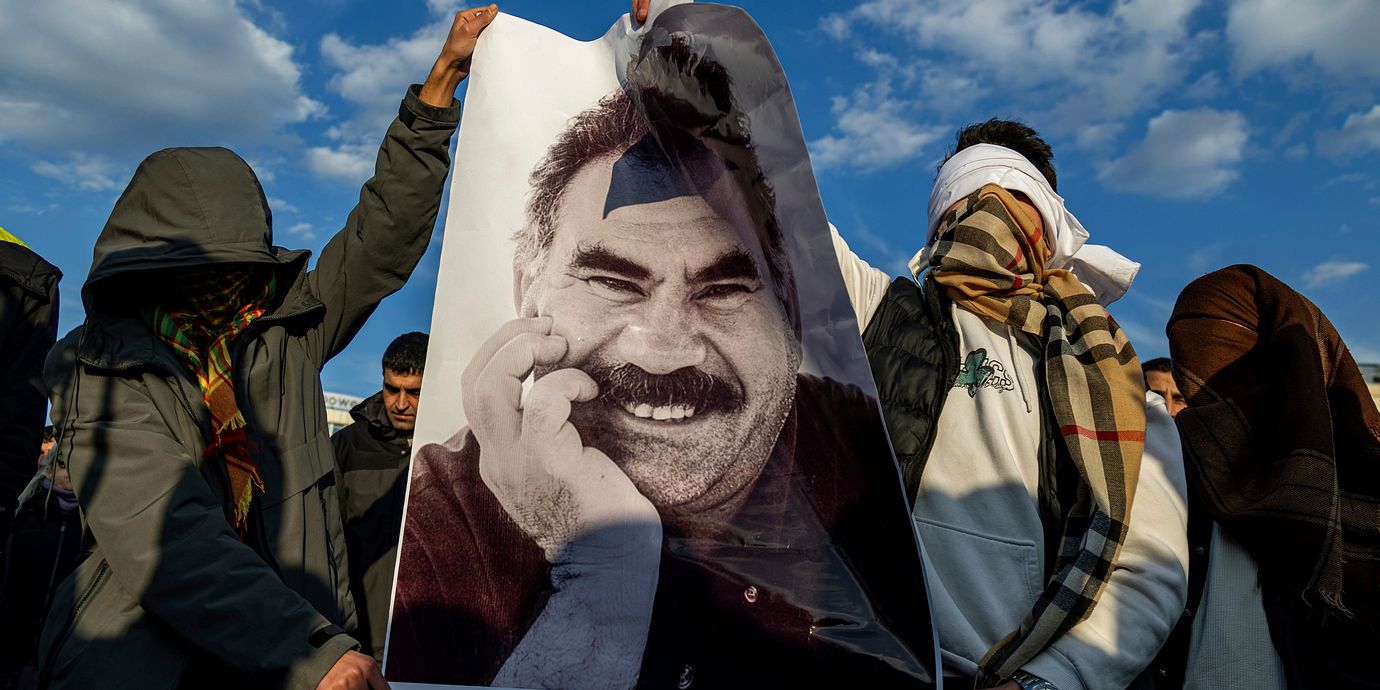
Den fängslade PKK‑grundaren Abdullah Öcalan säger att vägen är öppen för ”en ny politisk era”, ett år efter att han utropade slutet på den kurdiska rörelsens väpnade kamp mot Turkiet. Det skriver AFP.
Efter Öcalans uppmaning har Kurdistans arbetarparti, PKK, formellt upplösts. En tvärpolitisk kommission i Turkiets parlament har nyligen lagt fram ett förslag som ska bana väg för återintegrering av tidigare kurdiska stridande.
Om det röstas igenom kommer det att vara det första konkreta steget mot en försoning som tagits av Turkiet, enligt nyhetsbyrån.
Öcalan sitter isolerad på fängelseön Imrali sedan 1999, men utövar fortfarande ett omfattande inflytande.
bakgrund
Kurdistans arbetarparti (PKK)
Wikipedia (en)
The Kurdistan Workers' Party, or the PKK, is a Kurdish militant political organization and armed guerrilla group primarily based in the mountainous Kurdish-majority regions of southeastern Turkey, northern Iraq and north-eastern Syria. It was founded in Ziyaret, Lice, on 27 November 1978 and was involved in asymmetric warfare in the Kurdistan Workers' Party insurgency (with several ceasefires between 1993 and 2013–2015). Although the PKK initially sought an independent Kurdish state, in the 1990s, its official platform changed to seeking autonomy and increased political and cultural rights for Kurds within Turkey.
The PKK is designated as a terrorist organization by Turkey, the United States, the European Union, Australia, and Japan. Some analysts and organizations disagree with this designation, believing that the PKK no longer engages in organized terrorist activities or systemically targets civilians. Turkey has often characterized the demand for education in Kurdish as supporting terrorist activities by the PKK. Finland and Sweden's alleged support for the PKK is one of the points which caused Turkey to oppose Finland and Sweden's NATO accession bids.
The PKK's ideology was originally a fusion of revolutionary socialism and Marxism–Leninism with Kurdish nationalism, seeking the foundation of an independent Kurdistan. The PKK was formed as part of a growing discontent over the suppression of Turkey's Kurds, in an effort to establish linguistic, cultural, and political rights for the Kurdish minority. Following the military coup of 1980, the Kurdish language was officially prohibited in public and private life. Many who spoke, published, or sang in Kurdish were arrested and imprisoned. The Turkish government denied the existence of Kurds and the PKK was portrayed trying to convince Turks of being Kurds.
The PKK has been involved in armed clashes with Turkish security forces since 1979, but the full-scale insurgency did not begin until 15 August 1984, when the PKK announced a Kurdish uprising. Since the conflict began, more than 40,000 people have died, most of whom being Turkish Kurdish civilians. In 1999, PKK leader Abdullah Öcalan was captured and imprisoned. In May 2007, serving and former members of the PKK set up the Kurdistan Communities Union (KCK), an umbrella organisation of Kurdish organisations in Turkish, Iraqi, Iranian, and Syrian Kurdistan. In 2013, the PKK declared a ceasefire and began slowly withdrawing its fighters to Iraqi Kurdistan as part of a peace process with the Turkish state. The ceasefire broke down in July 2015. Both the PKK and the Turkish state have been accused of engaging in terror tactics and targeting civilians. The PKK has bombed city centres and recruited child soldiers, and conducted several attacks that massacred civilians. Turkey has depopulated and burned down thousands of Kurdish villages and massacred Kurdish civilians in an attempt to root out PKK militants.
On 1 March 2025, the PKK declared a ceasefire with Turkey, and on 12 May, announced plans for a total dissolution of the organisation.
Omni är politiskt obundna och oberoende. Vi strävar efter att ge fler perspektiv på nyheterna. Har du frågor eller synpunkter kring vår rapportering? Kontakta redaktionen