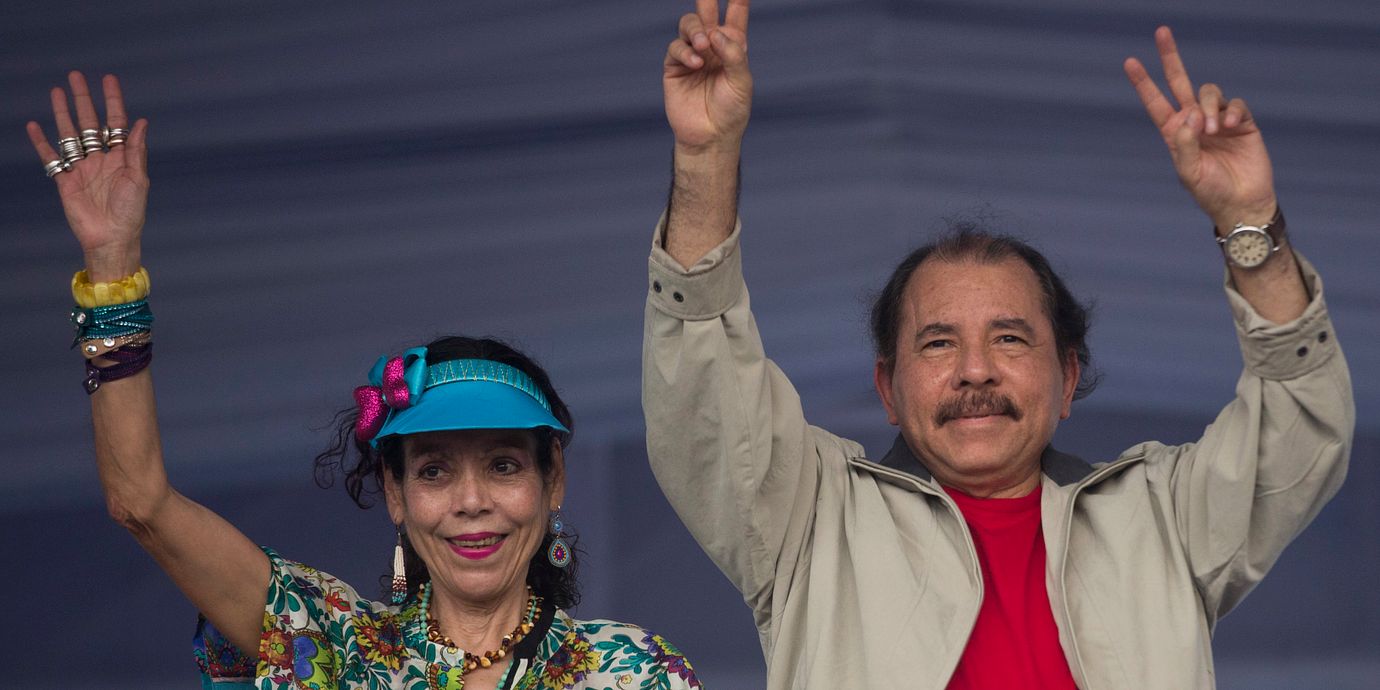
President vill ha sin fru som vicepresident
Nicaraguas president, den tidigare gerillaledaren Daniel Ortega, anklagas för nepotism efter att han utsett sin fru till sin vicepresidentkandidat inför valet i november. Ortega styrde landet under perioden 1979-1990 och återvände senast till makten 2006. I dag är hans hustru Rosario Murillo regeringens kommunikationschef.
bakgrund
Rosario Murillo
Wikipedia (en)
Rosario Murillo (Spanish pronunciation: [roˈsaɾjo muˈɾiʝo]; born June 22, 1951) is a Nicaraguan poet and revolutionary who fought in the Sandinista revolution in 1979. She is married to the current President Daniel Ortega and is the First Lady of Nicaragua, a title she also held in 1985 when her husband became President 6 years after the Sandinista National Liberation Front (FSLN) overthrew the Somoza dynasty. Murillo serves as the Nicaraguan government's lead spokeswoman, government minister, head of the Sandinista Association of Cultural Workers and Communications Coordinator of the Council on Communication and Citizenry. A polyglot, she speaks Spanish, English, Italian and French; she also has the ability to read German.
bakgrund
Daniel Ortega
Wikipedia (en)
José Daniel Ortega Saavedra (Spanish pronunciation: [daˈnjel oɾˈteɣa]; born November 11, 1945) is a Nicaraguan politician who has been President of Nicaragua since 2007; previously he was leader of Nicaragua from 1979 to 1990, first as Coordinator of the Junta of National Reconstruction (1979–1985) and then as President (1985–1990). A leader in the socialist Sandinista National Liberation Front (Frente Sandinista de Liberación Nacional, FSLN), his policies in government have seen the implementation of leftist reforms across Nicaragua.
Born into a working-class family, from an early age Ortega opposed ruling President Anastasio Somoza Debayle, widely recognized as a dictator, and became involved in the underground movement against his regime. Joining the Sandinistas, he also travelled to Cuba to receive training in guerilla warfare from Fidel Castro's Marxist-Leninist government. After the Nicaraguan Revolution resulted in the overthrow and exile of Somoza's government, Ortega became leader of the ruling multipartisan Junta of National Reconstruction. A Marxist-Leninist, his first period in office was characterized by a controversial program of nationalization, land reform, wealth redistribution and literacy programs.
Ortega's relationship with the United States was never very cordial, due to U.S. support for Somoza prior to the revolution. Although the U.S. supplied post-revolution Nicaragua with tens of millions of dollars in economic aid, relations broke down when the Sandinistas supplied weapons to leftist El Salvadoran rebels (something which Ortega later admitted occurred). His government was opposed by the Contras in a vicious civil war; the Contras were funded by the Reagan administration of the United States. A joint peace proposal by the Democratic Speaker of the House Jim Wright and Ronald Reagan helped precipitate a peace agreement at a meeting of five Central American chiefs of state in July 1987, which won Costa Rican President Oscar Arias the Nobel Peace Prize. This led to free elections in which Ortega was defeated by Violeta Chamorro in the 1990 presidential election, but he remained an important figure in Nicaraguan opposition politics, gradually moderating in his political position from Marxism–Leninism to democratic socialism.
Ortega was an unsuccessful candidate for president in 1996 and 2001, before winning the 2006 presidential election. In office, he made alliances with fellow Latin American socialists, such as Venezuelan President Hugo Chávez, and under his leadership, Nicaragua joined the Bolivarian Alliance for the Americas.
Omni är politiskt obundna och oberoende. Vi strävar efter att ge fler perspektiv på nyheterna. Har du frågor eller synpunkter kring vår rapportering? Kontakta redaktionen