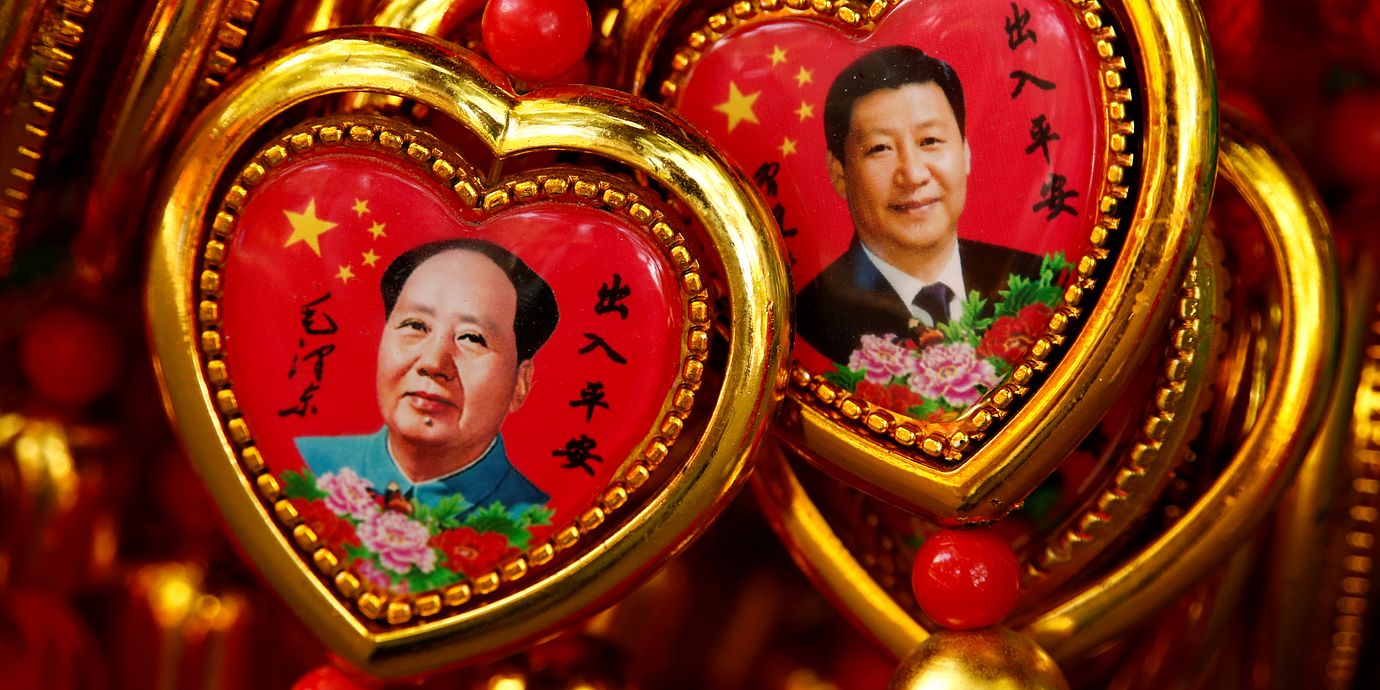
”Xi Jinpings dubbla agenda underminerar ekonomin”
När Kinas president Xi Jinping tog över lovade han att fortsätta på den inslagna vägen med reformer. Då verkade han uppriktig – men nu underminerar han i stället landets ekonomiska utveckling, skriver Wall Street Journals Joshua Eisenman i en analys. ”Herr Xis reformer har fastnat i ett moras av byråkratiska hinder och avsiktligt fördröjande från officiellt håll”.
Problemet, enligt Eisenman, är att Xi Jinpings agenda är motsägelsefull, eftersom den både ropar efter reformer, men samtidigt kräver strikt partilydnad.
”Det här receptet, som kan kallas reform utan att öppenhet, har misslyckats med att ge resultat”, skriver Joshua Eisenman.
bakgrund
Xi Jinping
Wikipedia (en)
Xi Jinping (pronounced [ɕǐ tɕînpʰǐŋ], simplified Chinese: 习近平; traditional Chinese: 習近平; Pinyin: Xí Jìnpíng; born 15 June 1953) is the General Secretary of the Communist Party of China, the President of the People's Republic of China, and the Chairman of the Central Military Commission. As Xi holds the top offices of the party and the military, in addition to being the head of state through the office of the president, Xi is sometimes referred to as China's "Paramount Leader". As the general secretary (de facto leader), Xi is also an ex-officio member of the Politburo Standing Committee, China's top decision-making body.
The son of Communist veteran Xi Zhongxun, Xi Jinping rose through the ranks politically in China's coastal provinces. Xi served as the Governor of Fujian, from 1999 to 2002, and then as the Governor and the Party Committee Secretary of the neighboring Zhejiang, from 2002 to 2007. Following the dismissal of Chen Liangyu, Xi transferred to Shanghai as the Party Secretary for a brief period in 2007. Xi joined the Politburo standing committee and central secretariat in October 2007, and was Hu Jintao's successor. Xi served as vice-president from 2008 to 2013 and Vice Chairman of the Central Military Commission from 2010 to 2012.
Xi has attempted to legitimize the authority of the Communist Party, by introducing far-ranging measures to enforce party discipline and to ensure internal unity, as well as initiating an unprecedented and far-reaching campaign against corruption. Xi's anti-corruption campaign has led to high-profile arrests such as General Xu Caihou and Zhou Yongkang. Xi has also imposed further restrictions over ideological discourse, advocating the concept of "internet sovereignty".
Considered the central figure of the People's Republic's fifth generation of leadership, Xi has significantly centralized institutional power by taking on a wide range of leadership positions, including chairing the newly formed National Security Commission, as well as new steering committees on economic and social reforms, military reform, and the Internet. Xi has called for further market economic reforms, for governing according to the law and for strengthening legal institutions, with an emphasis on individual and national aspirations under the neologism "Chinese Dream". Xi has also championed a more assertive foreign policy, particularly in relation to Sino-Japanese relations, China's claims to the bulk of the South China Sea Islands, involvement in Asian regional affairs, and initiatives related to energy and natural resources.
bakgrund
Kinas ekonomi
Wikipedia (en)
China's socialist market economy is the world's second largest economy by nominal GDP, and the world's largest economy by purchasing power parity according to the IMF, although China's National Bureau of Statistics rejects this claim. Until 2015 China was the world's fastest-growing major economy, with growth rates averaging 10% over 30 years. Due to historical and political facts of China's developing economy, China's public sector accounts for a bigger share of the national economy than the burgeoning private sector.
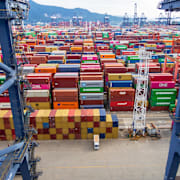
China is a global hub for manufacturing, and is the largest manufacturing economy in the world as well as the largest exporter of goods in the world. China is also the world's fastest growing consumer market and second largest importer of goods in the world. China is a net importer of services products.
China is the largest trading nation in the world and plays the most important role in international trade, and has increasingly engaged in trade organizations and treaties in recent years. China became a member of the World Trade Organization in 2001. China also has free trade agreements with several nations, including Australia, South Korea, ASEAN, New Zealand, Switzerland and Pakistan.
On a per capita income basis, China ranked 72nd by nominal GDP and 84th by GDP (PPP) in 2015, according to the International Monetary Fund (IMF). The provinces in the coastal regions of China tend to be more industrialized, while regions in the hinterland are less developed. As China's economic importance has grown, so has attention to the structure and health of the economy.
To avoid the long-term socioeconomic cost of environmental pollution in China, it has been suggested by Nicholas Stern and Fergus Green of the Grantham Research Institute on Climate Change and the Environment that the economy of China be shifted to more advanced industrial development with high-tech, low carbon emissions with better allocation of national resources to innovation and R&D for sustainable economic growth in order to reduce the impact of China's heavy industry. This is in accord with the planning goals of the central government.
Xi Jinping’s Chinese Dream is described as achieving the "Two 100s": the material goal of China becoming a "moderately well-off society" by 2021, the 100th anniversary of the Chinese Communist Party, and the modernization goal of China becoming a fully developed nation by 2049, the 100th anniversary of the founding of the People's Republic.
The internationalization of the Chinese economy continues to affect the standardized economic forecast officially launched in China by the Purchasing Managers Index in 2005. At the start of the 2010s, China became the sole Asian nation to have a GDP (PPP) above the $10-trillion mark (along with the United States and the European Union). As China's economy grows, so does China's Renminbi, which undergoes the process needed for its internationalization. China initiated the founding of the Asian Infrastructure Investment Bank in 2015.
China has been criticized by Western media for unfair trade practices, including artificial currency devaluation, intellectual property theft, protectionism, and local favoritism due to one-party oligopoly by the Communist Party of China and its socialist market economy.
The rate of economic growth of the Chinese economy has started slowing with fears of an impending hard landing of the economy. The slowdown manifested in industrial regions as excess capacity in basic industries such as coal, steel, and cement, in the auto industry as reduced sales.
Omni är politiskt obundna och oberoende. Vi strävar efter att ge fler perspektiv på nyheterna. Har du frågor eller synpunkter kring vår rapportering? Kontakta redaktionen