Xi kopplar greppet om Kina – nämns i konstitution
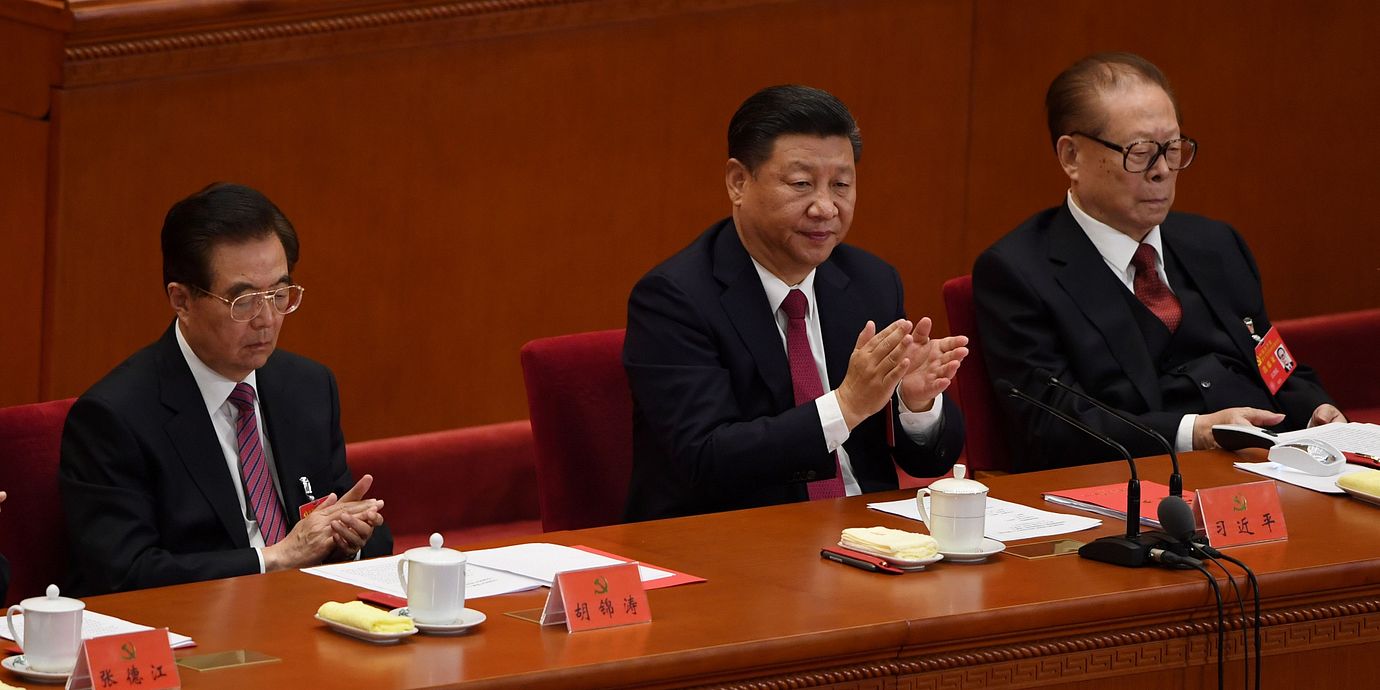
Kommunistpartiets kongress lägger till president Xi Jinpings namn till sin konstitution. Därmed upphöjs han till samma status som kommunistdiktaturens grundare Mao Zedong, skriver flera medier.
Xi är den ende förutom Zedong som lagts till i konstitutionen under sin levnad. Reformisten Deng Xiaoping lades till efter sin död.
Tillägget i lagtexten syftar på att Xis ledarideologi. Han har valt att styra varje aspekt av landet, till exempel vad medborgarna skriver på sociala medier.
– Vi måste arbeta outtröttligt och ihärdigt för att förnya den kinesiska nationen, sa Xi i sitt avslutningsanförande på kongressen.
bakgrund
Xi Jinping
Wikipedia (en)
Xi Jinping (born 15 June 1953), also known as Chairman Xi or Uncle Xi, is a Chinese politician. He is the current General Secretary of the Communist Party of China, President of the People's Republic of China, and Chairman of the Central Military Commission. As Xi holds the top offices of the party and the military, in addition to being the head of state through the office of the president, he is sometimes referred to as China's "Paramount leader" and recognized by the party as its leadership "core". As General Secretary, Xi holds an ex-officio seat on the Politburo Standing Committee of the Communist Party of China, China's top decision-making body.
The son of Chinese Communist veteran Xi Zhongxun, Xi Jinping rose through the ranks politically in China's coastal provinces. Xi was governor of Fujian from 1999 to 2002, and governor, then party secretary of neighboring Zhejiang province from 2002 to 2007. Following the dismissal of Chen Liangyu, Xi was transferred to Shanghai as party secretary for a brief period in 2007. Xi joined the Politburo Standing Committee and central secretariat in October 2007, spending the next five years as Hu Jintao's presumed successor. Xi was vice-president from 2008 to 2013 and Vice Chairman of the Central Military Commission from 2010 to 2012.
Since assuming power, Xi has attempted to legitimize the authority of the Communist Party by introducing far-ranging measures to enforce party discipline and to ensure internal unity. He initiated an unprecedented and far-reaching campaign against corruption, leading to the downfall of prominent incumbent and retired officials. Xi has also imposed further restrictions over civil society and ideological discourse, advocating the concept of "internet sovereignty", the idea that each country has the right to control its domestic internet space via censorship.
Considered the central figure of the People's Republic's fifth generation of leadership, Xi has significantly centralized institutional power by taking on a wide range of leadership positions, including chairing the newly formed National Security Commission, as well as new steering committees on economic and social reforms, military reform, and the Internet. Xi has called for further market economic reforms, for governing according to the law and for strengthening legal institutions, with an emphasis on individual and national aspirations under the neologism "Chinese Dream". Xi has also championed a more assertive foreign policy, particularly with regard to China–Japan relations, China's claims in the South China Sea, and its role as a leading advocate of free trade and globalization. He has also sought to expand China's regional influence through the Belt and Road Initiative, played a leading role in the fight against climate change, and invested heavily in energy and natural resources. In late 2017, he was labeled by The Economist as “The world’s most powerful man”.
Omni är politiskt obundna och oberoende. Vi strävar efter att ge fler perspektiv på nyheterna. Har du frågor eller synpunkter kring vår rapportering? Kontakta redaktionen