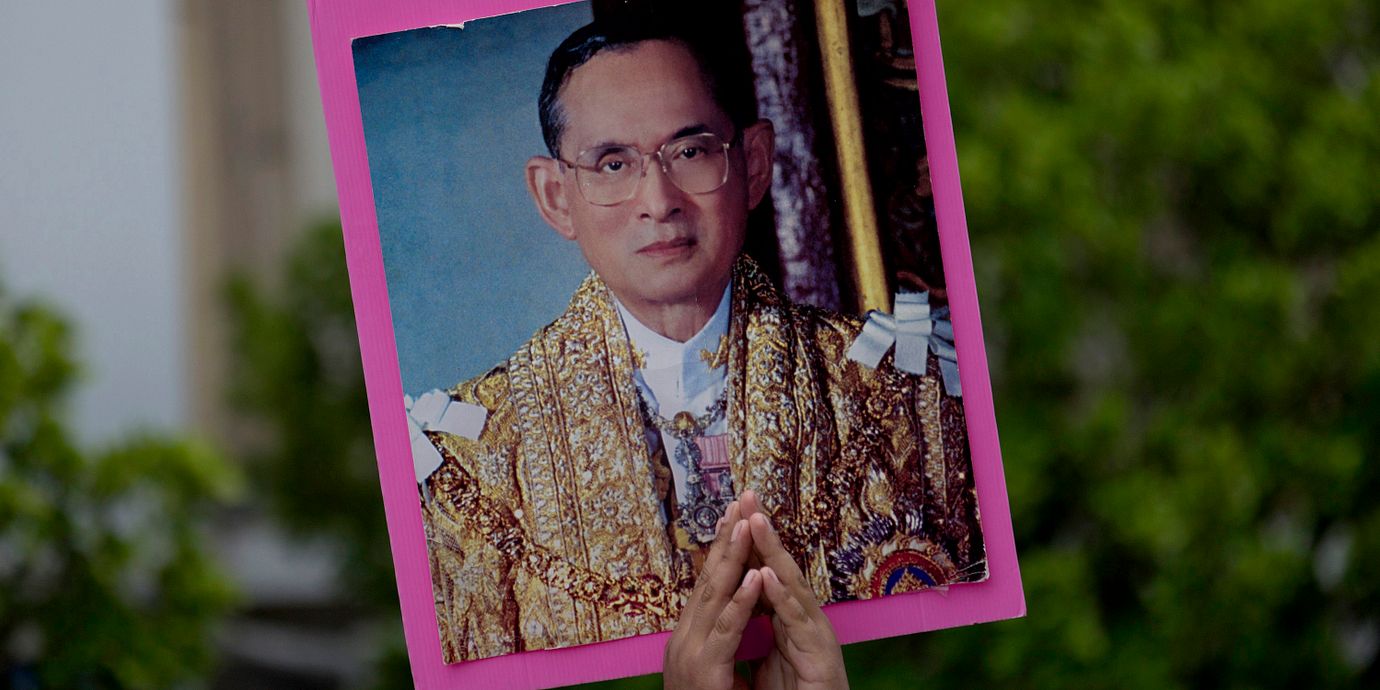
Klottrade om kungen på två toaletter – döms igen
En 68-årig thailändsk man döms till 18 månaders fängelse för att ha klottrat kritik mot monarkin och landets styrande militärjunta, rapporterar TT. Domen kommer medan han redan avtjänar ett exakt likadant straff.
– Utredarna delade upp hans fall i två eftersom han skrev på två separata toalettdörrar, säger mannens advokat.
bakgrund
Lagen som förbjuder kränkning av kungafamiljen eller staten
Wikipedia (en)
Lèse majesté is the crime of violating majesty, an offence against the dignity of a reigning sovereign or against a state. It has been prohibited by the law of Thailand since 1908. In 1932, when Thailand's monarchy ceased to be absolute and a constitution was adopted, it too included language prohibiting lèse-majesté. The 2007 constitution of Thailand, and all seventeen versions since 1932, contain the clause, "The king shall be enthroned in a position of revered worship and shall not be violated. No person shall expose the king to any sort of accusation or action." The Thai Criminal Code elaborates in section 112: "Whoever defames, insults or threatens the king, queen, heir-apparent, or regent shall be punished with imprisonment of three to fifteen years." Missing from the code, however, is a definition of what actions constitute "defamation" or "insult".
As mentioned in the criminal code, lèse majesté only applies to criticism of the king, queen, crown prince, and regent. Tanin Kraivixien, a former Supreme Court justice, reinterpreted this as a blanket ban against criticism of royal development projects, the royal institution, the Chakri Dynasty, or any Thai king. The reinterpretation has stood to the present day. In addition, the Supreme Court of Justice of Thailand decided in 2013 that the term "king" in section 112 of the Criminal Code also applies to previous or deceased monarchs, not only the reigning one. This decision has led to many lèse majesté cases based upon past monarchs. One of the notable cases is the 2014 charge against prominent scholar Sulak Sivaraksa who, during an academic forum, raised doubts about an elephant battle between Ayutthayan King Naresuan and Burmese Prince Mingyi Swa that took place 400 years ago. Another notable case is that against Michael Wright, a deceased British historian who doubted the genuineness of the Ramkhamhaeng Inscription, allegedly created by King Ramkhamhaeng about 800 years ago.
From 1990 to 2005, the Thai court system only saw four or five lèse majesté cases a year. From January 2006 to May 2011, however, more than 400 cases came to trial, an estimated 1,500 percent increase. For example, there were 478 cases in 2010 alone. Observers attribute the increase to King Bhumibol's public invitation of criticism in 2005, increased polarization following the 2006 military coup and speculation over Bhumibol's declining health. Jail terms for Thai citizens committing lèse majesté are usually harsher than for foreigners.
Cases are often filed by state authorities or by individuals, and anyone may take action against anyone else. In one notable incident during the 2005–2006 political crisis, deposed Prime Minister Thaksin Shinawatra and his political opponent Sondhi Limthongkul filed charges of lèse majesté against each other. Thaksin's alleged lèse majesté was one of the stated reasons for the Thai military's 2006 coup.
Since the military coup of May 2014, the junta has brought 53 lèse majesté cases, 40 for comments posted or shared online. Military courts have routinely imposed harsher sentences than did the civilian courts. In August 2015, the Bangkok Military Court sentenced Pongsak Sriboonpeng to 60 years in prison for his six alleged lèse majesté Facebook postings (later reduced to 30 years when he pleaded guilty). It was Thailand’s longest recorded sentence for lèse majesté.
Omni är politiskt obundna och oberoende. Vi strävar efter att ge fler perspektiv på nyheterna. Har du frågor eller synpunkter kring vår rapportering? Kontakta redaktionen