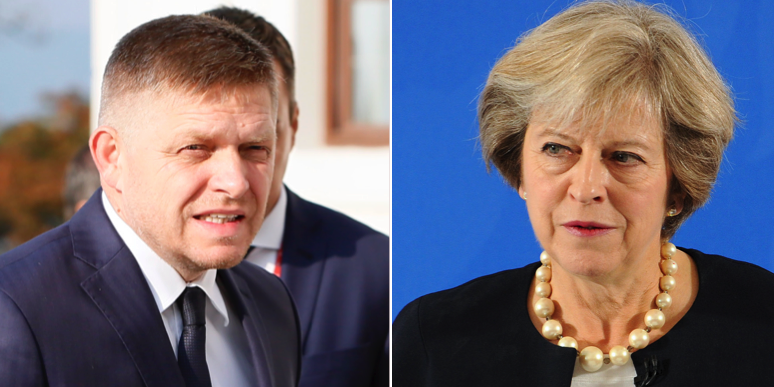
EU-länder vill blocka hot mot fri rörlighet
Slovakien, Ungern, Tjeckien och Polen skulle inte tveka om att lägga fram ett veto för att blockera en brexituppgörelse mellan Storbritannien och EU om det skulle hota den fria rörligheten för arbetskraft, skriver The Guardian. Slovakiens premiärminister Robert Fico uppger att de fyra länderna – som utgör Visegrádgruppen eller V4-länderna – vill försvara sina medborgares rätt till att fortsatt arbeta och bo i Storbritannien på lika villkor.
– V4-länderna kommer att vara kompromisslösa, säger han enligt tidningen.
bakgrund
Brexit
Wikipedia (en)
The United Kingdom (UK) intends to withdraw from the European Union (EU), a process commonly known as Brexit, as a result of a June 2016 referendum in which 51.9% voted to leave the EU. The separation process is complex, causing political and economic changes for the UK and other countries. As of September 2016, neither the timetable nor the terms for withdrawal have been established: in the meantime, the UK remains a full member of the European Union. The term "Brexit" is a portmanteau of the words "British" and "exit".
The possibility of withdrawal from the European Union has existed under Article 50 of the Treaty on European Union of EU member states since 2007. Article 50 which governs the withdrawal, however, has never been used before. The withdrawal must be in accordance with the Member State's constitutional requirements and uncertainty exists as to the constitutional requirements in the UK. Unless extensions are agreed to unanimously by the Council of Europe, the timing for leaving under the article is two years from when the UK gives official notice, but this official notice was not given immediately following the referendum in June 2016. The assumption is that during the two-year window new agreements will be negotiated, but there is no requirement that there be new agreements. Some aspects, such as trade agreements, may be made difficult to negotiate by the EU until after Britain has formally left the EU.
Withdrawal has been the goal of various individuals, advocacy groups, and political parties since the UK joined the European Economic Community (EEC), the predecessor of the EU, in 1973, though continued membership of the EEC and the Common Market was approved in a 1975 referendum by 67.2% of votes.
bakgrund
Visegrádgruppen
Wikipedia (en)
The Visegrad Group, also called the Visegrad Four, or V4 is an alliance of four Central European states – Czech Republic, Hungary, Poland and Slovakia – for the purposes of furthering their European integration, as well as for advancing military, economic and energy cooperation with one another. The group used to be occasionally referred to as the Visegrád Triangle, due to the fact that it was originally an alliance of three states – the term has not been valid since 1993, but does continue to appear sometimes.
The Group traces its origins to the summit meeting of leaders from Czechoslovakia, Hungary and Poland held in the Hungarian castle town of Visegrád on 15 February 1991 (not to be confused with Vyšehrad, a castle in Prague, or with the town of Višegrad in Bosnia and Herzegovina). After the dissolution of Czechoslovakia in 1993, the Czech Republic and Slovakia became independent members of the group, thus increasing the total number of members to four. All four members of the Visegrád Group joined the European Union on 1 May 2004.
The Group's name in the languages of the four countries is Visegrádská čtyřka or Visegrádská skupina (Czech); Visegrádi Együttműködés or Visegrádi négyek (Hungarian); Grupa Wyszehradzka (Polish); and Vyšehradská skupina or Vyšehradská štvorka (Slovak).
Omni är politiskt obundna och oberoende. Vi strävar efter att ge fler perspektiv på nyheterna. Har du frågor eller synpunkter kring vår rapportering? Kontakta redaktionen