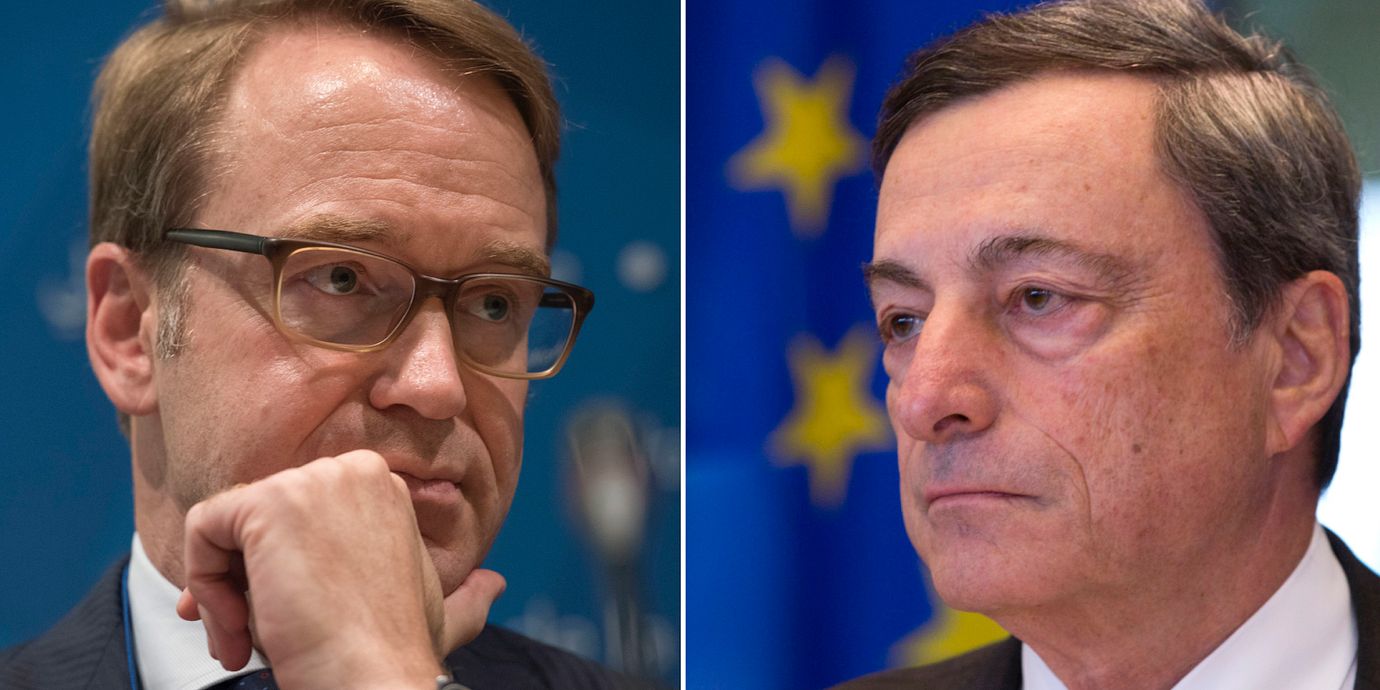
Bundesbanks chef Jens Weidmann, ECB-chefen Mario Draghi (arkivbilder). (TT)

Bundesbank: ECB får inte sitta i famnen på politiker

Europeiska centralbanken ECB måste hålla kvar blicken på målet att uppnå prisstabilitet och inte låta sig förföras av politik. Det menar den tyska centralbanken Bundesbanks chef Jens Weidmann. I ett tal i Frankfurt pekade Weidmann, som tidigare kritiserat ECB:s stödköpsprogram, på att den expansiva penningpolitiken inte kan pågå hur länge som helst.

– Vi får inte låta folk tro att centralbankerna kommer att göra vad som helst för politikerna eller att penningpolitiken styrs av valresultat, sa han, men efterlyste samtidigt fler politiska åtgärder för att tackla tillväxtproblemen.

Uttalandet kommer bara veckan efter att ECB-chefen Mario Draghi meddelat att man förlänger sitt stödköpsprogram med nästan ett år, samtidigt som man bantar ner programmet något.
bakgrund
 
Bundesbank
Wikipedia (en)
The German Federal Bank known in German as the Deutsche Bundesbank (pronounced [ˈdɔʏtʃə ˈbʊndəsˌbaŋk]; is the central bank of the Federal Republic of Germany and as such part of the European System of Central Banks (ESCB). Due to its strength and former size, the Bundesbank is the most influential member of the ESCB. Both the German Federal Bank and the European Central Bank (ECB) are located in Frankfurt, Germany. It is sometimes referred to as "Buba" for Bundesbank, while its official abbreviation is BBk. The Bundesbank was established in 1957 and succeeded the Bank deutscher Länder, which introduced the Deutsche Mark on 20 June 1948. Until the euro was physically introduced in 2002, the German Federal Bank was the central bank of the former Deutsche Mark ("German Mark", sometimes known in English as the "Deutschmark"). The German Federal Bank was the first central bank to be given full independence, leading this form of central bank to be referred to as the Bundesbank model, as opposed, for instance, to the New Zealand model, which has a goal (i.e. inflation target) set by the government. Nowadays, the ECB also uses the Bundesbank model, making the concept the foundation of the entire Euro system. The Bundesbank was greatly respected for its control of inflation through the second half of the 20th century. This made the German Mark one of the most respected currencies, and the Bundesbank gained substantial indirect influence in many European countries.
Omni är politiskt obundna och oberoende. Vi strävar efter att ge fler perspektiv på nyheterna. Har du frågor eller synpunkter kring vår rapportering? Kontakta redaktionen