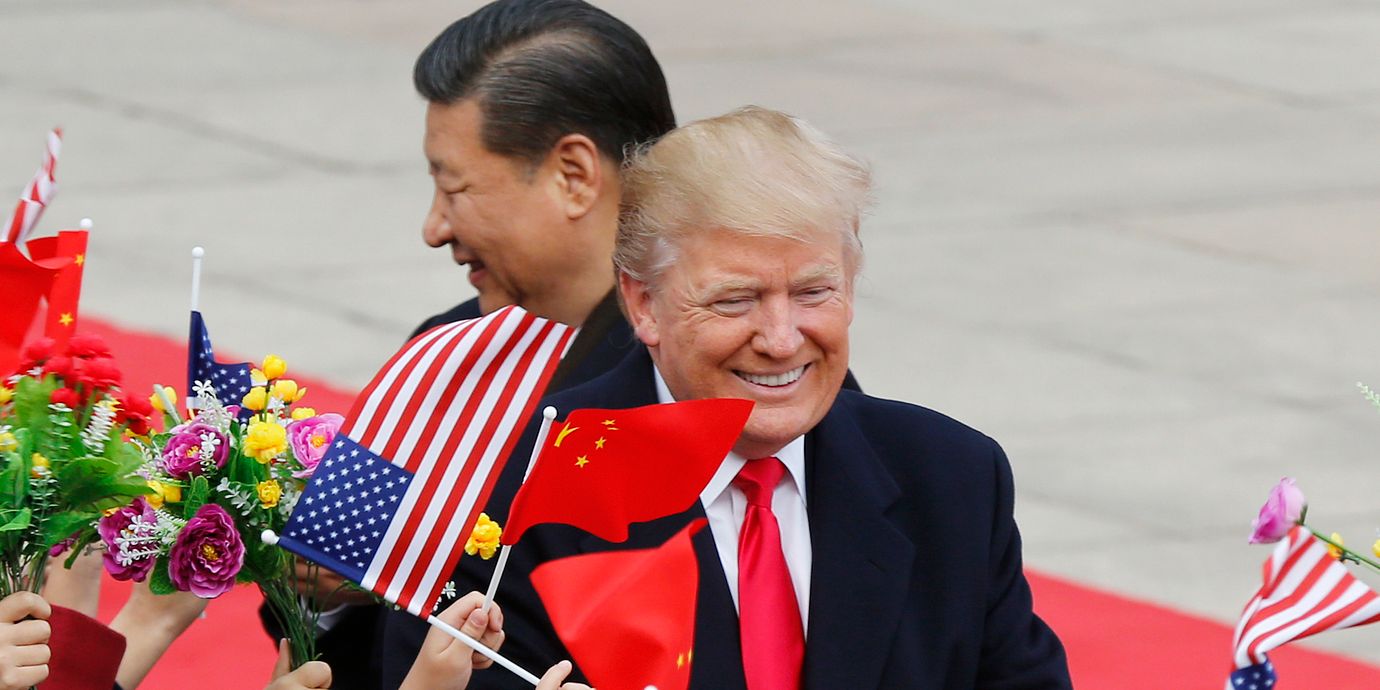
Arkivbild: Kinas president Xi Jinping tillsammans med USA:s Donald Trump i samband med Trumps besök i Peking i november i fjol. (Andy Wong / TT / NTB Scanpix)

Källa: Peking tvivlade på att Trump menade allvar

När USA:s president Donald Trump initialt aviserade att USA skulle införa importtullar mot Kina trodde de allra flesta inom den kinesiska regimen att det hela skulle utspela sig enligt devisen ”tomma tunnor skramlar mest”. Det säger en anonym kinesisk ekonom nära Peking till Financial Times. Så verkar det däremot inte bli.

– Trump har överraskat alla, säger ekonomen till tidningen.

Tullarna sägs nu ha fått det styrande kommunistpartiet att på allvar börja räkna på den ekonomiska påverkan. Hittills har Kina infört hämndtullar mot USA varje gång Trump presenterat nya tariffer, men enligt statsvetaren Yanmei Xie överväger Peking nu att dämpa sitt svar på Trumps upptrappningar.

– Peking lägger mindre betoning på ”hämnd i motsvarande intensitet och skala”, eftersom det är svårt att verkställa utan att acceptera smärta för den kinesiska ekonomin, säger Yanmei Xie.
bakgrund
 
Trump-administrationens tullpolitik
Wikipedia (en)
The Trump tariffs are a series of tariffs imposed during the presidency of Donald Trump. In January 2018, Trump imposed tariffs on solar panels and washing machines, and later the same year, he imposed tariffs on steel and aluminum. On June 1, 2018, the United States imposed a 25% tariff on imports of steel, and a 10% tariff on aluminum, on the European Union, Canada, and Mexico.The tariffs angered trading partners, who implemented retaliatory tariffs on U.S. goods. Canada imposed matching retaliatory tariffs on July 1, 2018. China accused the U.S. of starting a trade war and on July 6 implemented tariffs equivalent to the $34 billion tariff imposed on it by the U.S. India plans to recoup trade penalties of $241 million on $1.2 billion worth of Indian steel and aluminium. Other countries, such as Australia, are concerned of the consequences of a trade war.Morgan Stanley estimated that Trump's tariffs on steel, aluminum, washing machines, and solar panels, as of March 2018, covered 4.1% of U.S. imports. The tariffs measures were poorly received by the vast majority of economists; almost 80% of 60 economists surveyed by Reuters believed that tariffs on steel and aluminum imports would be a net harm to the U.S. economy, with the rest believing that the tariffs would have little or no effect; none of the economists surveyed believed that the tariffs would benefit the U.S. economy.In July 2018 the Trump administration announced it would use a Great Depression-era program, the Commodity Credit Corporation, to pay farmers up to $12 billion. This government assistance program aims to make up a shortfall as farmers lose sales abroad due to the trade war with China, the European Union and other states.
Omni är politiskt obundna och oberoende. Vi strävar efter att ge fler perspektiv på nyheterna. Har du frågor eller synpunkter kring vår rapportering? Kontakta redaktionen