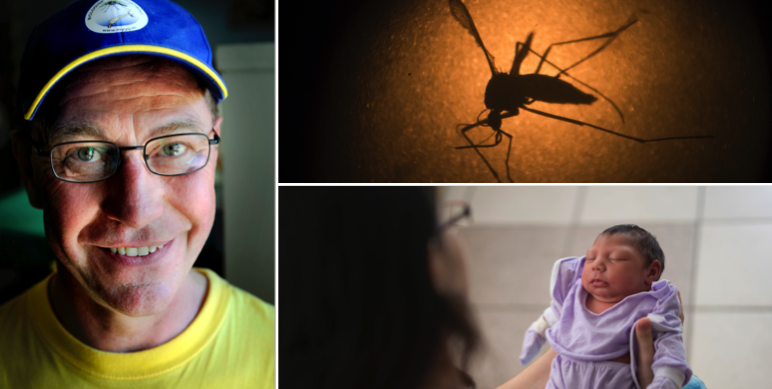
Svenske myggexperten: ”Tror jag kan göra skillnad”
Den svenske forskaren och myggexperten Jan Lundström har bjudits in att delta i ett möte i Brasilien som ska handla om hur spridningen av zikaviruset kan motverkas.
– Framför allt känns det ju fantastiskt om jag får möjlighet att göra en verklig insats och göra en skillnad. Och det tror jag att jag har möjlighet att göra, säger han till Expressen.
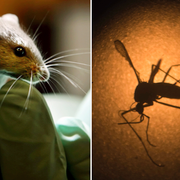
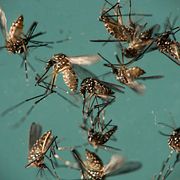
Lundström är insatt i en metod som går ut på att tusentals myggor föds upp och hanmyggen steriliseras. Hannarna släpps sedan ut i naturen där de utan framgång försöker föröka sig.
– Fördelen med den här metoden, jämfört med alla andra bekämpningsmetoder, är att kåta mygghannar hittar honorna. Det är svårt att komma åt den här myggan på något annat sätt.
bakgrund
Sterile insect technique
Wikipedia (en)
The sterile insect technique is a method of biological insect control, whereby overwhelming numbers of sterile insects are released into the wild. The released insects are normally male, as the females cause the damage usually by laying eggs in the crop, or, in the case of mosquitoes, taking blood from humans. The sterile males compete with wild males to mate with the females. Females that mate with a sterile male produce no offspring, thus reducing the next generation's population. Repeated release of sterile males can diminish small populations, although success with dense target populations have not been demonstrated.
The technique has successfully been used to eradicate the Screw-worm fly (Cochliomyia hominivorax) in areas of North America. Many successes controlled species of fruit flies, most particularly the Medfly (Ceratitis capitata) and the Mexican fruit fly (Anastrepha ludens).
Insects are mostly sterilized with radiation, which might weaken them if doses are not correctly applied, reducing their fitness. Other sterilization techniques are under development which would not affect fitness.
bakgrund
Zika virus
Wikipedia (en)
Zika virus (ZIKV) is a member of the virus family Flaviviridae and the genus Flavivirus, transmitted by daytime-active Aedes mosquitoes, such as A. aegypti. Its name comes from the Zika Forest of Uganda, where the virus was first isolated in 1947.
In humans, the virus causes a usually mild illness known as Zika fever, which since the 1950s has been known to occur within a narrow equatorial belt from Africa to Asia. In 2014, the virus spread eastward across the Pacific Ocean to French Polynesia, then to Easter Island and in 2015 to Mexico, Central America, the Caribbean, and South America, where the Zika outbreak has reached pandemic levels.
Zika virus is related to dengue, yellow fever, Japanese encephalitis, and West Nile viruses. The illness it causes is similar to a mild form of dengue fever, is treated by rest, and cannot yet be prevented by drugs or vaccines. There is a possible link between Zika fever and microcephaly in newborn babies by mother-to-child transmission, as well as a stronger one with neurologic conditions in infected adults, including cases of the Guillain–Barré syndrome.
In January 2016, the U.S. Centers for Disease Control and Prevention (CDC) issued travel guidance on affected countries, including the use of enhanced precautions, and guidelines for pregnant women including considering postponing travel. Other governments or health agencies soon issued similar travel warnings, while Colombia, the Dominican Republic, Ecuador, El Salvador, and Jamaica advised women to postpone getting pregnant until more is known about the risks. On February 2, 2016, Dallas County Health and Human Services confirmed the first case of transmission in the United States.
Omni är politiskt obundna och oberoende. Vi strävar efter att ge fler perspektiv på nyheterna. Har du frågor eller synpunkter kring vår rapportering? Kontakta redaktionen