”FN kommer uppmana världen att tillåta droger”
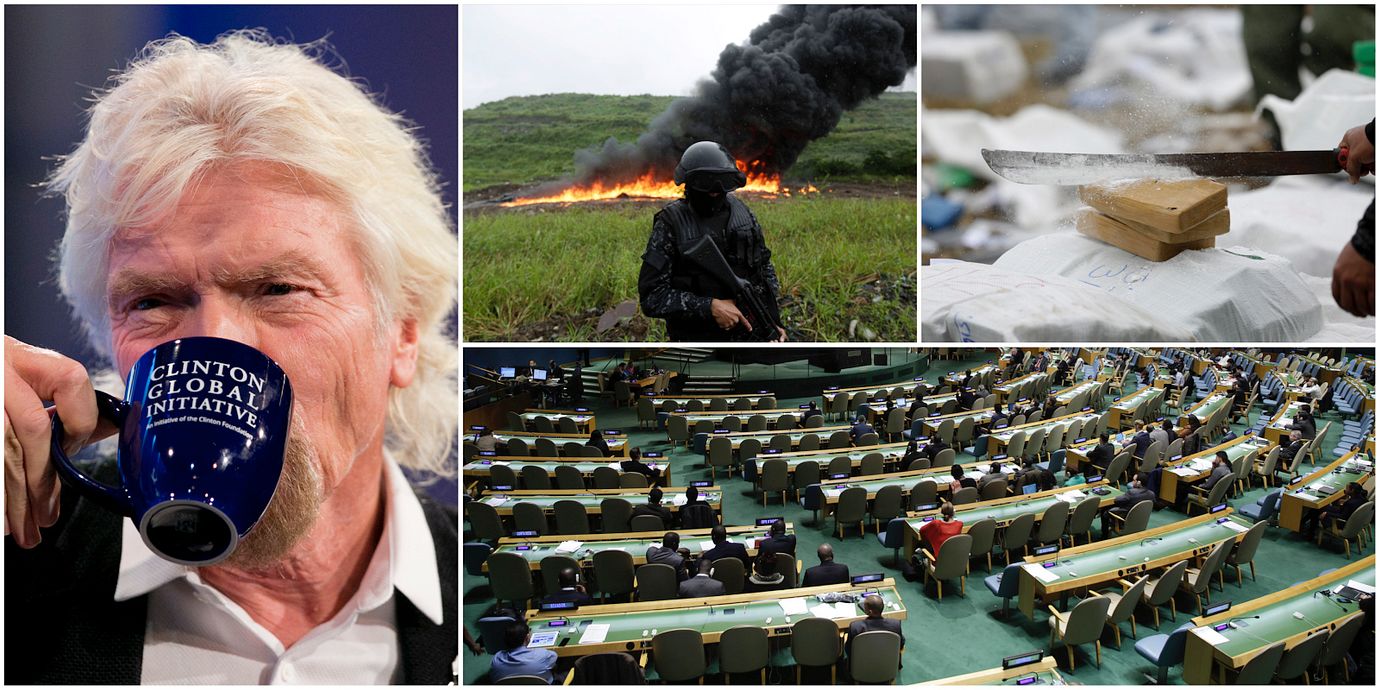
FN är i färd att uppmana alla världens regeringar att legalisera innehav och användande av alla droger i syfte att avsluta ”kriget mot knarket”. Det hävdar entreprenören Richard Branson i ett inlägg på sitt bolag Virgins sajt baserat på en FN-rapport som han säger sig ha tagit del av.
Uppmaningen, som skulle skulle innebära en dramatiskt svängning i FN:s syn på narkotikakontroll, ska ha skickats till mediebolag världen över men med restriktioner. Att Branson trots det redan nu offentliggör uppmaningen gör han för att FN inte ska backa, enligt The Independent.
bakgrund
War on Drugs
Wikipedia (en)
War on Drugs is an American term commonly applied to a campaign of prohibition of drugs, military aid, and military intervention, with the stated aim being to reduce the illegal drug trade. This initiative includes a set of drug policies that are intended to discourage the production, distribution, and consumption of psychoactive drugs that the participating governments and the UN have made illegal. The term was popularized by the media shortly after a press conference given on 18 June 1971, by United States President Richard Nixon—the day after publication of a special message from President Nixon to the Congress on Drug Abuse Prevention and Control—during which he declared drug abuse "public enemy number one". That message to the Congress included text about devoting more federal resources to the "prevention of new addicts, and the rehabilitation of those who are addicted", but that part did not receive the same public attention as the term "war on drugs". However, two years even prior to this, Nixon had formally declared a "war on drugs" that would be directed toward eradication, interdiction, and incarceration. Today, the Drug Policy Alliance, which advocates for an end to the War on Drugs, estimates that the United States spends $51 billion annually on these initiatives.
On 13 May 2009, Gil Kerlikowske—the Director of the Office of National Drug Control Policy (ONDCP)—signaled that the Obama administration did not plan to significantly alter drug enforcement policy, but also that the administration would not use the term "War on Drugs", because Kerlikowske considers the term to be "counter-productive". ONDCP's view is that "drug addiction is a disease that can be successfully prevented and treated... making drugs more available will make it harder to keep our communities healthy and safe". One of the alternatives that Kerlikowske has showcased is the drug policy of Sweden, which seeks to balance public health concerns with opposition to drug legalization. The prevalence rates for cocaine use in Sweden are barely one-fifth of those in Spain, the biggest consumer of the drug.
In June 2011, a self-appointed Global Commission on Drug Policy released a critical report on the War on Drugs, declaring: "The global war on drugs has failed, with devastating consequences for individuals and societies around the world. Fifty years after the initiation of the UN Single Convention on Narcotic Drugs, and years after President Nixon launched the US government's war on drugs, fundamental reforms in national and global drug control policies are urgently needed." The report was criticized by organizations that oppose a general legalization of drugs.
Omni är politiskt obundna och oberoende. Vi strävar efter att ge fler perspektiv på nyheterna. Har du frågor eller synpunkter kring vår rapportering? Kontakta redaktionen