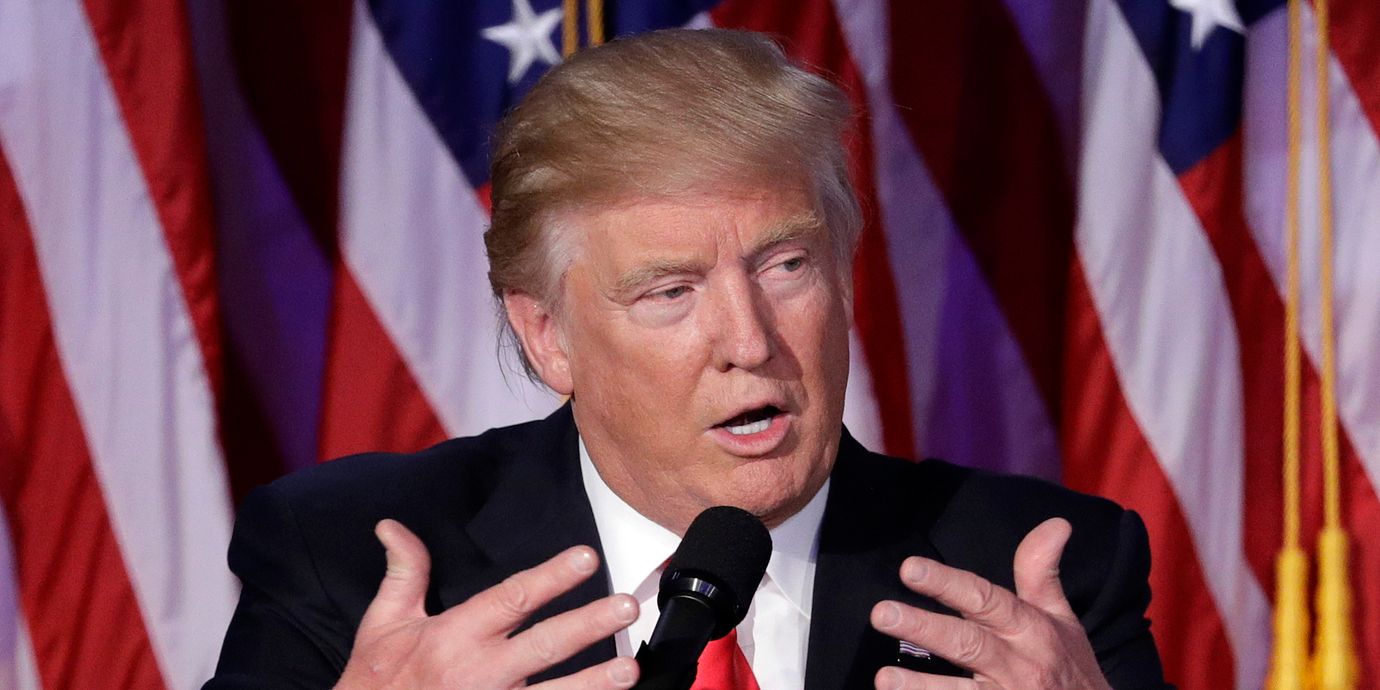
Donald Trump (arkivbild). (John Locher / TT / NTB Scanpix)

Analys: Trump kan vara det mirakel Opec behöver

Oljekartellen Opec kan mycket väl ha hittat en oväntad gynnare i USA:s tillträdande president Donald Trump, skriver Bloomberg Gadflys Julian Lee i en analys. Trumps vilja att riva upp diverse avtal med andra länder – däribland kärnvapenavtalet med Iran – kan resultera i att Iran tvingas minska sin oljeproduktion med omkring en miljon fat per dag, på grund av återinförda sanktioner. Som av en händelse är det ungefär den minskningen som Opec behöver för att stabilisera oljemarknaden, menar han.

Nackdelen, skriver Lee, hade varit att Iran i så fall säkerligen skulle ”göra livet svårare för amerikaner i Irak”, där trupper från USA backas upp av militär från Iran i kampen mot terrororganisationerna IS. Att bekämpa IS är ett annat av Trumps vallöften, konstaterar han. ”Men råoljepriserna skulle i alla fall återhämta sig, vilket vore jättebra för amerikansk olja. […] Jag antar att den nya presidenten måste välja vem han vill behaga”, skriver han.
bakgrund
 
Avtalet om Irans kärnprogram
Wikipedia (en)
The Joint Comprehensive Plan of Action (JCPOA) (Persian: برنامه جامع اقدام مشترک‎‎, acronym: برجام BARJAM), known commonly as the Iran deal or Iran nuclear deal, is an international agreement on the nuclear program of Iran reached in Vienna on 14 July 2015 between Iran, the P5+1 (the five permanent members of the United Nations Security Council—China, France, Russia, United Kingdom, United States—plus Germany), and the European Union. Formal negotiations toward the Joint Comprehensive Plan of Action on Iran's nuclear program began with the adoption of the Joint Plan of Action, an interim agreement signed between Iran and the P5+1 countries in November 2013. For the next twenty months, Iran and the P5+1 countries engaged in negotiations, and in April 2015 agreed on a Iran nuclear deal framework for the final agreement and in July 2015, Iran and the P5+1 agreed on the plan. Under the agreement, Iran agreed to eliminate its stockpile of medium-enriched uranium, cut its stockpile of low-enriched uranium by 98%, and reduce by about two-thirds the number of its gas centrifuges for 13 years. For the next 15 years, Iran will only enrich uranium up to 3.67%. Iran also agreed not to build any new heavy-water facilities for the same period of time. Uranium-enrichment activities will be limited to a single facility using first-generation centrifuges for 10 years. Other facilities will be converted to avoid proliferation risks. To monitor and verify Iran's compliance with the agreement, the International Atomic Energy Agency (IAEA) will have regular access to all Iranian nuclear facilities. The agreement provides that in return for verifiably abiding by its commitments, Iran will receive relief from U.S., European Union, and United Nations Security Council nuclear-related economic sanctions.
Omni är politiskt obundna och oberoende. Vi strävar efter att ge fler perspektiv på nyheterna. Har du frågor eller synpunkter kring vår rapportering? Kontakta redaktionen