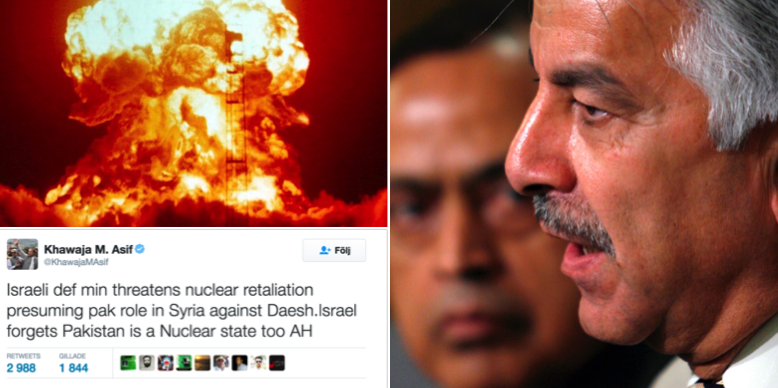
Fejknyhet fick Pakistan att hota Israel med kärnvapen
En fejkad nyhet fick i helgen storpolitiskt gensvar. Pakistans försvarsminister Khawaja Mohammad Asif läste en falsk nyhet om att Israel hotat ”förstöra Pakistan med en kärnvapenattack” om landet skulle skicka soldater till Syrien. Det gjorde att ministern på Twitter skrev: ”Israel glömmer att Pakistan också är en kärnvapenmakt”.
Israels försvarsdepartement har i en tweet svarat att nyheten som Khawaja Mohammad Asif tolkat som sann i själva verket är helt falsk.
Pakistan är ett av åtta länder i världen som har kärnvapen och det finns misstankar om att Israel har det.
bakgrund
Frågan om Israels kärnvapen
Wikipedia (en)
Israel is widely believed to possess nuclear weapons and to be the sixth country in the world to have developed them, allegedly having built its first nuclear weapon in December 1966 with the help of France. It is one of four nuclear-armed countries not recognized as a Nuclear Weapons State by the Nuclear Non-Proliferation Treaty (NPT), the others being India, Pakistan and North Korea. Israel maintains a policy known as "nuclear ambiguity" (also known as "nuclear opacity"). Israel has never officially admitted to having nuclear weapons, instead repeating over the years that it would not be the first country to "introduce" nuclear weapons to the Middle East, leaving ambiguity as to whether it means it will not create, will not disclose, will not make first use of the weapons or possibly some other interpretation of the phrase. The "not be the first" formulation goes back to the Eshkol-Comer (sic) memorandum of understanding made between Israel and the United States on March 10, 1965, which contained Israel's written assurance for the first time that it would not be the first to introduce nuclear weapons in the Middle East. Israel has refused to sign the NPT despite international pressure to do so, and has stated that signing the NPT would be contrary to its national security interests.
Additionally, Israel has made extensive efforts to deny other regional actors the ability to acquire their own nuclear weapons. The counter-proliferation, preventive strike Begin Doctrine added another dimension to Israel's existing nuclear policy. Israel remains the only country in the Middle East believed to possess them.
Israel started investigating the nuclear field soon after its founding in 1948 and with French support secretly began building the Negev Nuclear Research Center, a facility near Dimona housing a nuclear reactor and reprocessing plant in the late 1950s. Israel is alleged to have built its first nuclear weapon in December 1966, but it is not publicly confirmed. In 1986, Mordechai Vanunu, a former Israeli nuclear technician, provided explicit details and photographs to the Sunday Times of a nuclear weapons program in which he had been employed for nine years, "including equipment for extracting radioactive material for arms production and laboratory models of thermonuclear devices." In 1987, an unclassified US DoD report (released in February 2015 in response to a FOIA request) stated that "As far as nuclear technology is concerned, the Israelis are roughly where the U.S. [w]as in the fission weapon field in about 1955 to 1960. It should be noted that the Israelis are developing the kind of codes which will enable them to make hydrogen bombs."
Estimates as to the size of the Israeli nuclear arsenal vary between 75 and 400 nuclear warheads. It is estimated that the Israel nuclear deterrent force has the ability to deliver them by intermediate-range ballistic missile, intercontinental ballistic missile, aircraft, and submarine-launched cruise missile. The Stockholm International Peace Research Institute estimates that Israel has approximately 80 intact nuclear weapons, of which 50 are for delivery by Jericho II medium-range ballistic missiles and 30 are gravity bombs for delivery by aircraft. Former U.S. officials Jimmy Carter and Colin Powell have stated that Israel has 200 (Powell) or more than 300 (Carter) nuclear warheads.
bakgrund
Kärnvapen i Pakistan
Wikipedia (en)
Pakistan is one of nine states to possess nuclear weapons, and the only Muslim majority country to do so. Pakistan began development of nuclear weapons in January 1972 under Prime Minister Zulfikar Ali Bhutto, who delegated the program to the Chairman of the Pakistan Atomic Energy Commission (PAEC) Munir Ahmad Khan with a commitment to have the bomb ready by the end of 1976. Since PAEC, consisting of over twenty laboratories and projects under nuclear engineer Munir Ahmad Khan, was falling behind schedule and having considerable difficulty producing fissile material, Abdul Qadeer Khan was brought from Europe by Bhutto at the end of 1974. As pointed out by Houston Wood, Professor of Mechanical & Aerospace Engineering, University of Virginia, Charlottesville, in his article on gas centrifuges, "The most difficult step in building a nuclear weapon is the production of fissile material"; as such, this work in producing fissile material as head of the Kahuta Project was pivotal to Pakistan developing the capability to detonate a nuclear bomb by the end of 1984.
The Kahuta Project started under the supervision of a coordination board that oversaw the activities of KRL and PAEC. The Board consisted of A G N Kazi (secretary general, finance), Ghulam Ishaq Khan (secretary general, defence), and Agha Shahi (secretary general, foreign affairs), and reported directly to Bhutto. Ghulam Ishaq Khan and General Tikka Khan appointed military engineer Major General Ali Nawab to the program. Eventually, the supervison passed to Lt General Zahid Ali Akbar in President General Muhammad Zia-ul-Haq's Administration. Moderate uranium enrichment for the production of fissile material was achieved at KRL by April 1978.
Pakistan's nuclear weapons development was in response to the loss of East Pakistan in 1971's Bangladesh Liberation War. Bhutto called a meeting of senior scientists and engineers on 20 January 1972, in Multan, which came to known as "Multan meeting". Bhutto was the main architect of this programme, and it was here that Bhutto orchestrated nuclear weapons programme and rallied Pakistan's academic scientists to build the atomic bomb in three years for national survival.
At the Multan meeting, Bhutto also appointed Munir Ahmad Khan as chairman of PAEC, who, until then, had been working as director at the nuclear power and Reactor Division of the International Atomic Energy Agency (IAEA), in Vienna, Austria. In December 1972, Abdus Salam led the establishment of Theoretical Physics Group (TPG) as he called scientists working at ICTP to report to Munir Ahmad Khan. This marked the beginning of Pakistan's pursuit of nuclear deterrence capability. Following India's surprise nuclear test, codenamed Smiling Buddha in 1974, the first confirmed nuclear test by a nation outside the permanent five members of the United Nations Security Council, the goal to develop nuclear weapons received considerable impetus.
Finally, on 28 May 1998, a few weeks after India's second nuclear test (Operation Shakti), Pakistan detonated five nuclear devices in the Ras Koh Hills in the Chagai district, Balochistan. This operation was named Chagai-I by Pakistan, the underground iron-steel tunnel having been long-constructed by provincial martial law administrator General Rahimuddin Khan during the 1980s. The last test of Pakistan was conducted at the sandy Kharan Desert under the codename Chagai-II, also in Balochistan, on 30 May 1998. Pakistan's fissile material production takes place at Nilore, Kahuta, and Khushab/Jauharabad, where weapons-grade plutonium is refined. Pakistan thus became the seventh country in the world to successfully develop and test nuclear weapons. Although, according to a letter sent by A.Q. Khan to General Zia, the capability to detonate a nuclear bomb using highly enriched uranium as fissile material produced at KRL had been achieved by KRL in 1984.
Omni är politiskt obundna och oberoende. Vi strävar efter att ge fler perspektiv på nyheterna. Har du frågor eller synpunkter kring vår rapportering? Kontakta redaktionen