James Webb-teleskopet har träffats av meteorit
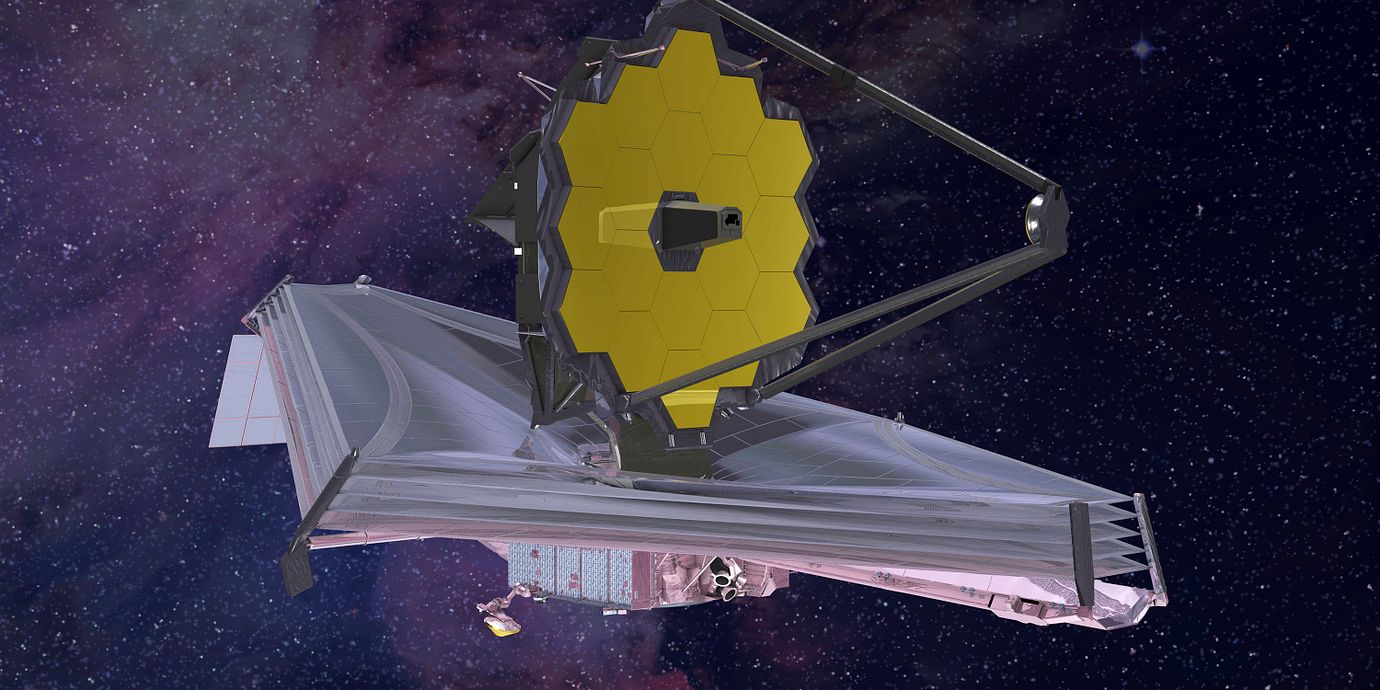
Rymdteleskopet James Webb har under sin rymdresa träffats av en mindre meteorit mellan den 24 och 25 maj, rapporterar Washington Post. Teleskopet ska ha klarat sig utan några större skador.
– Vi visste att teleskopet skulle drabbas av små stötar men vi blev förvånade över att det inträffade så kort tid efter avfärden, säger Heidi Hammel, astronom på Nasa.
Vidare säger hon att de tror att meteoritträffar som denna beräknas inträffa ungefär vart femte år.
bakgrund
James Webb-teleskopet
Wikipedia (en)
The James Webb Space Telescope (JWST) is a space telescope designed primarily to conduct infrared astronomy. The most powerful telescope ever launched into space, its greatly improved infrared resolution and sensitivity will allow it to view objects too old, distant, or faint for the Hubble Space Telescope. This is expected to enable a broad range of investigations across the fields of astronomy and cosmology, such as observations of first stars and the formation of the first galaxies, and detailed atmospheric characterization of potentially habitable exoplanets. JWST was launched in December 2021 on a European Space Agency (ESA) Ariane 5 rocket from Kourou, French Guiana, and as of June 2022 is undergoing testing and alignment. Once operational, expected about the end of June 2022, JWST is intended to succeed the Hubble as NASA's flagship mission in astrophysics.
NASA led JWST's development in collaboration with ESA and the Canadian Space Agency (CSA). The NASA Goddard Space Flight Center (GSFC) in Maryland managed telescope development, the Space Telescope Science Institute in Baltimore operates JWST, and the prime contractor was Northrop Grumman. The telescope is named after James E. Webb, who was the administrator of NASA from 1961 to 1968 during the Mercury, Gemini, and Apollo programs.
JWST's primary mirror consists of 18 hexagonal mirror segments made of gold-plated beryllium which combined create a 6.5-meter (21 ft) diameter mirror, compared to Hubble's 2.4 m (7.9 ft). This gives the Webb telescope a light-collecting area of about 25 square meters, about 6 times that of Hubble. Unlike Hubble, which observes in the near ultraviolet, visible, and near infrared (0.1–1.7 μm) spectra, JWST will observe in a lower frequency range, from long-wavelength visible light (red) through mid-infrared (0.6–28.3 μm). The telescope must be kept extremely cold, below 50 K (−223 °C; −370 °F), to observe faint signals in the infrared without interference from other sources of warmth. It is deployed in a solar orbit near the Sun–Earth L2 Lagrange point, about 1.5 million kilometers (930,000 mi) from Earth, where its five layer kite-shaped sunshield protects it from warming by the Sun, Earth, and Moon.
Development began in 1996 for a launch initially planned for 2007 with a US$500 million budget. There were many delays and cost overruns, including a major redesign in 2005, a ripped sunshield during a practice deployment, recommendations from an independent review board, a threat by the U.S. Congress to cancel the project, the COVID-19 pandemic, and problems with the telescope itself. The high-stakes nature of the launch and the telescope's complexity were remarked upon by the media, scientists and engineers. Construction was completed in late 2016, followed by years of extensive testing before launch. The total project cost is now expected to be about US$9.7 billion.
Omni är politiskt obundna och oberoende. Vi strävar efter att ge fler perspektiv på nyheterna. Har du frågor eller synpunkter kring vår rapportering? Kontakta redaktionen