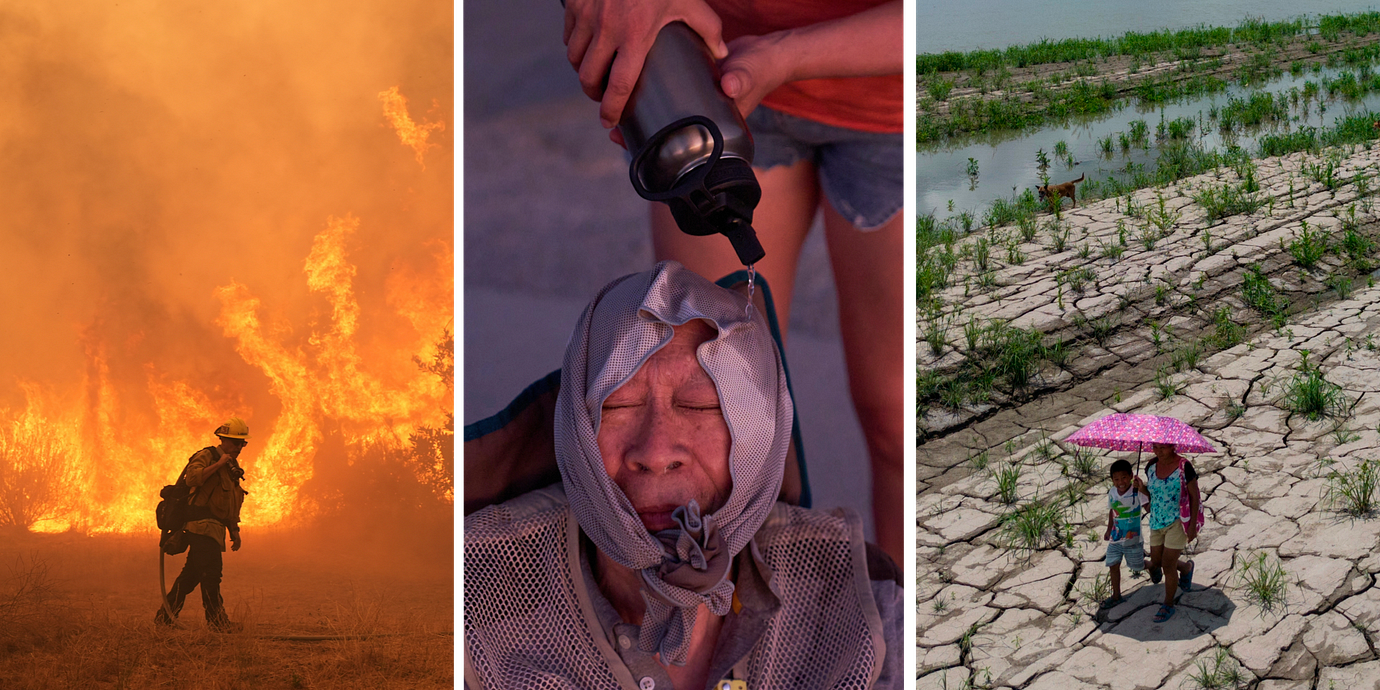
Skogsbränder, vattenbrist och svält är tre konsekvenser som kan uppstå i högre grad under El Niño-år. (TT/AP)

Analyser: Väntad El Niño kan bli den mest extrema hittills

Klimatforskare spår att världen kan stå inför en super-El Niño det kommande året. Prognoserna pekar mot extremväder och temperaturer i en skala som ännu inte uppmätts på jorden, skriver Berlingske och New York Times.

”Alla pilar pekar på att ett nytt globalt värmerekord kommer bli verklighet, kanske redan 2026, även om sannolikheten i högre grad talar för 2027”, skriver vetenskapsreporter Lars Henrik Aagard i Berlingske.

Den hittills mest omtalade super-El Niño inträffade 1877–1878 – då miljoner människor dog världen över, bland annat i svält.

Världen är mer förberedd på klimatförändringar i dag än vad den var då, konstaterar Chico Harlan i New York Times, bland annat är jordbruket mer sofistikerat, många samhällen har också blivit bättre på att skydda sig från extremväder genom att företeelsen kan förutspås.

”El Niño-år når vanligen sin högsta styrka sent under kalenderåret och orsakar sedan varmare globala temperaturer i flera månader”, skriver Harlan.


bakgrund
 
Väderfenomenet El Niño
Wikipedia (en)
El Niño–Southern Oscillation (ENSO) is a global climate phenomenon that emerges from variation in winds and sea surface temperatures over the tropical Pacific Ocean. Those variations have an irregular pattern but do have some semblance of cycles. The occurrence of ENSO is not predictable. It affects the climate of much of the tropics and subtropics, and has links (teleconnections) to higher-latitude regions of the world. The warming phase of the sea surface temperature is known as "El Niño" and the cooling phase as "La Niña". The Southern Oscillation is the accompanying atmospheric oscillation, which is coupled with the sea temperature change. El Niño is associated with higher than normal air sea level pressure over Indonesia, Australia and across the Indian Ocean to the Atlantic. La Niña has roughly the reverse pattern: high pressure over the central and eastern Pacific and lower pressure through much of the rest of the tropics and subtropics. The two phenomena last a year or so each and typically occur every two to seven years with varying intensity, with neutral periods of lower intensity interspersed. El Niño events can be more intense but La Niña events may repeat and last longer. A key mechanism of ENSO is the Bjerknes feedback (named after Jacob Bjerknes in 1969) in which the atmospheric changes alter the sea temperatures that in turn alter the atmospheric winds in a positive feedback. Weaker easterly trade winds result in a surge of warm surface waters to the east and reduced ocean upwelling on the equator. In turn, this leads to warmer sea surface temperatures (called El Niño), a weaker Walker circulation (an east–west overturning circulation in the atmosphere) and even weaker trade winds. Ultimately the warm waters in the western tropical Pacific are depleted enough so that conditions return to normal. The exact mechanisms that cause the oscillation are unclear and are being studied. Each country that monitors the ENSO has a different threshold for what constitutes an El Niño or La Niña event, which is tailored to their specific interests. El Niño and La Niña affect the global climate and disrupt normal weather patterns, which as a result can lead to intense storms in some places and droughts in others. El Niño events cause short-term (approximately 1 year in length) spikes in global average surface temperature while La Niña events cause short term surface cooling. Therefore, the relative frequency of El Niño compared to La Niña events can affect global temperature trends on timescales of around ten years. The countries most affected by ENSO are developing countries that are bordering the Pacific Ocean and are dependent on agriculture and fishing. In climate change science, ENSO is known as one of the internal climate variability phenomena. Future trends in ENSO due to climate change are uncertain, although climate change exacerbates the effects of droughts and floods. The IPCC Sixth Assessment Report summarized the scientific knowledge in 2021 for the future of ENSO as follows: "In the long term, it is very likely that the precipitation variance related to El Niño–Southern Oscillation will increase". The scientific consensus is also that "it is very likely that rainfall variability related to changes in the strength and spatial extent of ENSO teleconnections will lead to significant changes at regional scale".
Omni är politiskt obundna och oberoende. Vi strävar efter att ge fler perspektiv på nyheterna. Har du frågor eller synpunkter kring vår rapportering? Kontakta redaktionen