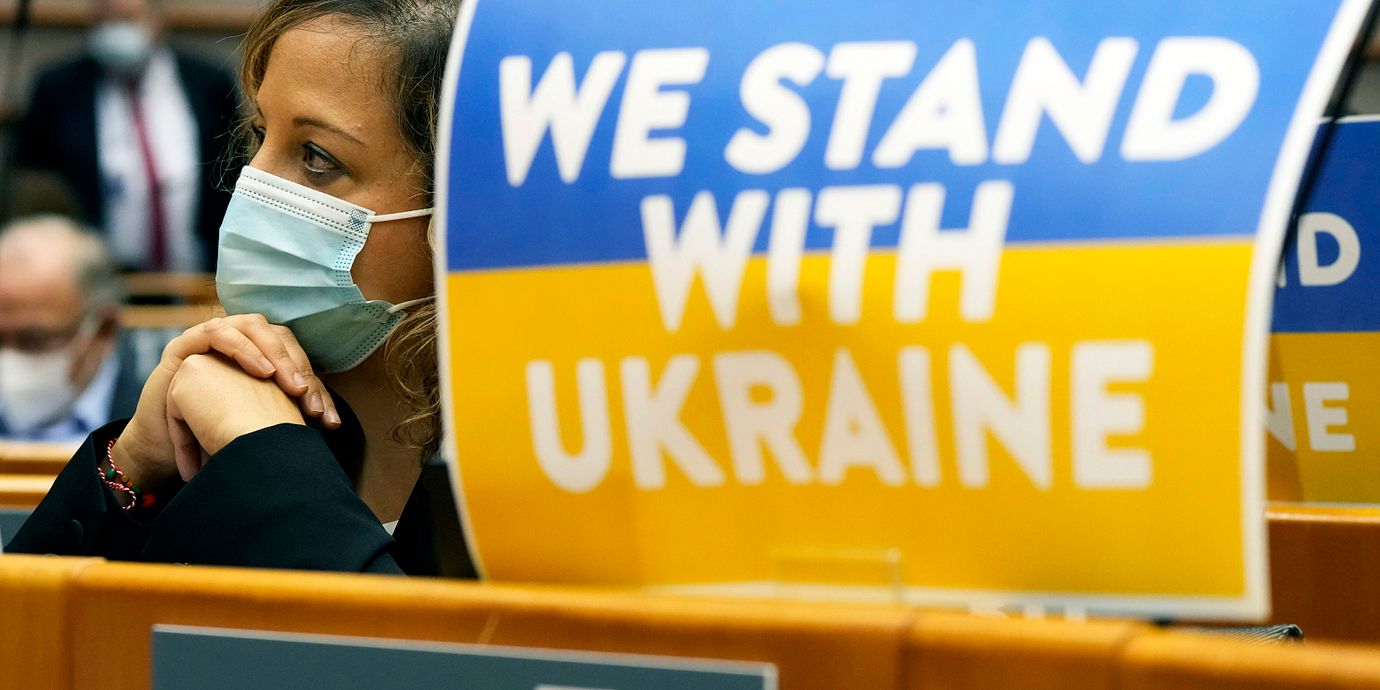
EU: Ukraina bör bli medlem ”så snart som möjligt”
EU vill att Ukraina godkänns som medlem ”så snart som möjligt”, säger kommissionären Maroš Šefčovič till journalister efter ett ministermöte på fredagen.
– Det är dags att signalera att Ukrainas folk är ett av de europeiska folken och vi vill ha in dem så snart som möjligt, säger han enligt Reuters.
Šefčovič tillägger att han tror att det viktigaste just nu är att hjälpa Ukraina i kriget mot Ryssland.
bakgrund
Maroš Šefčovič
Wikipedia (en)
Maroš Šefčovič (Slovak: [ˈmarɔʂ ˈʂeftʂɔʋitʂ] (listen); born 24 July 1966) is a Slovak diplomat and politician serving as Vice-President of the European Commission for Interinstitutional Relations since 2019, and previously from 2010 to 2014. He has been member of the European Commission since 2009. He also stood for office in the 2019 Slovak presidential election, which he lost against Zuzana Čaputová.He served as European Commissioner for Education, Training, Culture and Youth from 2009 to 2010 and Vice-President of the European Commission for Interinstitutional Relations and Administration from 2010 to 2014. He also served as European Commissioner for Energy from 2014 to 2019. In 2019, he was again nominated to become Vice President for Interinstitutional Relations and Foresight.
bakgrund
Relationen mellan EU och Ukraina
Wikipedia (en)
Relations between the European Union (EU) and Ukraine are shaped through the Ukraine–European Union Association Agreement and the Deep and Comprehensive Free Trade Area (DCFTA). Ukraine is a priority partner within the Eastern Partnership and the European Neighbourhood Policy (ENP). The EU and Ukraine are seeking an increasingly close relationship with each other, going beyond co-operation, to gradual economic integration and deepening of political co-operation.The association agreement was initiated in 2012, but the Ukrainian government suspended preparations for signing the association agreement on 21 November 2013, during the presidency of pro-Russian Viktor Yanukovych, who attended the EU summit in Vilnius on 28–29 November 2013 where the association agreement was originally planned to be signed but it was not. The decision to put off signing the association agreement led to the pro-EU Euromaidan movement. These led to the removal of Yanukovych and his government by parliament after the 2013–2014 Ukrainian revolution in February 2014.The political part of the Association Agreement was signed on 21 March 2014 by the new Prime Minister, Arsenii Yatseniuk. Meanwhile, the EU has attempted to stabilize Ukraine by freezing assets of allegedly corrupt Russians and Ukrainians and by granting financial aid to Ukraine. The economic part of the Ukraine–European Union Association Agreement was signed on 27 June 2014 by the new president, Petro Poroshenko. On 1 January 2016, Ukraine joined the DCFTA with the EU. Ukrainian citizens were granted visa-free travel to the Schengen Area for up to 90 days during any 180-day period on 11 June 2017 and the Association Agreement formally came into effect on 1 September 2017. On 21 February 2019, the Constitution of Ukraine was amended, the norms on the strategic course of Ukraine for membership in the European Union and NATO are enshrined in the preamble of the Basic Law, three articles and transitional provisions. On 28 February 2022, during the 2022 Russian invasion of Ukraine, Ukrainian President Volodymyr Zelensky officially signed an EU membership application for Ukraine. Eight EU states signed a letter supporting an accelerated accession process for Ukraine. 1 On March 2022, the European Parliament, following a debate in which the President of Ukraine addressed and received applause, recommended that Ukraine be made an official "candidate" for EU membership. The European Parliament has voted to advance Ukraine's membership with 637 voted for, with 13 voted against, and 26 abstained.Ukraine has shared borders with four EU member states—Hungary, Poland, Slovakia, and Romania—that stretch about 2,235 kilometres (1,389 mi) in total, with 33 border crossings by road, rail, ferry, and walking and bicycle path.
Omni är politiskt obundna och oberoende. Vi strävar efter att ge fler perspektiv på nyheterna. Har du frågor eller synpunkter kring vår rapportering? Kontakta redaktionen