Ihopvikt som origami – här är allt du behöver veta
James Webb-teleskopet är försenat med ett decennium och har gått tio gånger över budgeten. Men nu är det på väg ut i rymden för att ersätta Hubble-teleskopet och ge svar på frågor om de första stjärnorna och – möjligen – andra världar.
Flera medier listar de mest anmärkningsvärda detaljerna om teleskopet och vad som ska ske härnäst.
- Huvudspegeln mäter 6,5 meter i diameter vilket kan jämföra med Hubbles 2,4 meter. Den vägar 6,5 ton.
- Teleskopet kan observera objekt motsvarande storleken av ett mynt på fyra mils avstånd.
- Avståndet till James Webb-teleskopet från jorden kommer att vara 1,5 miljoner kilometer, vilket är fyra gånger avståndet till månen.
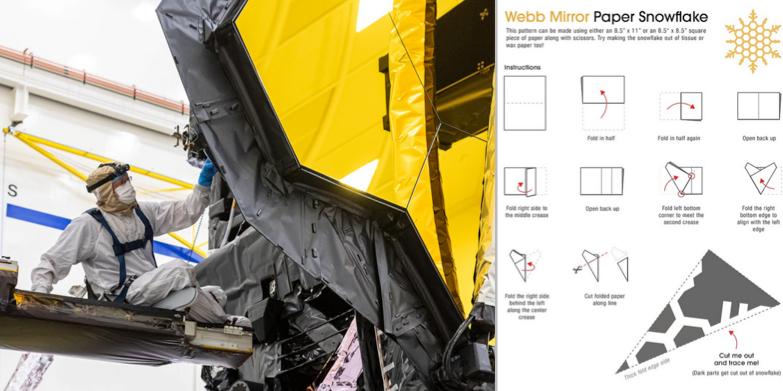
- Teleskopet är ihopvecklat, likt origami, och ska vecklas ut under färden i 178 steg. Allt måste gå felfritt och kan inte korrigeras i efterhand.
- Den planerade livslängden för superteleskopet är tio år.
- Teleskopet har fått sin namn efter James E Webb, chef för USA:s rymdstyrelse Nasa 1961–1968, den epok när Apolloprogrammet byggdes upp.
Källa: AP/Rymdstyrelsen/TT.
bakgrund
James Webb-teleskopet
Wikipedia (en)
The James Webb Space Telescope (JWST) is a space telescope jointly developed by NASA, the European Space Agency (ESA), and the Canadian Space Agency (CSA). It is planned to succeed the Hubble Space Telescope as NASA's flagship astrophysics mission. JWST was launched on 25 December 2021 during Ariane flight VA256. It will provide improved infrared resolution and sensitivity over Hubble, and will enable a broad range of investigations across the fields of astronomy and cosmology, including observing some of the most distant events and objects in the universe, such as the formation of the first galaxies, and detailed atmospheric characterization of potentially habitable exoplanets.
The primary mirror of JWST, the Optical Telescope Element, consists of 18 hexagonal mirror segments made of gold-plated beryllium which combine to create a 6.5 m (21 ft) diameter mirror—considerably larger than Hubble's 2.4 m (7 ft 10 in) mirror. Unlike the Hubble telescope, which observes in the near ultraviolet, visible, and near infrared (0.1 to 1 μm) spectra, JWST will observe in a lower frequency range, from long-wavelength visible light through mid-infrared (0.6 to 28.3 μm), which will allow it to observe high redshift objects that are too old and too distant for Hubble to observe. The telescope must be kept very cold in order to observe in the infrared without interference, so it will be deployed in space near the Sun–Earth L2 Lagrange point, about 1.5 million kilometres (930,000 mi) from Earth (0.01 au – 3.9 times the distance of the Moon). A large sunshield made of silicon- and aluminum-coated Kapton will keep its mirror and instruments below 50 K (−223 °C; −370 °F).The NASA Goddard Space Flight Center (GSFC) in Maryland is managing the development effort, and the Space Telescope Science Institute will operate Webb after launch. The prime contractor is Northrop Grumman. The telescope is named after James E. Webb, who was the administrator of NASA from 1961 to 1968 and played an integral role in the Apollo program.Development began in 1996 for a launch that was initially planned for 2007 and a US$500 million budget. The project had numerous delays and cost overruns, including a major redesign in 2005, a ripped sunshield during a practice deployment, a recommendation from an independent review board, the COVID-19 pandemic, issues with the Ariane 5 rocket and the telescope itself, and communications issues between the telescope and the launch vehicle. Concerns among the involved scientists and engineers about the launch and deployment of the telescope have been well described.Construction was completed in late 2016, after which an extensive testing phase began. JWST launched at 12:20 UTC on 25 December 2021 by an Ariane 5 launch vehicle from Kourou, French Guiana, on the northeastern coast of South America, and was released from the upper stage 27 minutes later. The telescope was confirmed to be receiving power, and is currently en route to its target destination.
Omni är politiskt obundna och oberoende. Vi strävar efter att ge fler perspektiv på nyheterna. Har du frågor eller synpunkter kring vår rapportering? Kontakta redaktionen