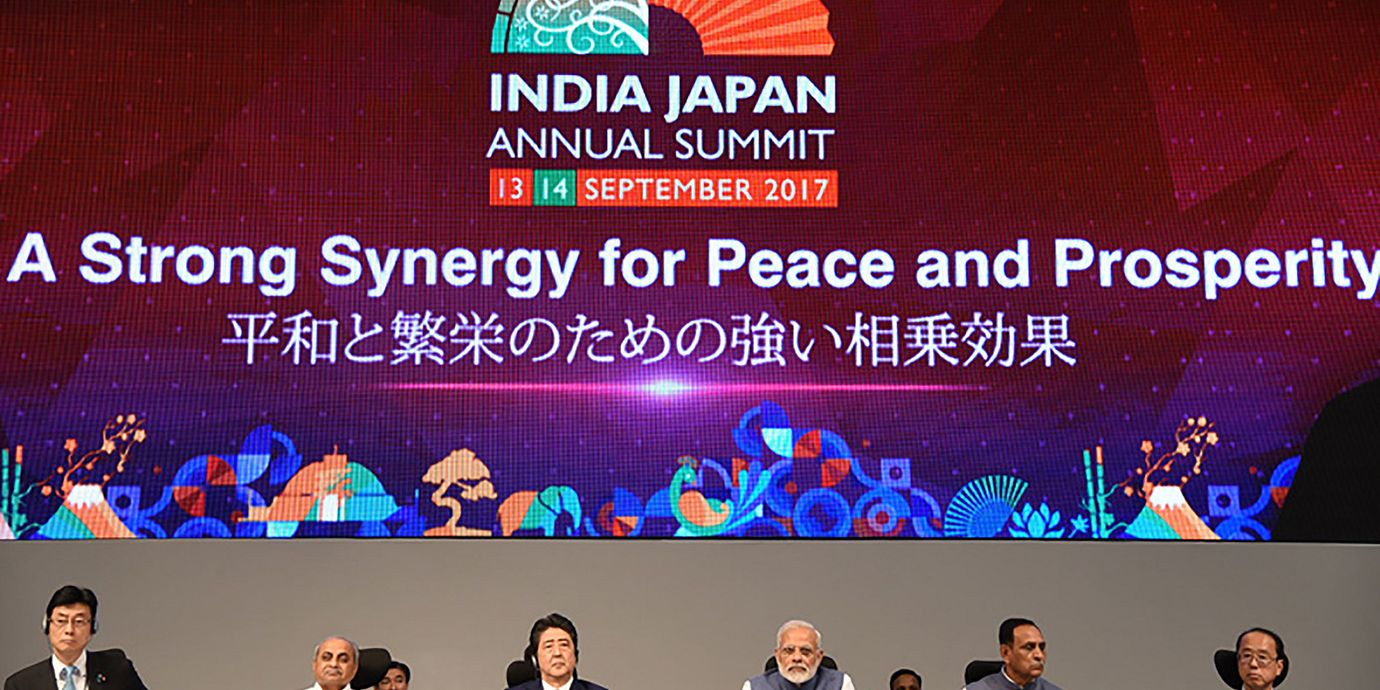
Modi och Abe banar väg för stort infrastrukturpaket
Japan och Indiens premiärministrar, Shinzo Abe respektive Narendra Modi, har enats om flera frågor. Under deras senaste möte undertecknades 15 avsiktsförklaringar om olika investeringar på ett sammanlagt värde på 5 000 miljarder rupier, motsvarande mer än 600 miljarder kronor, enligt Business Standards källor. Ett av projekten världsledarna la grunden till var ett nytt snabbtåg i indiska Ahmedabad.
bakgrund
Indiens relationer med Japan
Wikipedia (en)
India–Japan relations (Japanese: 日印関係, Hepburn: Nichiinkankei) and (Hindi: भारत-जापान सम्बन्ध, translit. Bhārat - jāpān sambandh) have traditionally been strong. For centuries, the people of India and Japan have engaged in cultural exchanges, primarily as a result of Buddhism, which spread indirectly from India to Japan, via China and Korea. The people of India and Japan are guided by common cultural traditions including the heritage of Buddhism, and share commitment to the ideals of democracy, tolerance, pluralism and open society. India and Japan, two of the largest and oldest democracies in Asia, having a high degree of congruence of political, economic and strategic interests, view each other as partners that have responsibility for and are capable of responding to global and regional challenges. India is the largest recipient of Japanese official development assistance (ODA). As of 2013, bilateral trade between India and Japan stood at US$16.31 billion and is expected to reach US$50 billion by 2019-20.
India, under British colonial rule, and Japan were enemies in World War II, but political relations between the two nations have remained warm since India's independence. Japanese companies, such as Sony, Toyota, and Honda, have manufacturing facilities in India, and with the growth of the Indian economy, India is a big market for Japanese firms. Japanese firms in fact, were some of the first firms to invest in India. The most prominent Japanese company to have an investment in India is automobiles multinational Suzuki, which is in partnership with Indian automobiles company Maruti Suzuki, the largest car manufacturer in the Indian market, and a subsidiary of the Japanese company.
In December 2006, Indian Prime Minister Manmohan Singh's visit to Japan culminated in the signing of the "Joint Statement Towards Japan-India Strategic and Global Partnership". Japan has helped finance many infrastructure projects in India, most notably the Delhi Metro system. Indian applicants were welcomed in 2006 to the JET Programme, starting with just one slot available in 2006 and 41 in 2007. Also, in the year 2007, the Japanese Self-Defence Forces and the Indian Navy took part in a joint naval exercise in the Indian Ocean, known as Malabar 2007, which also involved the naval forces of Australia, Singapore and the United States. The year 2007 was declared "India-Japan Friendship Year."
According to a 2013 BBC World Service Poll, 42% of Japanese people think India's international impact is mainly positive, with 4% considering it negative.
They have the strongest relationship of all Asian nations. The big friendship between Japan and India is often referred as "Japanese-Indian Brotherhood" (Japanese: 日本のインド同胞団 (Nihon no Indo dōhō-dan) ; Hindi: जापानी भारतीय भाईचारा (Jaapaanee Bhaarateey Bhaeechaara)).
Omni är politiskt obundna och oberoende. Vi strävar efter att ge fler perspektiv på nyheterna. Har du frågor eller synpunkter kring vår rapportering? Kontakta redaktionen