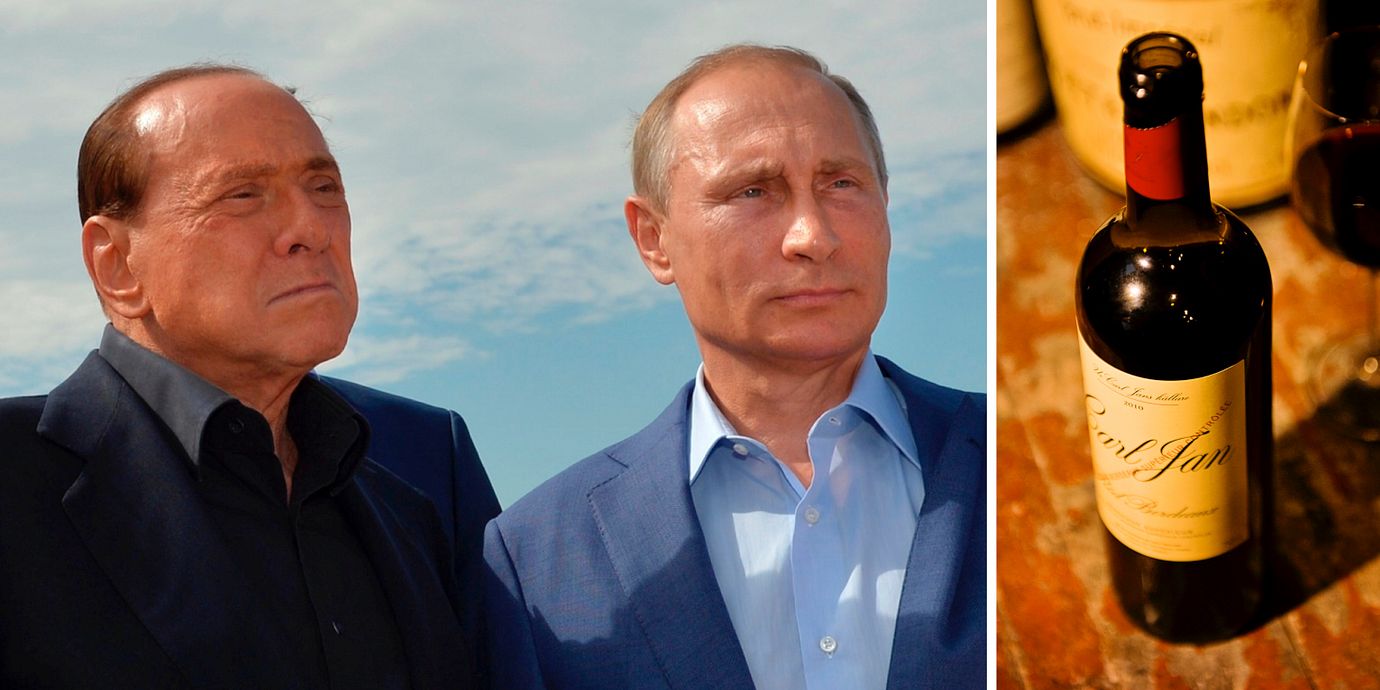
Njöt 241-årigt vin – nu anklagas Putin för stöld
Under ett besök på den annekterade Krimhalvön passade Rysslands president Vladimir Putin och hans resekamrat, den tidigare italienske premiärministern Sivlio Berlusconi, på att avnjuta en flaska spanskt vin, skriver flera medier.
Nu har åklagare i Ukrainas huvudstad Kiev inlett en förundersökning mot dem. Orsaken? Flaskan var 241 år gammal, värderad till runt 760 000 kronor och anses vara en kulturskatt på Krimhalvön.
Åklagaren kallar tilltaget ”ett storskaligt missbruk av egendom”, skriver Evening Standard.
bakgrund
Annekteringen av Krim
Wikipedia (en)
The internationally recognised Ukrainian territory of Crimea was annexed by the Russian Federation in March 2014. From the time of the annexation on 18 March 2014, Russia has de facto administered the territory as two federal subjects—the Republic of Crimea and the city of Sevastopol—within the Crimean Federal District.
The military intervention and annexation by Russia took place in the aftermath of the Ukrainian Revolution. It was a part of the wider unrest across southern and eastern Ukraine. On 22–23 February, Russian President Vladimir Putin convened an all-night meeting with security services chiefs to discuss extrication of deposed President, Viktor Yanukovych, and at the end of that meeting Putin had remarked that "we must start working on returning Crimea to Russia." On 23 February pro-Russian demonstrations were held in the Crimean city of Sevastopol. On 27 February masked Russian troops without insignias took over the Supreme Council of Crimea, and captured strategic sites across Crimea, which led to the installation of the pro-Russian Aksyonov government in Crimea, the declaration of Crimea's independence and the holding of a disputed, unconstitutional referendum.
The event was condemned by many world leaders, as well as NATO, as an illegal annexation of Ukrainian territory, in violation of the 1994 Budapest Memorandum on sovereignty and territorial integrity of Ukraine, signed by Russia. It led to the other members of the then G8 temporarily suspending Russia from the group, then introducing the first round of sanctions against the country.
The Russian Federation opposes the "annexation" label, with Putin defending the referendum as complying with international law. Ukraine disputes this, as it does not recognise the independence of the Republic of Crimea or the accession itself as legitimate. The United Nations General Assembly also rejected the vote and annexation, adopting a non-binding resolution affirming the "territorial integrity of Ukraine within its internationally recognized borders". The resolution also "[u]nderscores that the referendum [in Crimea], having no validity, cannot form the basis for any alteration of the status of [Crimea]." The resolution draws attention to the obligation of all States and international organizations not to recognize or to imply the recognition of Russia's annexation.
Omni är politiskt obundna och oberoende. Vi strävar efter att ge fler perspektiv på nyheterna. Har du frågor eller synpunkter kring vår rapportering? Kontakta redaktionen