Opposition vill att domstol avsätter Thailands ledare
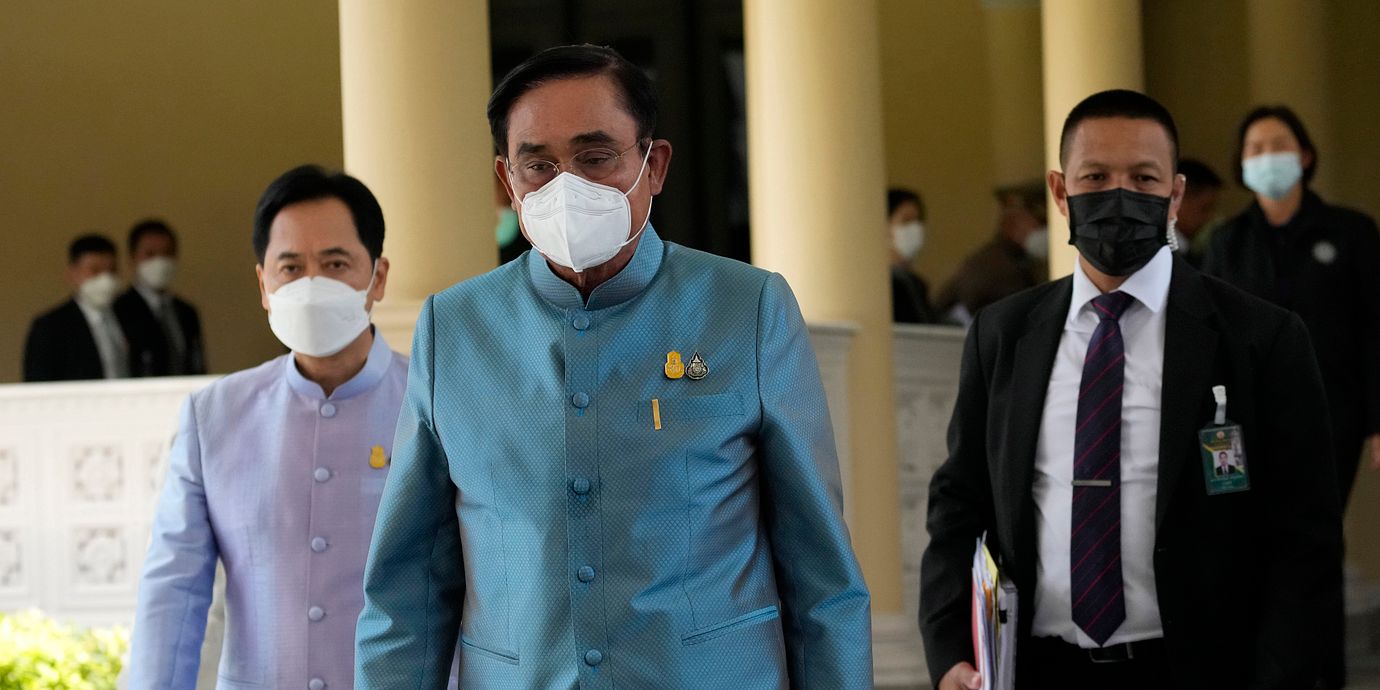
Thailändska myndigheter förbereder sig för oroligheter i Bangkok under tisdagen, skriver Reuters. Anledningen är diskussionen om huruvida premiärminister Prayuth Chan-ocha måste avgå på onsdagen efter att ha suttit på sin post i åtta år, vilket är det längsta konstitutionen tillåter.
Pheu Thai, som är det största oppositionspartiet, har lyft frågan till Thailands konstitutionsdomstol, men det är inte klart om domstolen kommer att ta upp frågan.
Prayuth Chan-ocha tillträdde efter en militärkupp 2014, och vissa av hans anhängare hävdar att åttaårsgränsen inte kan gälla honom eftersom konstitutionen ännu inte gällde när han blev premiärminister.
bakgrund
Prayut Chan-ocha
Wikipedia (en)
Prayut Chan-o-cha (sometimes spelled Prayuth Chan-ocha; Thai: ประยุทธ์ จันทร์โอชา, pronounced [prā.jút tɕān.ʔōː.tɕʰāː]; born 21 March 1954) is a Thai politician and retired Royal Thai Army officer who seized power as Prime Minister of Thailand in 2014. He has also served as Minister of Defence since 2019. Prayut served as chief of the Thai army from 2010 to 2014 and led the 2014 Thai coup d'état which installed the National Council for Peace and Order (NCPO), the military junta which governed Thailand between 22 May 2014 and 10 July 2019.
After his appointment as army chief in 2010, Prayut was characterised as a royalist and an opponent of former prime minister Thaksin Shinawatra. Considered a hardliner within the military, he was one of the leading proponents of military crackdowns on the Red Shirt demonstrations of April 2009 and April–May 2010. He later sought to moderate his profile, talking to relatives of protesters who were killed in the bloody conflict, and co-operating with the government of Yingluck Shinawatra who won parliamentary elections in July 2011.
During the political crisis that began in November 2013 and involved protests against the caretaker government of Yingluck, Prayut claimed that the army was neutral and would not launch a coup. However, in May 2014, Prayut launched a military coup against the government and assumed control of the country as dictator and leader of the National Council for Peace and Order, a military junta. He later issued an interim constitution granting himself sweeping powers and giving himself amnesty for staging the coup. In August 2014, an unelected military-dominated national legislature appointed him as Prime Minister.After seizing power, Prayut's government oversaw a significant crackdown on dissent. He formulated “twelve values” based on traditional Thai values and suggested that these be included in school lessons. Measures were implemented to limit public discussions about democracy and criticism of the government, including increases in Internet and media censorship. Prayut was re-elected as Prime Minister of Thailand following the disputed 2019 Thai general election. Prayut later used Thailand's lèse-majesté laws, which are unusually strict, to prosecute protesters. Many co-leaders have been detained throughout 2021.
Omni är politiskt obundna och oberoende. Vi strävar efter att ge fler perspektiv på nyheterna. Har du frågor eller synpunkter kring vår rapportering? Kontakta redaktionen