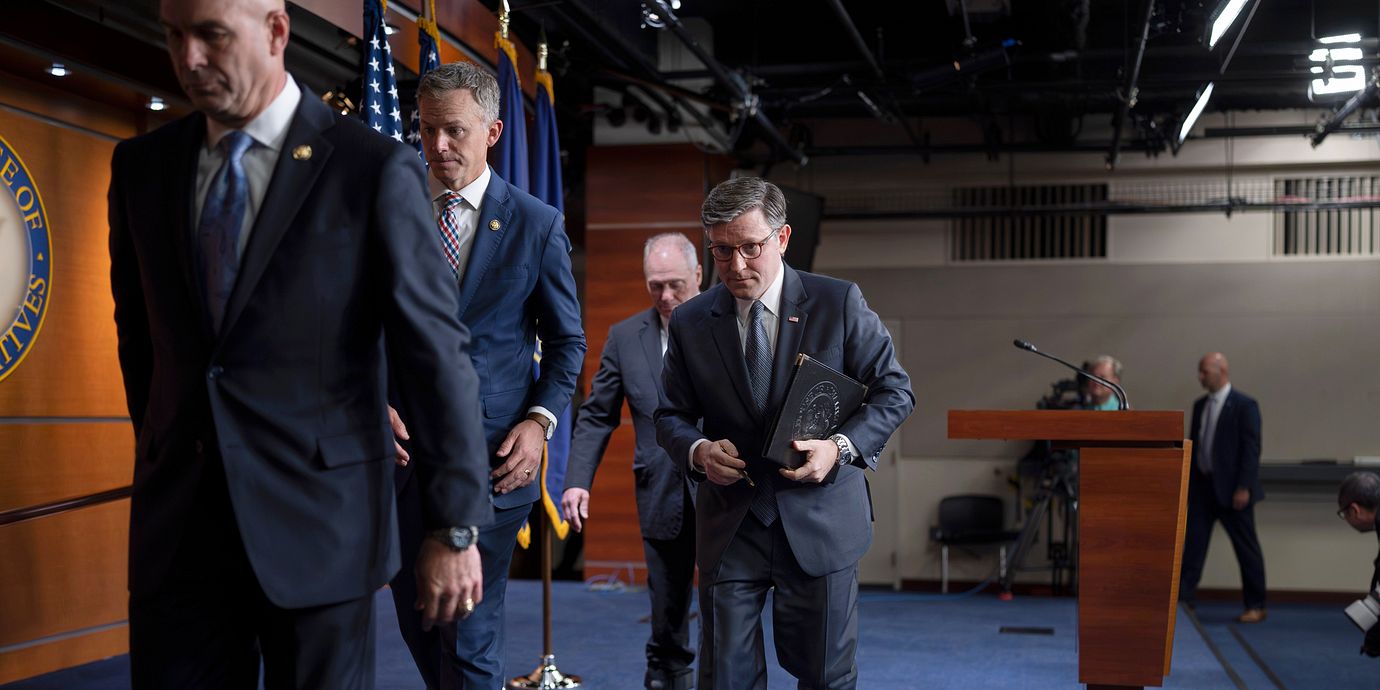
Representanthusets republikanske talman Mike Johnson tidigare i veckan. Johnson har den senaste tiden haft allt svårare att kontrollera sin majoritet. (J. Scott Applewhite /AP/TT / AP)

Republikanerna skjuter upp omröstning om kriget – såg ut att förlora

Republikanerna i representanthuset sköt i natt upp en omröstning om att instruera Trump att avsluta kriget i Iran, efter att det blivit tydligt att de saknade de röster som krävdes för att stoppa förslaget. Det skriver New York Times.

Flera republikanska ledamöter var inte närvarande, och andra hade tidigare under kvällen röstat med Demokraterna.

Liknande förslag har röstats ned i kongressen flera gånger, men den senaste tiden har republikanernas tunna majoritet sett allt osäkrare ut efter att en del av deras ledamöter övergett partilinjen i viktiga frågor.

Omröstningen skjuts nu upp i drygt en vecka. Republikanen Brian Fitzpatrick, som hade tänkt rösta för förslaget, tror inte att det gjort mer än skjuta upp det oundvikliga.

– Jag tror inte att de kommer att ha rösterna när vi kommer tillbaka. Nästa gång det läggs fram så kommer det att passera.

bakgrund
 
War Powers Resolution
Wikipedia (en)
The War Powers Resolution (also known as the War Powers Resolution of 1973 or the War Powers Act)(50 U.S.C. ch. 33) is a federal law intended to check the U.S. president's power to commit the United States to an armed conflict without the consent of the U.S. Congress. The resolution was adopted in the form of a United States congressional joint resolution. It provides that the president can send the U.S. Armed Forces into action abroad only by Congress’s statutory authorization", or in case of "a national emergency created by attack upon the United States, its territories or possessions, or its armed forces". The bill was introduced by Clement Zablocki, a Democratic congressman representing Wisconsin's 4th district. The bill had bipartisan support and was co-sponsored by a number of U.S. military veterans. The War Powers Resolution requires the president to notify Congress within 48 hours of committing armed forces to military action and forbids armed forces from remaining for more than 60 days, with a further 30-day withdrawal period, without congressional authorization for use of military force (AUMF) or a declaration of war by the United States. The resolution was passed by two-thirds each of the House and Senate, overriding the veto of American President Richard Nixon. It has been alleged that the War Powers Resolution has been violated in the past. However, no allegations have resulted in successful legal actions taken against a president.

Gå förbi betalväggar!

Omni Mer låser upp en mängd artiklar. En smidig lösning när du vill fördjupa dig.

Omni är politiskt obundna och oberoende. Vi strävar efter att ge fler perspektiv på nyheterna. Har du frågor eller synpunkter kring vår rapportering? Kontakta redaktionen