
Saffran ger afghanska kvinnor första jobbet
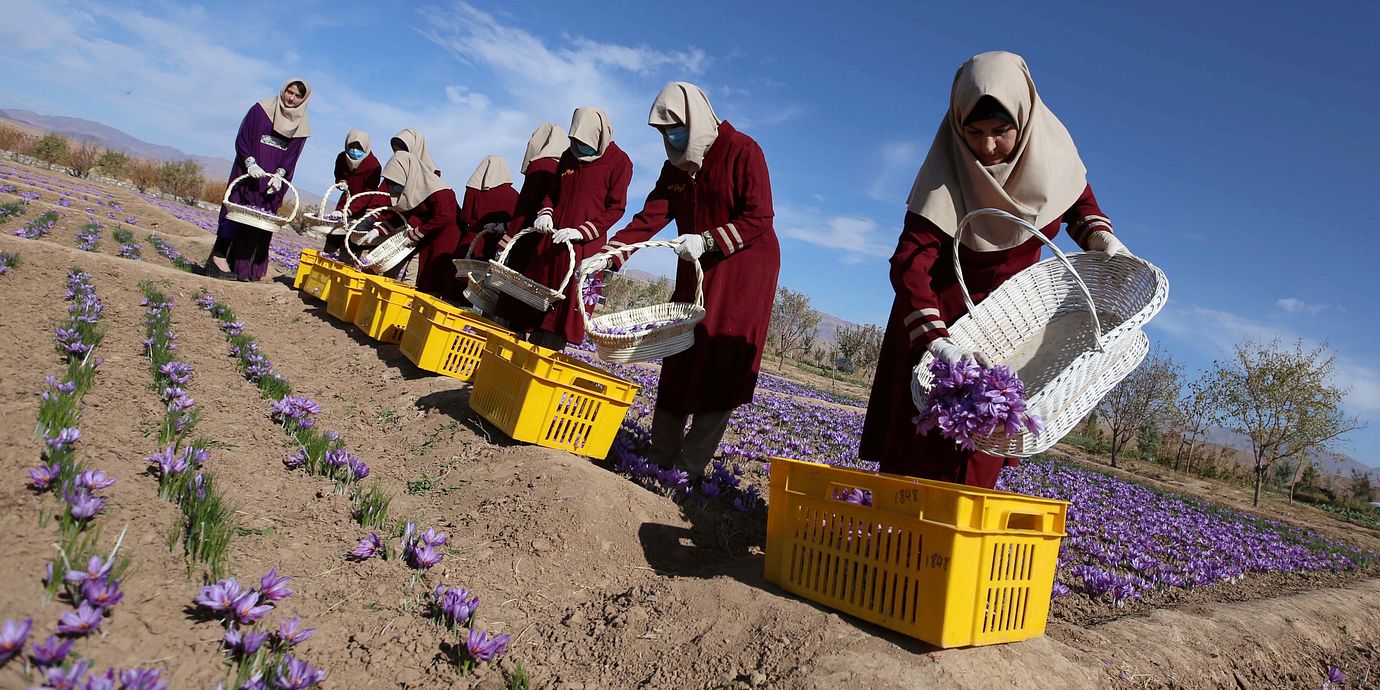
Saffran, världens dyraste krydda, har blivit en allt större exportvara för Afghanistan. Den blomstrande industrin gör att fler kvinnor, som annars har begränsade möjligheter att arbeta, kan få ett första betalt jobb i landet.
– Det är mest kvinnor som skördar och sedan separerar saffran från blomman. Vi är mycket glada över den ökade efterfrågan av saffran eftersom det har banat väg för kvinnor att hitta jobb, säger Khanum Rassoli, som leder en arbetsgrupp som plockar den lila blomman på fält.
I dag producerar Afghanistan fyra ton saffran årligen, och kryddan säljs för mellan 1 200 och 1 800 dollar för ett kilo.
bakgrund
Handel med saffran
Wikipedia (en)
Saffron is a key seasoning, fragrance, dye, and medicine in use for over three millennia. One of the world's most expensive spices by weight, saffron consists of stigmas plucked from the vegetatively propagated and sterile Crocus sativus, known popularly as the saffron crocus. The resulting dried "threads" are distinguished by their bitter taste, hay-like fragrance, and slight metallic notes. The saffron crocus is unknown in the wild; its most likely precursor, Crocus cartwrightianus, originated in Crete or Central Asia; The saffron crocus is native to Southwest Asia and was first cultivated in what is now Greece.
From antiquity to modern times the history of saffron is full of applications in food, drink, and traditional herbal medicine: from Africa and Asia to Europe and the Americas the brilliant red threads were—and are—prized in baking, curries, and liquor. It coloured textiles and other items and often helped confer the social standing of political elites and religious adepts. Ancient peoples believed saffron could be used to treat stomach upsets, bubonic plague, and smallpox.
"Saffron, for example, was once less regarded than it is today because the crocus from which it is extracted was not particularly mysterious. It flourished in European locations extending from Asia Minor, where it originated, to Saffron Walden in England, where it was naturalised. Only subsequently, when its labour-intensive cultivation became largely centred in Kashmir, did it seem sufficiently exotic to qualify as one of the most precious of spices."
Saffron crocus cultivation has long centered on a broad belt of Eurasia bounded by the Mediterranean Sea in the southwest to India and China in the northeast. The major producers of antiquity—Iran, Spain, India, and Greece—continue to dominate the world trade.
The cultivation of saffron in the Americas was begun by members of the Schwenkfelder Church in Pennsylvania. In recent decades cultivation has spread to New Zealand, Tasmania, and California. Iran has accounted for around 90–93 percent of recent annual world production and thereby dominates the export market on a by-quantity basis.
Omni är politiskt obundna och oberoende. Vi strävar efter att ge fler perspektiv på nyheterna. Har du frågor eller synpunkter kring vår rapportering? Kontakta redaktionen