Statsvetare: Betydande risk att ryska systemet rasar
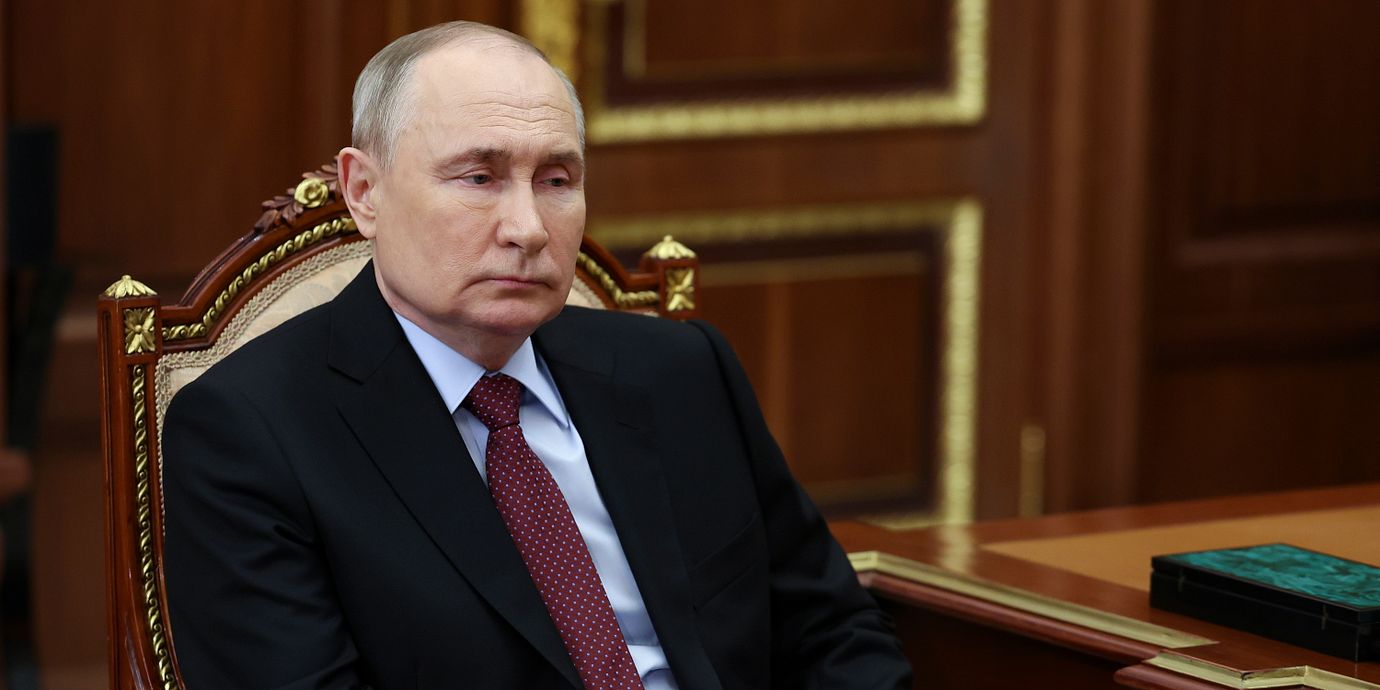
När den sista rösten i helgens ryska presidentval är räknad kommer det med all sannolikhet stå klart att Vladimir Putin inleder sin femte raka mandatperiod vid makten. Derek Hutcheson, professor i statsvetenskap vid Malmö universitet, säger däremot till DN att det finns anledning att misstänka att Putins regim går mot sitt slut.
Han säger att förbättringen av den ryska levnadsstandarden har stannat av samtidigt som mer totalitära lagar har införts.
– Ju mer systemets förtryck växer, desto mindre är dess legitimitet grundat i ett genuint folkligt stöd och historien visar oss att sådana system blir allt skörare, säger Hutcheson, som bedömer att risken för en rysk systemkollaps på lång sikt är ”betydande”.
bakgrund
Ryska presidentvalet 2024
Wikipedia (en)
A presidential election in Russia will be held on 15–17 March 2024. This will be the eighth presidential election in the country. If no candidate receives more than half the vote, a second round will take place exactly three weeks later, on 7 April 2024. The winner is scheduled to be inaugurated on 7 May 2024.The election is being run in an atmosphere in which independent Russian media outlets have been banned and with most opposition figures being in exile, imprisoned or murdered. Incumbent authoritarian president Vladimir Putin, who first became president in 2000 and is now the longest-serving Russian leader since Soviet dictator Josef Stalin, was originally due to have to stand down as president in 2024 due to term limits in Russia's constitution. However, it was widely expected that he would attempt to stay in power through certain means such as changing the constitution, even though he claimed otherwise in 2018. As predicted, Putin announced in 2020 that constitutional changes would be proposed allowing him to stay in power until 2036 by "resetting" his terms, which was widely criticised by opponents. The changes were 'approved' in a disputed referendum in which independent election monitors received hundreds of reports of violations and state employees were deliberately prompted to vote in favour.Former member of the State Duma and liberal politician Boris Nadezhdin attempted to run in the election, but was barred on the grounds that signatures collected for his candidacy were supposedly flawed. The process of having to collect signatures is regularly used by election authorities to refuse to register would-be opposition candidates that may pose problems for the Kremlin. Ultimately only three candidates other than Putin were allowed on the ballot, all of whom represent parties that are generally loyal to the Kremlin. Nadezhdin had been seen as the only candidate opposed to the war in Ukraine, although Vladislav Davankov later also promised "peace and negotiations". With this and Davankov's relatively youthful age contrasting with the aging 71-year-old Putin, he has been described as "the most likely to become the alternative-to-Putin candidate".As was the case in the 2018 presidential election, the most prominent member of the Russian opposition, Alexei Navalny, was unable to run due to a criminal conviction, which is widely seen as politically motivated. Navalny died in jail in suspicious circumstances in February 2024, one month before the election, in which he had called for Russians to all turn up to vote at noon on 17 March to show the strength of opposition in the "Noon Against Putin" protest action. After his death his widow Yulia Navalnaya said she would continue his work, reiterating his call for Russians to turn up to vote at noon on 17 March as a safe and peaceful protest that could not be legally prohibited by authorities.Most observers do not expect the election to be either free or fair. Instead, they expect the process to be dominated by Putin, who has been accused of increasing political repressions ever since launching his full-scale war with Ukraine in 2022. The previous presidential election in 2018 was described by election observers from the OSCE as lacking genuine competition and being marred by "continued pressure on critical voices". Putin's victory is seen as guaranteed, with even Kremlin spokesman Dmitry Peskov stating that "our presidential election is not really democracy, it is costly bureaucracy. Mr. Putin will be re-elected with more than 90 percent of the vote".
Omni är politiskt obundna och oberoende. Vi strävar efter att ge fler perspektiv på nyheterna. Har du frågor eller synpunkter kring vår rapportering? Kontakta redaktionen