Värmelarm inför VM – flera matcher kan vara riskfyllda
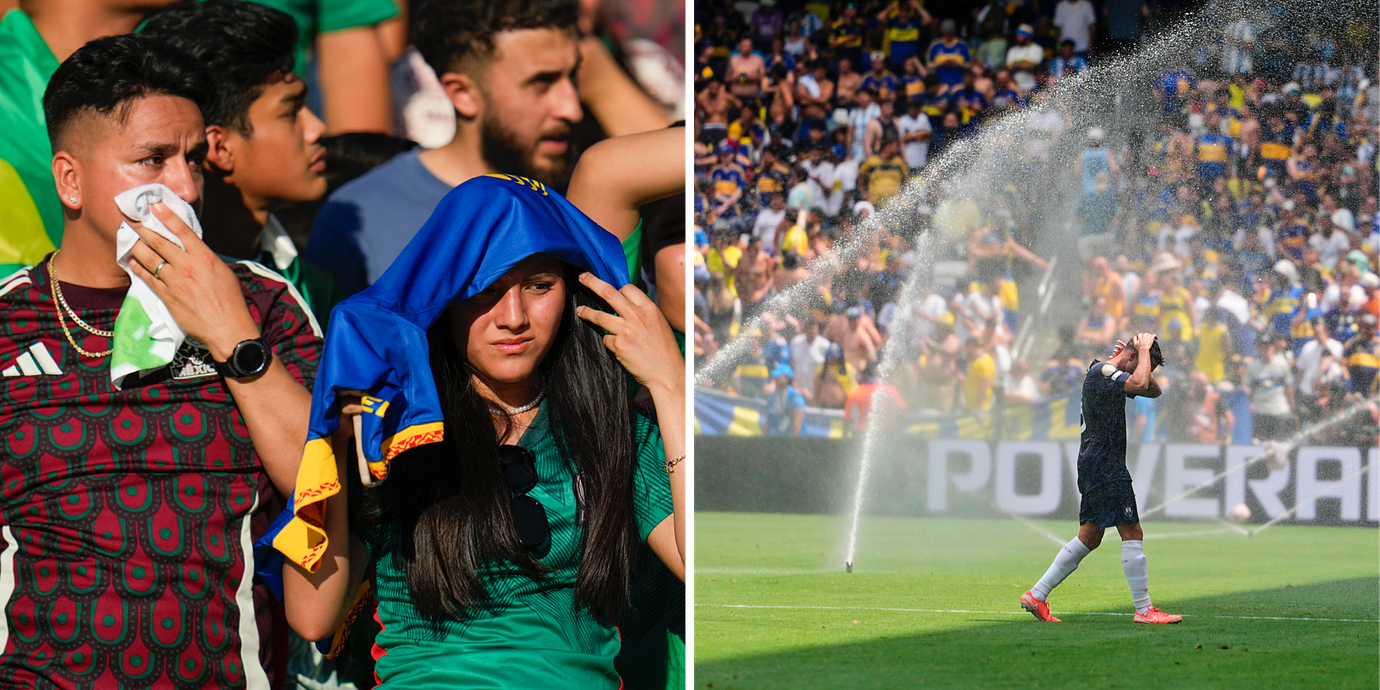
Det kan bli riktigt varmt under fotbolls-VM i sommar. Så pass varmt att en grupp klimatforskare nu slår larm om att matcherna kan utgöra säkerhetsrisker för spelare, ledare och publik.
Gruppen WWA uppger att en fjärdedel av matcherna i USA, Mexiko och Kanada överskrider gränsen för vad det internationella spelarfacket bedömer som för varmt, rapporterar Reuters. Det är fler jämfört med 1994 – senaste gången mästerskapet anordnades i Nordamerika.
Forskarna har använt sig av WBGT-indexet, som avgör den upplevda temperaturen. Facket rekommenderar att matcher ska ställas in om det är över 28 grader enligt WBGT.
Det internationella fotbollsförbundet Fifa uppger att det tagit höjd för höga temperaturer och att det finns åtgärder på plats.
bakgrund
Fotbolls-VM 2026
Wikipedia (en)
The 2026 FIFA World Cup will be the 23rd FIFA World Cup, the quadrennial international men's soccer championship contested by the national teams of the member associations of FIFA. The tournament will take place from June 11 to July 19, 2026. It will be jointly hosted by sixteen cities—eleven in the United States, three in Mexico, and two in Canada. The tournament will be the first FIFA World Cup to be hosted by three nations, and the first to include 48 teams, an expansion from 32.
The United 2026 bid beat a rival bid by Morocco during a final vote at the 68th FIFA Congress in Moscow. It will be the first men's World Cup since 2002 to be co-hosted by multiple nations. With its past hosting of the 1970 and 1986 tournaments, Mexico will become the first country to host or co-host the men's World Cup three times. The United States previously hosted the men's World Cup in 1994. By contrast, it will be Canada's first time hosting or co-hosting the men's tournament. The event will return to its traditional Northern Hemisphere summer schedule after the 2022 World Cup in Qatar was held in November and December.
As the host nations, Canada, Mexico, and the United States all automatically qualified. Cape Verde, Curaçao, Jordan, and Uzbekistan will all make their World Cup debuts. Argentina is the defending champion, having won its third World Cup title in 2022.
bakgrund
WWA
Wikipedia (en)
World Weather Attribution is an academic collaboration studying extreme event attribution, calculations of the impact of climate change on extreme meteorological events such as heat waves, droughts, and storms. When an extreme event occurs, the project computes the likelihood that the occurrence, intensity, and duration of the event was due to climate change. The project specializes in producing reports rapidly, while news of the event is still fresh.
World Weather Attribution was founded in 2014 by climatologists Friederike Otto, who continues as leader, and Geert Jan van Oldenborgh. Participating institutions are Imperial College London, the Royal Netherlands Meteorological Institute, Laboratoire des sciences du climat et de l'environnement, Princeton University, the U.S. National Center for Atmospheric Research, ETH Zurich, IIT Delhi, and climate impact specialists at the Red Cross / Red Crescent Climate Centre.
The WWA response to an extreme meteorological event has three parts:
Define the event: the geographic region affected, which weather parameters are of interest.
Gather historical data: weather data from the region from 1950 to the present. From this historical data statistics on normal and extreme weather patterns for the locale can be computed.
Simulate the event many times with computer models, comparing simulations with present-day greenhouse gas conditions against previous greenhouse-gas conditions.
Results are synthesized into a report and published first rapidly, then eventually through the scientific review process.
Omni är politiskt obundna och oberoende. Vi strävar efter att ge fler perspektiv på nyheterna. Har du frågor eller synpunkter kring vår rapportering? Kontakta redaktionen